



In recent years, the deliberate stripping of identity has emerged as a central instrument in the toolkit of Iran’s regimes—drawing increased scrutiny from the public, media, and social analysts alike. A closer examination of executions and political crackdowns reveals that identity erasure is not merely a propaganda tactic, but a deeply embedded strategy designed to control society. Its purpose is straightforward: reduce public reaction, fracture collective empathy, and prevent the formation of solidarity.
Within authoritarian systems, identity erasure is implemented systematically. The process begins with labeling. Political prisoners are no longer presented as dissenting citizens with political affiliations or ideological convictions; instead, they are recast as “spies” or “foreign agents.” This narrative shift is not incidental—it is engineered to reshape public perception. Once an individual is stripped of legitimate identity, their cause becomes easier to dismiss, and their fate easier to ignore.
Censorship reinforces this mechanism. State-controlled media withhold or distort information about prisoners’ identities, backgrounds, and demands, replacing reality with a constructed image that serves the regime’s objectives. As a result, society is confronted with a falsified narrative—one that systematically dulls sensitivity to executions and repression.
Reports indicate that many individuals arrested on charges of supporting opposition groups are subjected to identity erasure even before any semblance of due process. Character assassination, deletion of personal history, and narrative manipulation precede judicial proceedings. By the time sentences are handed down, the individual has already been symbolically erased in the public mind.
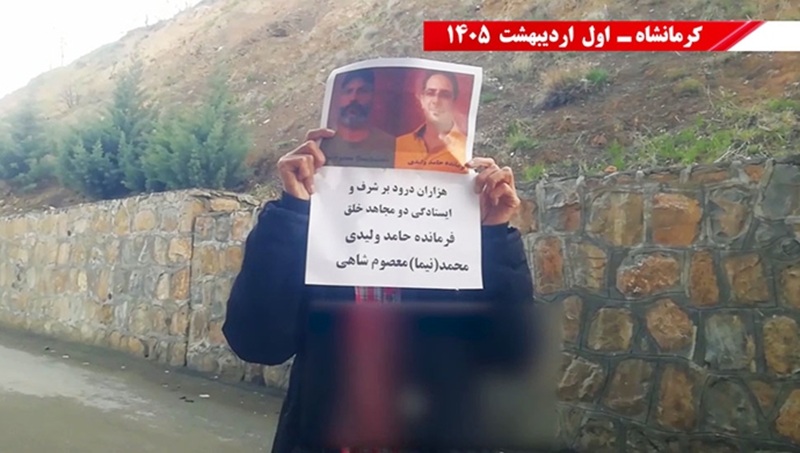
A stark example is the execution of two members of the People’s Mojahedin Organization of Iran (PMOI/MEK), Hamed Validi and Mohammad Masoum Shahi, on April 20, 2026. According to the judiciary’s official account, they were accused of constructing and transporting explosive projectiles, with authorities claiming that weapons and materials were discovered in locations linked to them in Karaj, Isfahan, and Tehran.
Yet these accusations were accompanied by contradictions that underscore the manipulative nature of the narrative. Officials in Alborz Province had earlier accused them, along with other detainees, of espionage related to the so-called “12-Day War”—despite the fact that they had been arrested a month before that conflict even began. Moreover, their identities and cases had already been documented and submitted by the PMOI to the United Nations and human rights organizations. Their arrests had also been publicly reported months earlier by resistance-affiliated media. Calls were made by opposition institutions for an international fact-finding investigation into their case.
This pattern illustrates a critical point: identity erasure often functions as a prerequisite for execution. When an individual is delegitimized in the public sphere, the reaction to their physical elimination diminishes. This mechanism is particularly evident in the regime’s treatment of organized opposition groups such as the PMOI, where propaganda campaigns relentlessly repeat stigmatizing labels to condition public perception and suppress empathy.
Identity erasure also operates through the distortion of reality in the broader political space. It is not only state institutions that reproduce these narratives; certain opportunistic or misaligned factions contribute as well. Through selective imagery or the instrumentalization of victims, they inadvertently—or deliberately—extend the regime’s narrative framework. In some cases, monarchist factions have echoed hostile rhetoric against opposition groups, effectively reinforcing the same discourse that facilitates repression.
One illustrative case involves the execution of Vahid Bani Amerian, a PMOI member, after which some monarchist activists displayed his image in public demonstrations in a manner widely perceived as an attempt to strip him of his political identity. Such actions provoked significant backlash across various segments of society, highlighting the deep sensitivities surrounding representation and memory.
The consequence of these overlapping narratives is a blurred boundary between truth and propaganda. When conflicting accounts proliferate, the authentic identity of victims risks being lost altogether. This erosion of clarity weakens collective memory—a dangerous development in any society confronting systemic repression. Yet despite these efforts, many continue to preserve and assert the identities of those who have been executed, resisting attempts to consign them to oblivion.
From a sociological perspective, identity erasure constitutes a form of symbolic violence. It precedes and enables physical violence, preparing the ground for it by reshaping perception and neutralizing moral resistance. For this reason, many scholars consider it an essential complement to direct repression.
The broader social consequences of this strategy are profound. One immediate effect is the erosion of public trust. When official narratives diverge sharply from lived reality, the credibility of governing institutions deteriorates, exposing patterns of deception. Another intended outcome is the weakening of social cohesion. By stripping victims of recognizable identity, authorities seek to prevent collective responses and isolate acts of repression from broader societal reaction.
Yet this calculation often underestimates the dynamics of resistance. Each act of repression, rather than extinguishing dissent, can generate renewed determination. The fall of one individual may inspire many others to take their place—a reality that authoritarian systems frequently fail to grasp.
Ultimately, identity erasure is also an assault on historical memory. A society that loses the ability to remember its victims becomes more vulnerable to the repetition of violence. Dictatorial systems rely on this erosion. But their success depends on one critical condition: the absence of an organized, conscious vanguard capable of preserving truth and mobilizing resistance.
Where such a force exists, the link between the people and those who lead the struggle for change cannot be severed—no matter how aggressively regimes attempt to erase it.