


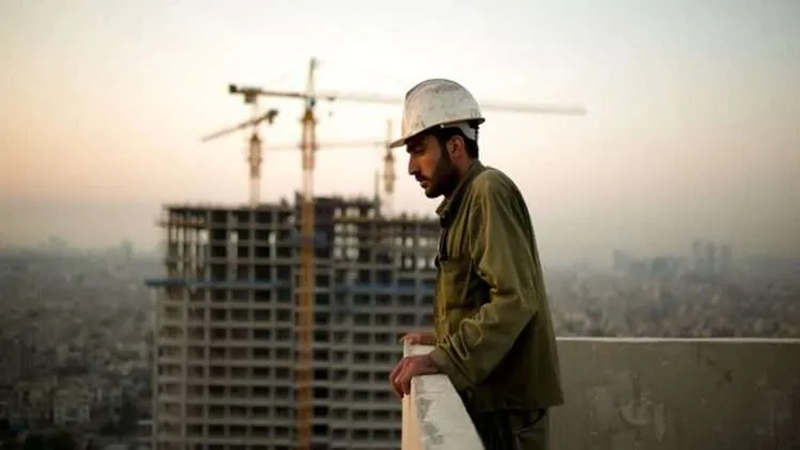

Military conflict and structural neglect by the Iran regime have paralyzed a vital workforce, leaving over a million families without income, protection, or hope.
The recent war involving the Iran regime, the United States, and Israel has driven Iran’s construction workers into a crisis, pushing them to the edge of absolute poverty and uncertainty. According to official statistics and field reports, approximately 1.2 million worker households have seen their livelihoods effectively collapse. This vast labor force, already weakened by a prolonged housing recession, now finds itself buried under crushing living costs with no safety net.
Iran’s construction sector had been deteriorating long before the outbreak of military conflict. Reports from the Ministry of Roads and Urban Development indicate that while the country requires at least one million new housing units annually, actual construction in recent years has barely reached one-third of that demand. With the onset of war, this fragile sector has now ground to a near-complete halt.
Akbar Shokat, head of the Construction Workers’ Trade Association, described the scale of the collapse in stark terms: “Between 2012 and 2022, around 110 million square meters of residential units were built annually. Last year, this fell to 65 million square meters, and now, with the military crisis, construction activity has dropped to just 20 percent of last year’s level.” For workers, this translates into an almost total loss of income.
A defining vulnerability of construction workers in Iran lies in their employment structure. Lacking fixed employers, they are excluded from one of the most basic forms of social protection: unemployment insurance. As war and insecurity have shut down projects across the country, these workers have been left with no alternative sources of income.
Insurance coverage is equally dire. Of the 1.2 million workers in this sector, only half have pension insurance, while the other half have spent more than five years waiting for access to this basic right. This is particularly alarming given that construction workers account for the highest rates of workplace injuries and disabilities. Many are forced to continue physically demanding labor well into old age or illness due to the absence of financial support.
Perhaps the most bitter irony is that those who build homes are themselves among the most housing-insecure groups in Iran. According to the Construction Workers’ Guild Association, nearly 90 percent of these workers are renters. Without fixed salaries or formal pay slips, they are effectively barred from government housing programs and denied access to bank loans.
Housing costs now consume between 60 to 70 percent of household expenses. At the same time, point-to-point food inflation reached triple digits in March 2026, intensifying the financial strain. Many workers now face mounting pressure from landlords to vacate their homes.
Traditional fallback options for unemployed workers, such as street vending or informal taxi driving, have also become inaccessible. The price of even the cheapest cars in Iran has surged to around 1 billion tomans—equivalent to more than five years of a worker’s total income—effectively eliminating these alternatives.
The war has not only suppressed demand but has also driven up construction costs by damaging key industrial infrastructure. Recent airstrikes targeting major steel production hubs—Mobarakeh Steel and Khuzestan Steel, which together supplied roughly one-third of Iran’s raw steel—have sent shockwaves through the materials market.
Iraj Rahbar, a board member of the Tehran Association of Mass Builders, highlighted the surge in prices: pipe profiles have risen from 70,000 to 150,000 tomans per kilogram, while rebar prices have jumped from 56,000 to 76,000 tomans. As a result, construction costs in Tehran have increased by 55 percent since the beginning of the Iranian year 1404, reaching an astonishing 45 million tomans per square meter.
This sharp rise in costs has driven investors out of Iran’s construction market, redirecting capital to neighboring countries such as the UAE, Oman, and Turkey. For construction workers, this capital flight signals prolonged unemployment and deepening economic despair.
Data from the Housing Foundation indicates that approximately 110,000 buildings have been damaged during the war and require reconstruction. However, Rahbar notes that even the current ceasefire has failed to restore confidence among investors. Meanwhile, the government’s severe budget deficit raises serious doubts about its ability to finance reconstruction efforts.
Today, construction workers in Iran find themselves abandoned in both peace and war—denied economic security in stable times and deprived of legal and insurance protections in crisis. For over two months, many have been surviving by depleting their limited savings, while rapidly rising prices continue to shrink their already fragile livelihoods.
Ultimately, the policies pursued by the Iran regime—diverting national wealth into nuclear ambitions, missile programs, and regional proxies—have culminated in a war that has devastated the country’s economy and its most vulnerable workers. The social consequences of this collapse are likely to prove even more destructive than the physical damage of war, unfolding gradually but with far-reaching and lasting impact.