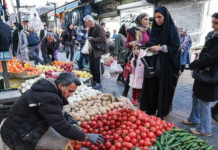
A regime that gambled on resilience now faces a reality of industrial paralysis, mass unemployment, and a rapidly expanding poverty crisis.
There is a persistent illusion at the heart of Iran regime’s economic narrative: that endurance can substitute for strategy.
For decades, Tehran has framed sanctions and isolation as catalysts for “self-sufficiency.” Today, that narrative is collapsing under the combined pressure of war, structural fragility, and political miscalculation. What is unfolding is not resilience—it is systemic breakdown.
An Economy Under Direct Assault
The scale of economic damage is no longer abstract.
Following more than five weeks of sustained U.S. and Israeli strikes, thousands of industrial facilities across Iran have been hit. The consequences are now cascading through every major sector of the economy.
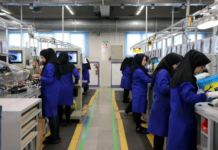
Core industries—steel, petrochemicals, construction, and even the culturally significant carpet sector—have either halted operations or drastically reduced output. In Kashan, the historic center of Iran’s carpet industry, roughly 80% of producers have ceased activity altogether.
This is not a temporary disruption. It is industrial paralysis.
Particularly devastating has been the targeting of Iran’s heavy industry backbone. Major steel producers, including Mobarakeh Steel and Khuzestan Steel, have stopped production. More than 50 petrochemical complexes have also shut down, effectively crippling Iran’s most important non-oil exports.
The ripple effects are immediate and severe. Supply chains have fractured. Prices for essential goods—from packaging materials to food products—are surging.
The Price Shock and Social Fallout
The economic shock is translating directly into a cost-of-living crisis.
Food prices have skyrocketed:
- Chicken prices have risen by 75%
- Beef and lamb by 68%
- Dairy products by around 50%
These are not marginal increases; they represent a rapid erosion of purchasing power in a society already strained by years of inflation and wage stagnation.
At the same time, the labor market is deteriorating at speed.
Hundreds of thousands have already lost their jobs, and millions more are at risk. Reports from within major private-sector firms indicate mass layoffs, halted projects, and hiring freezes. One engineering firm alone has dismissed half of its headquarters staff, while large-scale industrial projects have been abandoned, eliminating thousands of jobs.
For many Iranians, the timeline is measured in weeks, not months. Savings are being depleted rapidly, and financial buffers are vanishing.
Strategic Miscalculations
The regime’s response has compounded the crisis.
The closure of the Strait of Hormuz—intended as leverage against global markets—has further isolated Iran economically. Simultaneously, U.S. actions targeting Iranian ports have disrupted both imports and oil exports, cutting off critical revenue streams.
Tehran appears to be betting that its long experience under sanctions has hardened its economy against external pressure. This assumption is deeply flawed.
Sanctions-era adaptation relied on partial integration, informal trade networks, and functional export channels. Those mechanisms are now severely constrained or outright blocked.
Compounding this, Iran’s own military actions have backfired economically. Strikes against the United Arab Emirates—previously a conduit for roughly one-third of Iran’s imports—have prompted Abu Dhabi to suspend trade ties, further tightening supply constraints.
The Digital Economy Collapse
Another underappreciated dimension of the crisis is the shutdown of Iran’s internet infrastructure during the conflict.
This decision has devastated small and medium-sized enterprises dependent on online platforms. E-commerce, digital services, and startup ecosystems—once seen as adaptive sectors capable of absorbing labor shocks—have been effectively dismantled.
Reports indicate that Digikala, Iran’s largest e-commerce platform, has already begun widespread layoffs. Other internet-dependent businesses have either downsized dramatically or ceased operations entirely.
In a modern economy, disabling digital infrastructure during a crisis is not merely restrictive—it is economically self-destructive.
A Welfare System on the Brink
The government has attempted to project control, promising expanded unemployment benefits and social support.
But these assurances lack fiscal credibility.
Iran’s social security system is heavily dependent on revenues tied to petrochemical and industrial holdings—precisely the sectors now shut down. As those income streams collapse, so too does the state’s capacity to provide meaningful support.
This creates a dangerous feedback loop: rising unemployment increases demand for welfare, while shrinking revenues reduce the ability to fund it.
Poverty on the Rise
The long-term implications are stark.
According to estimates from the United Nations Development Programme, the current trajectory could push up to 4.1 million additional Iranians below the poverty line.
This is not merely an economic statistic—it is a structural transformation of society, with lasting consequences for stability, inequality, and public trust.
The Political Economy of Crisis
It is important to be clear: while war and sanctions have accelerated the collapse, they did not create the underlying vulnerabilities.
Years of mismanagement, corruption, over-centralization, and prioritization of security over economic rationality laid the groundwork for today’s crisis.
The current moment is the convergence point of those long-term failures and acute external shocks.
What Comes Next?
Iran now faces a triad of pressures:
- war-induced destruction
- hyperinflationary dynamics
- deepening recession
This combination is historically associated with social unrest—and Iran is no exception.
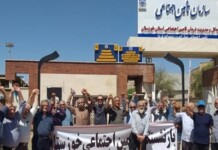
Previous waves of economic protests were already signaling systemic strain. Those protests were suppressed, but the underlying grievances remain unresolved. If anything, they have intensified.
The regime continues to insist that the country can withstand the pressure. But economic systems are not sustained by rhetoric.
They are sustained by production, trade, employment, and trust—all of which are now eroding simultaneously.
The question is no longer whether Iran’s economy is in crisis.
The question is how far the collapse will go—and what it will take, both internally and externally, to stop it.