
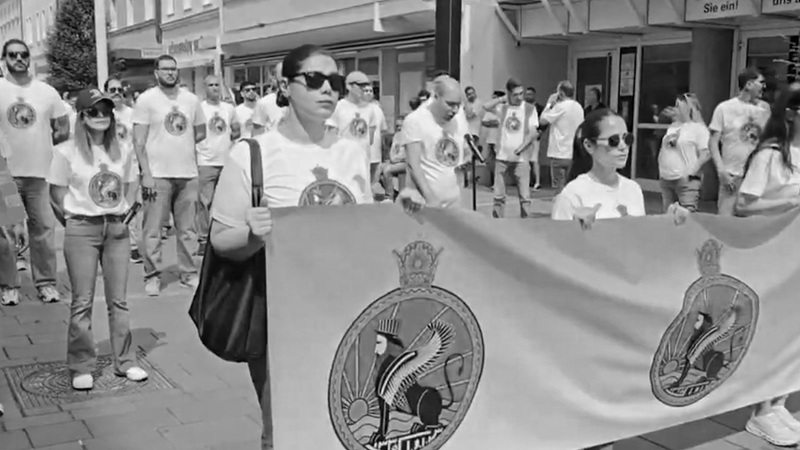

The promotion of SAVAK imagery at rallies organized by supporters of Reza Pahlavi raises renewed questions about the authoritarian foundations of his movement and its vision for Iran’s future.
The recent appearance of SAVAK symbols at rallies organized by supporters of Reza Pahlavi in Europe has once again exposed a central question surrounding his political project: does his movement genuinely seek a democratic future for Iran, or does it aim to rehabilitate the authoritarian legacy of the Pahlavi monarchy?
That question became even more urgent after Pahlavi recently refused to explicitly condemn torture and executions carried out by SAVAK, the Shah’s notorious secret police.
Now, the issue has moved beyond silence.
At a rally held by Pahlavi supporters in Regensburg on May 10, organizers reportedly distributed T-shirts bearing the emblem of SAVAK — the intelligence and security organization of Mohammad Reza Shah that became synonymous with torture, surveillance, political imprisonment, and the violent suppression of dissent.
The symbolism was unmistakable.
SAVAK does not represent “national pride,” “stability,” or “tradition.” It represents electric shocks, broken bodies, ripped fingernails, interrogation chambers, and thousands of destroyed lives. For generations of Iranians, SAVAK became the embodiment of state terror under the monarchy.
The public promotion of its imagery today cannot be separated from the political character of the movement that tolerates — or encourages — it.
A Movement Rooted in Authoritarian Nostalgia
The growing normalization of SAVAK imagery among sections of monarchist activism reveals something deeper than nostalgia for the pre-1979 era. It points toward the ideological foundations of Reza Pahlavi’s increasingly fascistic political movement, one that frequently glorifies centralized authority, personality cults, ultranationalist rhetoric, and the suppression of political opponents.
Rather than clearly distancing himself from the machinery of dictatorship built by his father, Pahlavi has repeatedly avoided direct condemnation of the Shah’s security apparatus and its crimes.
That silence matters.
No democratic movement seeking freedom, pluralism, and human rights can ambiguously treat an organization internationally associated with torture and political repression. The refusal to confront that history suggests not an accidental oversight, but an unwillingness to break with the authoritarian methods of the past.
Increasingly, critics argue that Reza Pahlavi’s political project appears less concerned with building a democratic Iran and more focused on restoring a modernized version of his father’s centralized authoritarian system.
SAVAK and the Foundations of the Islamic Republic’s Intelligence State
Ironically, the history of SAVAK also reveals another uncomfortable truth often ignored by monarchist narratives: parts of the Shah’s intelligence machinery directly contributed to the creation of the Islamic Republic’s own security and intelligence institutions after 1979.
A 2020 report published by BBC Persian examined the role of SAVAK officials in helping shape the intelligence structure of the newly established Islamic Republic.
According to memoirs and historical accounts cited in the report, senior SAVAK figures cooperated with the post-revolutionary government almost immediately after the fall of the monarchy.
Among them was General Manouchehr Hashemi, head of SAVAK’s counterintelligence division, and Ali-Akbar Farazian, director-general of SAVAK’s second department. Both reportedly reached agreements with members of Mehdi Bazargan’s provisional government to assist in organizing the new intelligence and security institutions of the Islamic Republic.
Former officials including Ebrahim Yazdi, Abbas Amir-Entezam, and Abdolali Bazargan later acknowledged aspects of this cooperation.
The implications were enormous.
Many SAVAK personnel — especially from foreign intelligence, surveillance, and counterintelligence divisions — reportedly returned to work under the new regime. According to Hashemi’s own memoirs, nearly 90 percent of personnel from SAVAK’s counterintelligence department resumed activity after the revolution.
These networks later continued operating through entities linked to the Prime Minister’s intelligence office and eventually the Ministry of Intelligence of the Islamic Republic.
Even Hossein Fardoust, one of the Shah’s closest intelligence figures, reportedly cooperated extensively with the Islamic Republic’s security establishment after the monarchy’s collapse.
This continuity demonstrates that the Islamic Republic did not simply destroy the Shah’s security apparatus. In many respects, it inherited, adapted, and expanded parts of it.
The architecture of repression survived the revolution.
From Monarchic Repression to Theocratic Repression
This historical continuity matters because it exposes a false binary often promoted in parts of the Iranian opposition discourse — namely, that dictatorship in Iran began only after 1979.
The Islamic Republic institutionalized repression on a massive scale, but it did not emerge in a vacuum. Many of its intelligence structures, interrogation methods, and security doctrines evolved from systems already developed under the Shah.
For this reason, many Iranians who oppose the current clerical dictatorship also reject any attempt to rehabilitate the monarchy’s authoritarian legacy.
They do not seek a return to SAVAK under a different flag.
They seek a democratic republic based on accountability, political pluralism, freedom of expression, and respect for human rights — values fundamentally incompatible with the glorification of secret police organizations.
The Meaning of Silence
When supporters of a political figure openly celebrate SAVAK and distribute its symbols in European cities, silence from that figure becomes politically meaningful.
A democratic leader would unequivocally condemn torture, reject the symbolism of political terror, and distance his movement from organizations associated with systematic human rights abuses.
Instead, what has emerged around Reza Pahlavi is a political culture increasingly tolerant of authoritarian nostalgia and hostile rhetoric toward dissenting voices inside the opposition itself.
That trend has alarmed many Iranians who fear that replacing one dictatorship with another — even under secular or nationalist slogans — would simply reproduce the cycle of repression that has haunted modern Iranian history.
The lesson of Iran’s past is clear: authoritarianism does not become acceptable merely because it changes ideological clothing.
Whether under monarchy or theocracy, systems built on fear, censorship, personality cults, and security repression ultimately deny the Iranian people the same fundamental right — the right to freely determine their own future.