



Tehran is using the climate of war and insecurity to criminalize dissent, justify mass detentions, and prepare the ground for executions under the language of “national security.”
The Iranian regime is no longer attempting to hide the scale of its domestic crackdown. In recent months — particularly under the shadow of war rhetoric and heightened security tensions — authorities have intensified a policy of widespread and arbitrary arrests. What was once framed as targeted action against specific individuals has evolved into a coordinated campaign designed to spread fear, criminalize dissent, and fuse political opposition with accusations of espionage, treason, and collaboration with foreign enemies.
The clearest confirmation came from Ahmadreza Radan, the commander of the regime’s police force. Radan publicly declared that security forces had arrested more than 6,500 people since the beginning of the recent wartime climate, describing them as “traitors” and “spies.” He further claimed that 567 of those detained were linked to what he called “hypocrisy,” “thugs,” and “counter-revolutionary groups.”
The significance of these statements extends far beyond the number itself. The language used by senior regime officials reveals the real objective of the crackdown. Thousands of detainees are being branded as spies, traitors, or enemies of the state before any transparent judicial process has taken place. In practical terms, this means the regime is attempting to remove political dissent and public protest from the realm of legitimate civic activity and redefine them as national security threats.
This strategy is neither accidental nor new. It has long been one of the regime’s central mechanisms of survival. By framing dissent as foreign-backed sabotage, the regime creates the political and psychological conditions necessary for prolonged detention, forced confessions, televised propaganda, harsh prison sentences, and ultimately executions.
The current wave of arrests must also be understood within a broader pattern documented by international human rights organizations. Reports published in recent months describe an organized campaign of intimidation involving mass arrests, torture, enforced disappearances, and denial of legal representation. Human rights monitors have repeatedly warned that detainees are increasingly being denied access to independent lawyers while facing coerced confessions and politically motivated prosecutions.
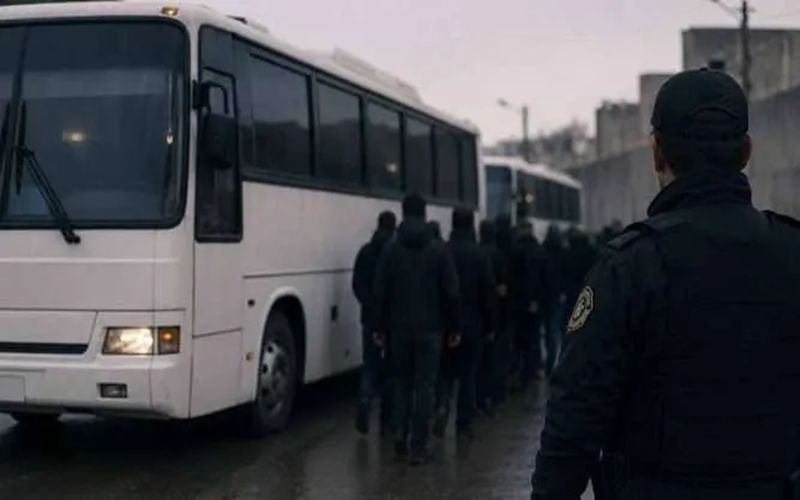
These concerns become even more alarming in light of videos and reports regarding the use of so-called “white buses” for the mass transfer of detainees. While individual footage may require independent verification regarding time and location, the overall pattern aligns closely with what both official statements and rights organizations have already confirmed: collective arrests, organized transfers, isolation from families, and restricted access to legal protection.
The danger does not end with detention. In Iran’s political system, public labeling often serves as the prelude to judicial violence. When senior security officials publicly classify thousands of detainees as enemies or spies, they are effectively preparing public opinion for harsher measures to come. The regime has historically used precisely this formula to justify executions following politically charged trials lacking even minimal due process standards.
The figure “6,500” therefore should not be interpreted merely as a policing statistic. It is an official acknowledgment of the scale of a coordinated repression campaign. It reflects the regime’s growing fear of public unrest, social organization, and the possibility of renewed nationwide protests.
The broader picture is increasingly clear: Tehran is exploiting the atmosphere of war and national insecurity not simply to protect the state, but to wage an internal campaign against society itself. The objective is not only security control. It is the containment of fear — specifically the regime’s fear of dissent, collective mobilization, and political change.
For this reason, expressions of international concern are no longer sufficient. The international community must demand the publication of detainees’ identities, transparency regarding detention locations, guaranteed access to independent legal counsel, an end to torture and forced confessions, and urgent safeguards against executions and retaliatory prosecutions. Silence or hesitation will only deepen the culture of impunity that has enabled such crackdowns for decades.