


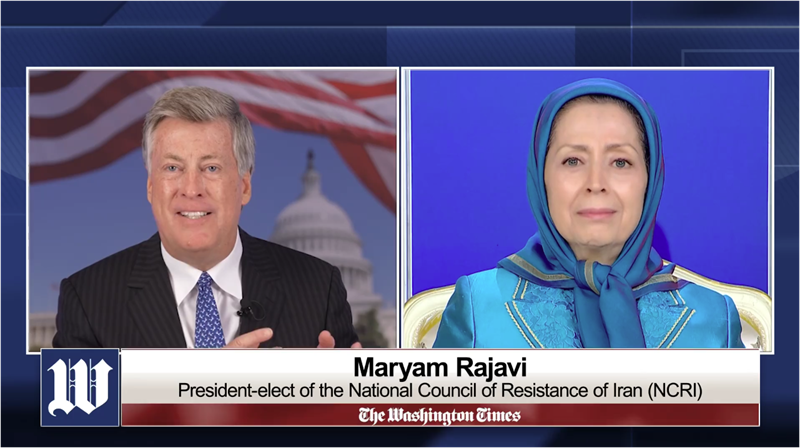

NCRI President-elect Maryam Rajavi says Tehran is facing unprecedented internal weakness as executions rise, resistance networks expand, and demands for democratic change intensify across Iran.
In an exclusive interview with The Washington Times published on May 20, Maryam Rajavi argued that Iran’s ruling clerical establishment is experiencing its deepest crisis since the 1979 revolution, despite efforts by some analysts to portray the regime as resilient following recent regional conflicts and internal crackdowns.
Rajavi, who serves as the president-elect of the National Council of Resistance of Iran (NCRI), rejected claims that Tehran has emerged stronger after recent confrontations with the United States and mounting regional isolation. Instead, she described a regime increasingly dependent on executions and repression to contain what she called an “explosive” social climate inside Iran.
“The Regime Is at Its Weakest Point”
Speaking with Washington Times host Tim Constantine, Rajavi said the Iranian regime’s internal crises have intensified rather than diminished.
“In my view, this assessment is incorrect, because the regime is at its weakest point in the past 48 years,” she said, referring to suggestions that Tehran has demonstrated unusual resilience.
According to Rajavi, the regime’s growing use of executions reflects fear of expanding unrest and organized resistance activities. She pointed to the execution of at least 23 political prisoners in recent weeks, including eight members of the People’s Mojahedin Organization of Iran (MEK), alongside others accused of participating in anti-government protests.
She argued that the executions are intended to intimidate Iranian youth and prevent the growth of organized resistance networks, but insisted the strategy is failing.
“The regime fails to grasp that it is confronting a generation that is in no way willing to tolerate the mullahs’ crackdown and suppression,” Rajavi stated.
Organized Resistance and the Prospect of Uprisings
Throughout the interview, Rajavi emphasized that meaningful political change in Iran can only emerge through organized resistance inside the country.
She described the NCRI’s strategy as a combination of mass uprisings and organized resistance units operating on the ground. According to Rajavi, these networks have expanded significantly since earlier nationwide protests and now play a central role in organizing demonstrations and confronting state repression.
Rajavi claimed that resistance units carried out thousands of anti-repression operations over the past year and argued that the regime’s persistent focus on suppressing the MEK demonstrates the movement’s influence inside Iran.
She also rejected attempts to present monarchist currents surrounding Reza Pahlavi as a viable alternative to the current system, describing such efforts as “manufactured alternatives” disconnected from realities inside the country.
“The people who sacrifice their lives do so not for a return to the past, but for a democratic future,” she said.
NCRI’s Roadmap for a Post-Theocratic Iran
Rajavi outlined what she described as a detailed transition plan for the period following the overthrow of the ruling establishment.
Under the NCRI proposal, a provisional government would oversee the country for a maximum of six months before holding free elections for a constituent assembly and national legislature. That body would then establish a permanent government based on democratic principles.
Central to the opposition coalition’s vision is Rajavi’s long-promoted “10-point plan,” which calls for:
- Free and fair elections
- Separation of religion and state
- Freedom of expression and political parties
- Gender equality
- Abolition of the death penalty
- Judicial independence
- Autonomy for Iran’s ethnic minorities
- A non-nuclear Iran
Rajavi repeatedly stressed that the NCRI does not seek permanent political power.
“Our only goal is to establish popular sovereignty and democracy,” she said.
Women at the Center of Iran’s Resistance
A major focus of the interview was the prominent role of women in Iran’s protest movement and opposition structures.
Rajavi argued that the visibility of women in recent uprisings is not accidental but the result of decades of political struggle against both the Shah’s dictatorship and the current theocratic regime.
She noted that women constitute a majority of leadership positions within the NCRI and the MEK’s central structures, describing female leadership as essential to achieving democratic transformation in Iran.
“Women’s leadership has been institutionalized within the resistance and serves as a springboard for achieving genuine gender equality,” Rajavi said.
Rejecting Comparisons With Iraq and Libya
Addressing concerns that regime change in Iran could produce instability similar to post-war Iraq or Libya, Rajavi insisted the comparison is fundamentally flawed.
She argued that unlike those countries, Iran possesses a long-established national identity, an organized opposition structure, and a defined political roadmap capable of preventing a power vacuum.
“In Iran, there exists an opposition force with defined structure, program, and networks,” she said.
Rajavi maintained that the existence of a provisional government plan and a timetable for elections distinguishes the Iranian opposition from foreign-imposed political projects seen elsewhere in the region.
Appeal to the International Community
Rajavi concluded the interview by urging Western governments and international institutions to adopt a tougher stance toward Tehran.
She called for diplomatic engagement with Iran to be conditioned on an end to executions and the release of political prisoners. She also urged the international community to close Iranian embassies, expel agents linked to the regime’s intelligence services and the Islamic Revolutionary Guard Corps (IRGC), and refer Tehran’s human rights record to the United Nations Security Council.
Additionally, Rajavi called for support to ensure unrestricted internet access for Iranians and for international recognition of what she described as the Iranian people’s right to overthrow the ruling system through organized resistance.
“The only solution is the overthrow of this brutal dictatorship,” Rajavi said at the close of the interview. “Our program can be summarized as freedom, equality, and the separation of religion and state.”