


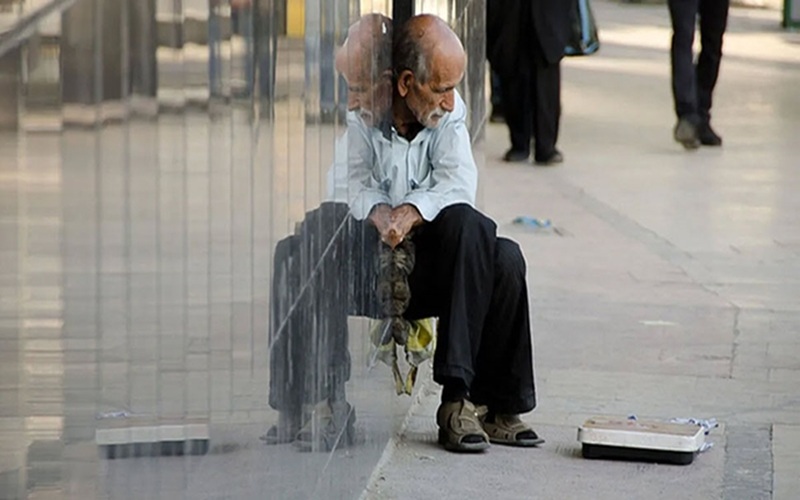

Economic experts warn that Iran is heading toward deeper recession, expanding poverty, and prolonged unemployment, exposing the structural failures that have pushed millions toward economic despair.
Iran’s crisis-ridden economy has entered a new and more dangerous phase—one that can no longer be managed through temporary fixes, monetary manipulation, or short-term government interventions. Warnings from economists and policy experts paint a bleak picture in which absolute poverty, chronic unemployment, and collapsing revenues threaten the livelihoods of millions of Iranians.
The latest assessments suggest that the country’s economic decline is not simply the result of recent military tensions or external pressures. Rather, these developments have accelerated structural weaknesses that have accumulated over decades of mismanagement, corruption, and failed economic policies.
According to discussions presented at a conference organized by Donya-e-Eqtesad on May 23, 2026, four economists and social policy researchers examined the state of Iran’s labor market, poverty trends, investment climate, and the future of household welfare. Their findings reveal an economy approaching a critical breaking point.
A Severe Economic Contraction
Among the most alarming warnings came from Hojat Mirzaei, a faculty member at Allameh Tabataba’i University’s Faculty of Economics. Mirzaei projected that Iran’s economic growth in 2026 could fall between negative 8.8 percent and negative 10 percent.
Such a contraction would imply widespread business closures, shrinking industrial production, declining investment, and severe reductions in government spending on infrastructure and social welfare programs. For ordinary citizens already struggling with soaring living costs, the consequences would be devastating.
Significantly, Mirzaei emphasized that the current economic collapse cannot be attributed solely to recent military developments, declining oil exports, or maritime disruptions. While these factors have intensified the crisis, they are not its root cause. Instead, they have acted as catalysts, accelerating destructive trends that were already embedded within the economy.
A similar assessment was offered by Gholamreza Keshavarz Haddad, a professor at Sharif University of Technology. Speaking at the same conference, he stressed that Iran’s economy was already in a state of crisis even before recent military tensions emerged. His remarks underscore a reality that many Iranian citizens have experienced firsthand: the country’s economic problems are deeply structural and long-standing.
The Expansion of Absolute Poverty
The human consequences of economic decline are becoming increasingly visible. The burden of inflation, unemployment, and declining purchasing power falls disproportionately on lower-income households and the shrinking middle class.
Mirzaei warned that between 3.5 and 4.5 million additional people could fall into poverty during the current year alone. If these projections prove accurate, the number of Iranians living below the poverty line could exceed 40 million people.
For a country of Iran’s size, such figures represent more than a statistical warning. They indicate that more than half of the population could soon be unable to secure basic necessities such as food, housing, healthcare, and education.
The growth of poverty on this scale reflects not only economic failure but also the erosion of social stability. As more families struggle to meet their most basic needs, frustration and distrust toward state institutions inevitably deepen.
The Rise of the “Working Poor”
One of the most troubling developments highlighted by experts is the emergence of a phenomenon increasingly common across Iran: the “working poor.”
Kosar Yousefi, a faculty member at the Institute for Management and Planning Studies, pointed out that a substantial portion of the population remains below the poverty line despite being employed.
This trend reveals a fundamental breakdown in the relationship between work and economic security. In functioning economies, employment provides a pathway out of poverty. In Iran, however, inflation has risen so dramatically and living costs have increased so rapidly that even full-time employment often fails to provide a minimum standard of living.
The spread of the working poor demonstrates that economic hardship is no longer confined to the unemployed. It has increasingly become a reality for teachers, workers, office employees, and many others who continue to work while watching their purchasing power disappear.
A Labor Market in Stagnation
Alongside growing poverty, Iran’s labor market is showing signs of deep stagnation.
Hossein Rajabpour, head of the Saba Research Institute, reported that only 57,000 jobs were created in Iran during 2024. For a country with millions of unemployed individuals, university graduates, and first-time job seekers, such a figure represents an exceptionally weak level of job creation.
The consequences are particularly severe for younger generations. Many educated Iranians face years of uncertainty, limited opportunities, and diminishing prospects for economic advancement. This contributes to brain drain, social frustration, and declining confidence in the future.
Even more concerning is the length of unemployment. Yousefi noted that while advanced economies often experience average unemployment periods of three to four months, joblessness in Iran can last three to four years.
Long-term unemployment carries consequences beyond lost income. It erodes skills, weakens social mobility, damages mental well-being, and reduces the likelihood of future employment. For many families, it also creates a cycle of poverty that can persist across generations.
Economic Crisis and Rising Social Tensions
The convergence of runaway inflation, expanding poverty, chronic unemployment, and declining incomes is transforming Iran’s economic crisis into a broader social challenge.
The regime’s own institutions have repeatedly expressed concern about growing public dissatisfaction and the potential for social unrest. Such warnings reflect an awareness that economic hardship is no longer an isolated policy problem but a source of mounting public anger.
As living standards continue to deteriorate, the gap between official narratives and everyday realities grows wider. Millions of Iranians are confronting a future marked by uncertainty, declining opportunities, and worsening economic insecurity.
The warnings issued by economists suggest that Iran is no longer facing a temporary downturn. Instead, the country appears to be entering a prolonged period of economic decline driven by structural weaknesses that successive governments have failed to address. Unless fundamental changes occur, poverty, unemployment, and social instability are likely to become defining features of Iran’s economic landscape in the years ahead.