


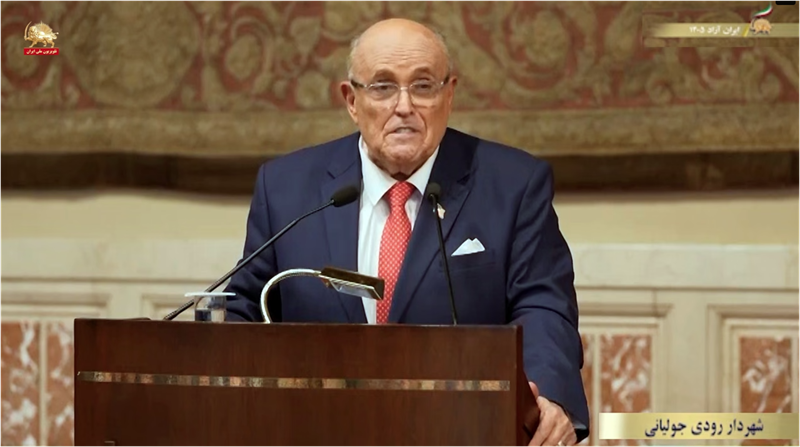

Speaking at the Italian Parliament conference on Iran, Rudy Giuliani argued that democratic change depends on supporting the Iranian people and their organized Resistance rather than pursuing appeasement.
Addressing the international conference “Iran: Beyond War—Human Rights and the Power of the People as the Solution” at the Italian Parliament, former New York City Mayor Rudy Giuliani argued that the central question facing policymakers is no longer whether change will come to Iran, but what should replace the current regime.
Speaking before Maryam Rajavi, Italian lawmakers, and international political figures, Giuliani maintained that the international community already has an answer: supporting the Iranian people and their organized democratic opposition rather than repeating policies of accommodation toward the ruling establishment.
“The Question Is What Comes Next”
Giuliani said that political transitions often generate uncertainty, with fears that one dictatorship may simply be replaced by another. Iran, however, presents a different situation because, in his view, a democratic alternative has spent decades preparing not only to challenge the regime but also to govern after it.
He argued that the National Council of Resistance of Iran (NCRI) and the PMOI/MEK have devoted nearly five decades to developing both a strategy for democratic change and a framework for political transition.
“The question today is not whether there is an alternative. We already know what exists in Maryam Rajavi, the NCRI, and the MEK, whose objective for decades has been freedom for the Iranian people.”
Rejecting a Return to Monarchy
A significant portion of Giuliani’s remarks focused on dismissing proposals advocating a restoration of Iran’s former monarchy.
He argued that returning to the Pahlavi dynasty would neither resolve Iran’s democratic deficit nor address the legacy of authoritarian rule before 1979. He criticized Reza Pahlavi’s public defense of his father’s record and maintained that monarchy cannot represent Iran’s democratic future.
Instead, Giuliani insisted that the organized Resistance remains the only political movement that has both sustained its opposition to dictatorship and developed a practical vision for democratic governance.
A Prepared Democratic Transition
According to Giuliani, one of the distinguishing features of the NCRI is that it has planned not only for the removal of the current regime but also for the transition that follows.
He highlighted Maryam Rajavi’s Ten-Point Plan, describing it as a roadmap that guarantees fundamental civil liberties, democratic elections, equality before the law, and expanded protections for women’s rights.
Giuliani said the Resistance has spent years preparing an interim governing framework and a constitutional roadmap, arguing that democratic institutions must be ready before political change occurs. He cited Rajavi’s Ten-Point Plan as evidence that the movement has developed a comprehensive vision for a future democratic republic.
Human Rights and the Cost of Resistance
Giuliani devoted considerable attention to the human cost paid by members of the Iranian Resistance.
He recalled the mass executions of political prisoners in 1988, describing them as one of the defining atrocities committed by the regime against members and supporters of the MEK. He argued that decades of executions and repression demonstrate both the regime’s brutality and the sacrifices made by those who have continued opposing it.
Referring to the 1988 massacre, Giuliani said the execution of approximately 30,000 political prisoners remains one of the clearest examples of the regime’s willingness to eliminate peaceful political opposition through mass violence.
He also condemned the continued use of executions and summary judicial proceedings against political prisoners, arguing that these practices remain central instruments of intimidation.
Criticism of Appeasement
Turning to international policy, Giuliani sharply criticized what he characterized as decades of appeasement by Western governments.
He argued that repeated condemnations, negotiations, and concessions have failed to alter the regime’s behavior and instead have prolonged its survival. According to Giuliani, lasting change can only come from inside Iran through the Iranian people and an organized democratic movement capable of replacing the current system.
Countering Regime Propaganda
Giuliani also argued that one of the greatest obstacles facing the Iranian Resistance is the regime’s extensive propaganda and disinformation campaign abroad.
He urged democratic governments and political leaders to help counter misinformation by presenting what he described as the Resistance’s political platform and democratic program more clearly to international audiences.
Giuliani said the international community should give greater visibility to the NCRI’s democratic platform and resist efforts to marginalize or misrepresent the organized Iranian opposition through disinformation campaigns.
A Call for International Support
Concluding his address, Giuliani appealed to European governments to move beyond expressions of concern and provide stronger political support for the Iranian people’s democratic aspirations.
He argued that concerns about a post-regime transition should not become an excuse for inaction, maintaining that a prepared democratic alternative already exists. Ending on an optimistic note, he expressed hope that future gatherings would take place in a free Tehran rather than in exile, reflecting his belief that political change in Iran is achievable.