


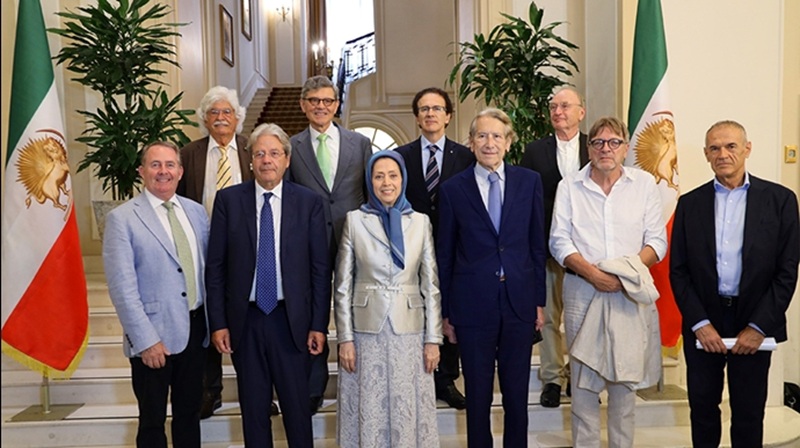

Political leaders and human rights advocates gathered in Italy to endorse the Iranian people’s right to democratic change and call for greater international accountability.
An international conference held in Italy brought together senior political figures, human rights advocates, and supporters of the Iranian democratic opposition to discuss what participants described as the only sustainable solution to Iran’s deepening political and humanitarian crisis: empowering the Iranian people to determine their own future.
Held under the theme “Iran: Beyond War—Human Rights and the Power of the People as the Solution,” the conference focused on the regime’s escalating human rights violations, growing domestic instability, and the need for a firm international policy that supports democratic change rather than continued accommodation.
International Leaders Call for a Firmer Policy
Moderated by Antonio Stango, President of the Italian Federation for Human Rights, the conference featured prominent European political figures, including former Italian Prime Minister Paolo Gentiloni, former Belgian Prime Minister Guy Verhofstadt, economist Carlo Cottarelli, Senator Giulio Terzi, former UK Defence Secretary Liam Fox, Ambassador Joachim Rücker, and Hans-Ulrich Seidt.
Speakers repeatedly argued that Iran’s current crisis cannot be resolved through preserving the existing political system or through military confrontation. Instead, they emphasized the central role of the Iranian people in achieving democratic change.
Participants also condemned the sharp increase in executions in Iran, calling for an end to impunity for those responsible for human rights abuses and urging democratic governments to adopt a more decisive policy toward the Iranian regime.
Throughout the conference, speakers reaffirmed their support for the Iranian people’s right to resist dictatorship and pursue freedom, democracy, and popular sovereignty, while expressing solidarity with Iran’s organized Resistance.
Maryam Rajavi: Neither Theocracy nor Monarchy
In her keynote address, Maryam Rajavi, President-elect of the National Council of Resistance of Iran (NCRI), reflected on nearly five decades of clerical rule and argued that Iran’s future lies in a democratic republic rather than either the continuation of the current system or a return to monarchical rule.
She stressed that the country’s crisis cannot be solved by preserving the existing regime or by restoring the former dictatorship of the Shah. Instead, she presented the establishment of a democratic republic based on the people’s sovereignty as the only viable path forward.
Rajavi also argued that the regime depends on manufacturing external crises because it has failed to address the needs of Iranian society and faces persistent domestic opposition. According to her assessment, the authorities resort to regional confrontation and external tensions as a means of preserving their grip on power in the face of growing internal resistance.
Organized Resistance and the Role of Resistance Units
Rajavi emphasized that meaningful political change requires an organized, independent movement rooted inside Iranian society and capable of confronting the regime’s repressive institutions, particularly the IRGC.
She pointed to the expansion of the Resistance Units despite widespread arrests and state repression, describing them as an increasingly visible manifestation of organized opposition inside Iran. Referring to recent activities, she cited coordinated operations targeting regime institutions during nationwide unrest as evidence of the Resistance’s continued growth and operational capacity.
Remembering the Victims of the 1988 Massacre
Marking the thirty-eighth anniversary of the 1988 massacre of political prisoners, Rajavi honored those who remained committed to the cause of freedom despite facing execution.
She drew a connection between their sacrifice and the younger generation of activists continuing the struggle today. Referring to a letter written by the late political prisoner Babak Alipour, she said the aspirations of Iran’s new generation center on unconditional freedom, equality, an end to discrimination, gender equality, and justice—objectives that, in her view, can only be achieved through democratic change and the establishment of a new political system.
A Shared Message
The conference concluded with a common message from many of its participants: Iran’s future should be determined by its own people. Speakers argued that supporting human rights, ending impunity for abuses, and recognizing the Iranian people’s right to seek democratic change constitute the most effective long-term response to the country’s ongoing political crisis.