


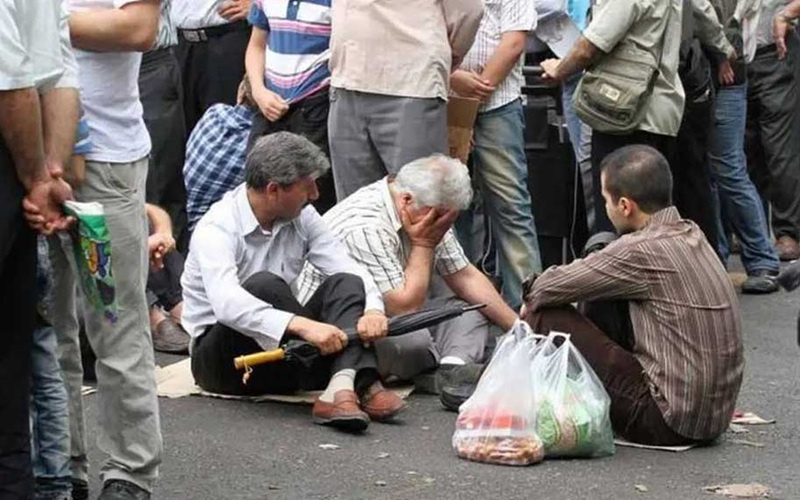

As inflation, unemployment, and housing costs continue to soar, millions of Iranians are being pushed from economic insecurity into outright poverty, exposing the failure of nearly five decades of regime policies.
For decades, Iranians have endured recurring waves of inflation, unemployment, economic stagnation, and declining living standards. Yet what was once described as a “cost-of-living crisis” has now transformed into something far more severe. Poverty is no longer confined to society’s most vulnerable segments. It has expanded deep into the middle class, creating a nationwide crisis that is reshaping how millions of people live, work, eat, and plan their futures.
Today, many Iranian families find themselves trapped in a reality where even the most basic aspirations—renting a suitable home, maintaining a balanced diet, obtaining medical care, or purchasing a modest vehicle—have become increasingly unattainable.
The Disappearance of Economic Stability
The most alarming feature of Iran’s current economic collapse is not merely the growth of poverty, but the disappearance of stability itself.
For years, many middle-class families managed to absorb economic shocks through savings, secondary jobs, or gradual reductions in consumption. That safety net has now largely vanished. Rising prices have outpaced incomes to such an extent that even households with regular employment struggle to cover essential expenses.
What was once considered a temporary financial squeeze has evolved into a structural crisis affecting nearly every aspect of daily life. Families are reducing both the quantity and quality of their meals. Medical treatments are postponed or abandoned altogether. Education, once viewed as a pathway to social mobility, is increasingly becoming a luxury. Even clothing purchases are often delayed indefinitely.
Perhaps the clearest indication of the depth of the crisis is that a worker earning less than 20 million tomans per month can no longer realistically aspire to purchase even the most basic vehicle—an item that was once considered within reach of ordinary working families.
The Cost of Simply Staying Alive
Recent market prices reveal the extent of the pressure facing ordinary citizens.
Beef now sells for roughly 1.9 million tomans per kilogram, while lamb exceeds 2.1 million tomans. Premium Iranian rice costs more than 540,000 tomans per kilogram. A tray of eggs has surpassed 550,000 tomans, and staple products such as cooking oil, milk, legumes, and beans have also experienced dramatic price increases.
The consequences are staggering. Meals that were once considered inexpensive household staples now cost hundreds of thousands of tomans to prepare. For a family of four, maintaining even a minimal monthly food basket consumes a substantial portion of total income.
And food is only one part of the equation.
Housing, utilities, transportation, healthcare, education, and clothing all compete for shrinking household budgets. Faced with impossible choices, many families sacrifice nutrition, healthcare, and personal necessities simply to avoid eviction.
In effect, millions of Iranians are no longer making decisions about improving their lives. They are making decisions about which basic needs they can no longer afford.
A Housing Crisis Driving Social Change
Housing costs have emerged as one of the most destructive forces behind Iran’s expanding poverty crisis.
Across the country, rising rents are forcing people to abandon lifestyles that only a few years ago seemed entirely normal. Shared housing arrangements are becoming increasingly common among adults who previously lived independently. Others are returning to their parents’ homes after years of self-sufficiency. Some are leaving major cities altogether in search of cheaper living costs.
These are not isolated incidents. They reflect a broader social transformation driven by economic desperation.
Media reports have documented cases of middle-aged professionals searching for roommates to divide rent payments. Others have described the painful decision to leave Tehran after decades of residence because maintaining even a modest standard of living has become impossible.
For many, the financial burden is accompanied by a profound psychological cost. Returning to a childhood home in middle age or abandoning a career built in the capital is often experienced not merely as an economic setback but as a personal defeat imposed by circumstances beyond one’s control.
The Misery Index Tells a Grim Story
Official statistics reinforce what millions of Iranians experience every day.
According to data published by Iran’s Statistical Center, the country’s misery index—a measure combining inflation and unemployment—has reached 61.3 percent.
Several provinces face even more severe conditions. Kurdistan tops the list with a misery index of 77 percent, followed by Kermanshah at 75 percent and Lorestan at 74.4 percent. Even Tehran, which records the lowest provincial figure, stands at 51.3 percent—a level that would be considered alarming in almost any economy.
These figures demonstrate that economic hardship is no longer concentrated in specific regions or among particular social groups. It has become a national condition.
Beyond the Numbers
Yet statistics alone fail to capture the full extent of the crisis.
The reality can be seen in crowded bakery lines, increasing reliance on charitable organizations, rising demand for subsidized healthcare, and growing numbers of families living one missed paycheck away from homelessness.
The gap between official data and lived experience is often wider than the numbers suggest. Inflation rates may be measured statistically, but poverty is ultimately experienced through daily compromises: skipped meals, untreated illnesses, postponed education, and abandoned dreams.
For millions of Iranians, life has become a constant exercise in survival.
The Price of the Regime’s Priorities
The central question is not whether Iran possesses the resources necessary to improve living standards. It does.
The question is how those resources are allocated.
While ordinary citizens struggle to afford food, housing, and healthcare, the regime continues to devote enormous financial resources to preserving its ideological agenda, maintaining regional influence, funding security institutions, and sustaining costly confrontations with the international community.
The result is a tragic contradiction. A nation rich in natural resources and human capital has produced one of the most severe cost-of-living crises in its modern history.
The poverty now engulfing Iran is not the product of a single economic downturn or an unavoidable external shock. It is the cumulative outcome of decades of political decisions that prioritized regime survival and ideological ambitions over the welfare of the Iranian people.
As long as those priorities remain unchanged, the crisis is unlikely to improve. Instead, more families will continue their descent from the middle class into poverty, and more citizens will find themselves trapped on the increasingly narrow line between survival and homelessness.