


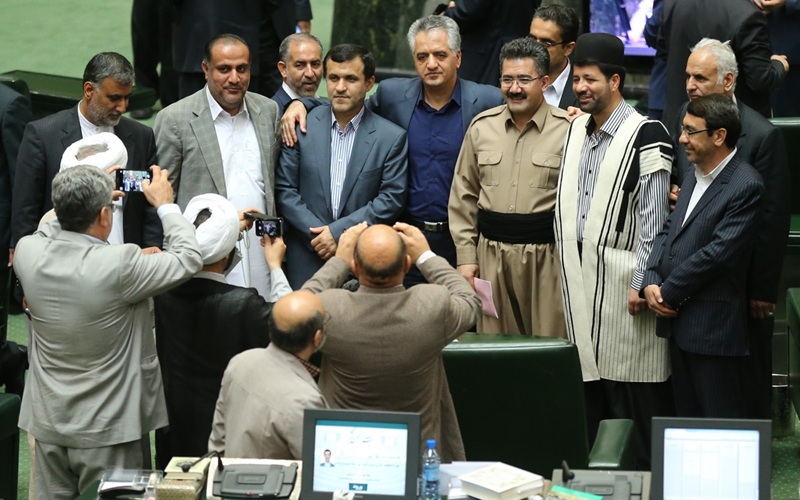

As Iranians struggle with inflation, unemployment, and economic collapse, the regime’s parliament remains consumed by factional warfare, exposing a political system designed to preserve power rather than serve the public.
In democratic societies, parliaments embody the principle of popular sovereignty. Legislators are elected to represent citizens, scrutinize governments, and craft laws that advance the public interest. Debate, political competition, and ideological diversity are not signs of weakness but essential features of pluralistic governance.
Under Iran’s clerical dictatorship, however, this institution has been stripped of its fundamental purpose.
The regime’s parliament has evolved into something entirely different: a stage where rival factions compete not over policies that improve the lives of ordinary Iranians, but over influence, patronage, and access to the levers of power. While millions of citizens struggle with soaring inflation, unemployment, housing insecurity, and the steady erosion of purchasing power, parliamentary politics revolve around an altogether different set of priorities.
The widening gap between the suffering of the public and the preoccupations of the political elite has become one of the clearest indicators of the regime’s structural failure.
Parliament Without Representation
The contradiction is difficult to ignore.
Iran faces a succession of interconnected crises. Inflation continues to devastate household budgets. Economic stagnation has left many young people without meaningful employment. Housing costs have become prohibitive, while repeated energy shortages and deteriorating public services further undermine living standards.
Yet these urgent issues rarely dominate the parliament’s political agenda.
Instead, much of the institution’s energy is consumed by internal rivalries among competing factions of the regime. Legislative sessions, committee appointments, and ministerial oversight have increasingly become instruments in a broader contest for political advantage rather than mechanisms for addressing national problems.
This reality reflects the nature of a political system in which loyalty to the ruling establishment outweighs accountability to voters.
The Ghalibaf–Paydari Rivalry
The ongoing confrontation between the faction aligned with Mohammad Bagher Qalibaf and the hardline Paydari Front illustrates this dynamic particularly well.
Although Ghalibaf retained the speakership of the parliament, the competition never ended with that vote. Instead, it merely shifted to other arenas: leadership positions, committee assignments, parliamentary boards, and procedural influence.
These battles are often presented as ordinary political disagreements. In reality, they concern access to power networks that shape appointments, budget allocations, government contracts, and strategic decision-making.
The outcome matters far less for ordinary citizens than it does for competing political factions seeking greater influence within the regime.
The Strategic Importance of Parliamentary Committees
Some of the fiercest struggles occur behind the scenes, particularly over membership in influential parliamentary committees.
Committees responsible for the national budget, the economy, energy, and national security are not simply advisory bodies. They play an important role in shaping fiscal priorities, reviewing major projects, influencing legislation, and exercising oversight over government agencies.
Securing positions within these committees provides political leverage, privileged access to information, and greater influence over the allocation of state resources.
It is therefore unsurprising that state-affiliated media have repeatedly acknowledged intense lobbying, negotiations, and factional maneuvering surrounding committee appointments. Such reports inadvertently reveal the priorities of the political establishment: institutional positions are valued primarily because they expand influence rather than improve governance.
Oversight as a Political Weapon
Even parliamentary oversight has increasingly become an extension of factional conflict.
Ministerial impeachment proceedings frequently appear less connected to administrative performance than to shifting alliances inside the ruling establishment. Parliamentary tools that should promote accountability are instead deployed to weaken rival factions or strengthen negotiating positions within the regime.
This pattern undermines one of the legislature’s most important constitutional functions.
When oversight becomes a weapon in an internal power struggle, public accountability inevitably becomes secondary.
Even State Media Acknowledge the Reality
Perhaps the most revealing aspect of this situation is that it is no longer described solely by outside observers.
State-controlled and regime-affiliated media have themselves referred to a “power struggle in parliament,” “conflicts within the conservative camp,” and competition for “a larger share of power.” Such language is unusually candid because it confirms what many Iranians already understand: these disputes are not fundamentally about defending public interests.
Instead, they reflect an increasingly fragmented political elite competing over diminishing resources and influence within an authoritarian system.
The Real Casualty
Authoritarian governments often attempt to portray internal competition as evidence of political vitality. Yet genuine democratic competition is measured by responsiveness to citizens, transparency, and accountability—not by struggles among elites over institutional control.
Iran’s parliament demonstrates the opposite.
Rather than serving as a forum where national crises are addressed through representative debate, it has become another arena in which rival factions compete for dominance inside the regime. Economic hardship, declining living standards, and public dissatisfaction remain largely outside this contest because they are not the source of political power.
The ultimate loser is not one parliamentary faction or another.
It is the Iranian people, whose daily hardships remain subordinate to the regime’s endless struggle to preserve itself. As long as the political system rewards loyalty over representation and factional advantage over public service, parliament will continue to function less as a house of the people than as a battlefield where power is defended, divided, and redistributed among competing elites.