



Authoritarian systems often appear strongest when power is concentrated in a single individual. Yet that same concentration can become their greatest weakness once the central authority disappears. The Iran regime is now confronting precisely this dilemma.
The increasingly visible infighting among the regime’s ruling elite is not simply another episode of factional politics. It reflects a deeper struggle over who will inherit influence, wealth, and political control in a system that has lost the figure capable of imposing discipline on competing power centers.
For decades, the regime’s various oligarchic networks—including the clerical establishment, the Revolutionary Guards, intelligence institutions, and politically connected economic interests—operated under the arbitration of a supreme leader whose authority ultimately settled disputes. With that unifying force gone, old rivalries are resurfacing with new intensity.
A Rare Crack Inside the Assembly of Experts
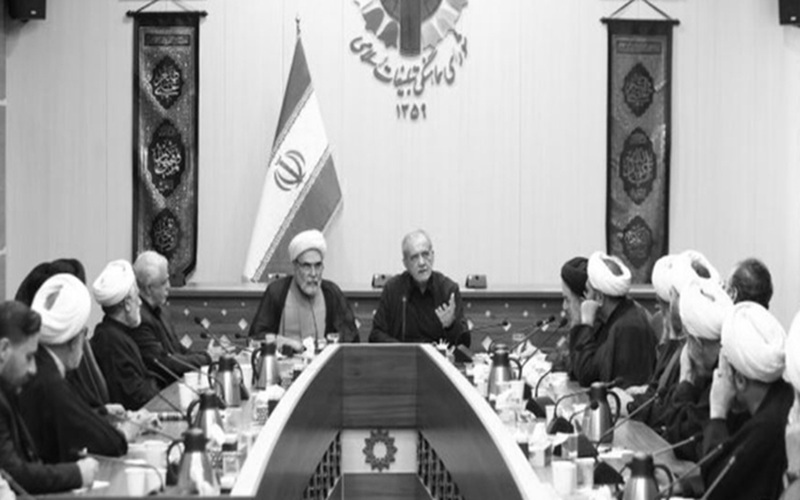
The latest sign of this power struggle emerged in an unexpected place: the Assembly of Experts, the body formally tasked with supervising and selecting the regime’s supreme leader.
Traditionally one of the regime’s most disciplined and silent institutions, the Assembly rarely displays public disagreement. That changed when 73 of its 88 members issued an unusual public statement criticizing the government’s handling of negotiations with the United States.
Although framed as a defense of the supreme leader’s authority, the statement implicitly accused senior officials of crossing Mojtaba Khamenei’s so-called “red lines.” Its language emphasized that no official should act contrary to the will of the supreme leader—a reminder that appeared directed as much at rival factions inside the regime as at negotiators themselves.
The significance of the statement became even greater when Hashem Hosseini Bushehri, secretary and spokesperson of the Assembly, publicly declared that he had not been informed before it was released. While he said he agreed with its content, he acknowledged that the declaration had bypassed the institution’s normal procedures.
That admission exposed an extraordinary level of internal division.
Several senior members of the Assembly’s leadership had signed the statement, while others—including its own secretary—were excluded from the process. Such public disunity inside one of the regime’s core institutions would have been almost unimaginable only a few years ago.
More Than a Dispute Over Diplomacy
At first glance, the controversy appears to concern negotiations with Washington.
In reality, the dispute is about something much larger.
Foreign policy has become the arena through which competing factions are testing one another’s strength, measuring political alliances, and asserting influence inside a system where authority is becoming increasingly fragmented.
The negotiations themselves are less important than what they reveal: competing centers of power no longer trust one another to define the regime’s strategic direction.
The Assembly’s intervention therefore should not be interpreted as a principled defense of ideology. Rather, it reflects growing anxiety within the ruling establishment that shifting political dynamics could threaten long-protected institutional privileges.
The Clerical Establishment Is Defending Its Interests
The Assembly of Experts has never functioned as an independent constitutional watchdog. In practice, it represents the interests of the ruling clerical establishment whose political and economic privileges have long depended on the supremacy of the office of the supreme leader.
Under Ali Khamenei, that hierarchy remained largely unquestioned.
Today, the situation is markedly different.
Mojtaba Khamenei may formally occupy the highest office, but he has yet to demonstrate the personal authority that allowed his predecessor to mediate disputes among competing elite factions. His limited public visibility has only reinforced perceptions that the new leadership lacks the commanding presence necessary to keep rival power centers aligned.
For many within the clerical establishment, this uncertainty creates a direct threat to their own influence.
Their public intervention therefore reflects not only concern over state policy but also a determination to preserve the political order from which they have benefited for decades.
Power Without Authority Cannot Last
At present, the regime continues to invoke Mojtaba Khamenei’s authority as a mechanism for preserving internal discipline.
His name still functions as a symbolic source of legitimacy that competing factions can cite to justify decisions, restrain rivals, and avoid open confrontation.
Yet symbolic authority has limits.
Unlike his father, whose constant public presence reinforced his position as the regime’s ultimate arbiter, Mojtaba Khamenei remains largely absent from public life. That absence creates uncertainty precisely where authoritarian systems are most vulnerable: at the center of power itself.
A system built around personal rule cannot indefinitely rely on an authority that is rarely seen or directly exercised.
If questions about the supreme leader’s ability to govern continue to grow, elite factions may increasingly conclude that they must prepare for another succession struggle rather than wait for one to emerge unexpectedly.
The Real Battle Has Already Begun
The public dispute inside the Assembly of Experts is therefore best understood as an early indicator of a broader realignment.
The clerical establishment, the Islamic Revolutionary Guard Corps, intelligence institutions, and competing political and economic networks are all positioning themselves to protect their interests as the regime’s traditional mechanisms of authority weaken.
For now, these rivalries remain largely contained within institutional boundaries.
History suggests, however, that authoritarian systems often appear stable until the moment internal consensus collapses. Once competing elites conclude that no single figure can reliably enforce political order, factional competition tends to accelerate rapidly.
What appears today as a disagreement over negotiations with the United States may soon evolve into something far more consequential: a struggle over who will dominate the Iran regime in the post-Khamenei era.
That prospect represents one of the most significant political vulnerabilities the regime has faced in decades. The greatest challenge to its survival may no longer come primarily from external pressure or domestic unrest, but from the increasingly open competition among the very elites whose unity has long sustained it.