


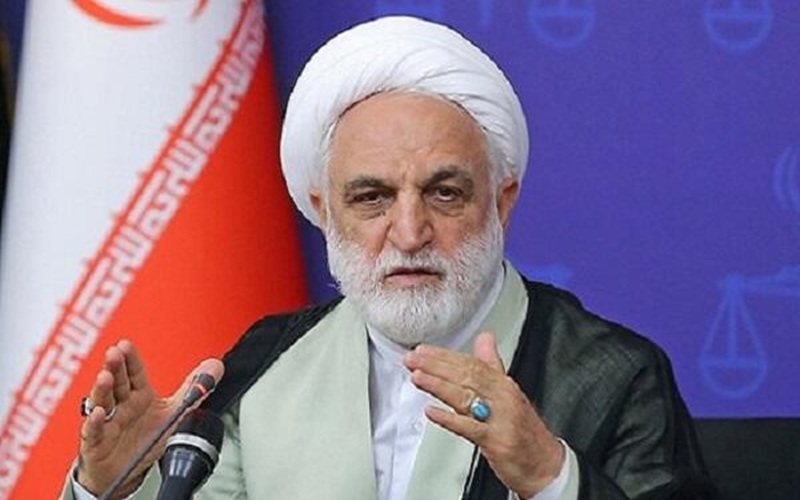

The decision to retain Gholamhossein Mohseni Ejei as judiciary chief underscores the new leadership’s reliance on security officials, mass executions, and politically motivated prosecutions to preserve power.
The reappointment of Gholamhossein Mohseni Ejei as head of the Iran regime’s judiciary is far more than a routine administrative decision. It is a political statement about the direction of the regime under Mojtaba Khamenei and a clear indication that the judiciary will remain an instrument of repression rather than justice.
By extending Ejei’s five-year term, the regime has chosen continuity over reform, reinforcing a judicial system that has long operated in close coordination with the intelligence services and security apparatus.
A Career Built on Security, Not Justice
Few officials better embody the fusion of intelligence, political control, and judicial authority than Mohseni Ejei.
Since the early years following the 1979 revolution, he has occupied influential positions within the Revolutionary Prosecutor’s Office, the Ministry of Intelligence, the Attorney General’s Office, and eventually the judiciary itself. Throughout his career, Ejei has been associated less with legal reform than with politically sensitive prosecutions, forced confessions, and the suppression of dissent.
His rise was closely linked to some of the regime’s most consequential internal purges. During the 1980s, he played a role in the investigation of Mehdi Hashemi, a case widely viewed as instrumental in eliminating the political influence of Ayatollah Hossein Ali Montazeri, once considered the successor to Ruhollah Khomeini.
This trajectory established Ejei not simply as a judicial administrator, but as a trusted security figure whose primary function has been protecting the ruling establishment.
International Sanctions and Human Rights Record
Ejei’s record has also drawn sustained international condemnation.
Following the suppression of the 2009 nationwide protests, both the United States and the European Union imposed human rights sanctions against him, citing his role in serious abuses, including arbitrary prosecutions, unfair trials, and severe punishments against political activists and protesters.
His reputation has become synonymous with a judiciary that routinely prioritizes political loyalty over due process.
The Judiciary Under Ejei: Executions Instead of Reform
When Ejei first became judiciary chief in 2021, the regime promoted slogans such as “judicial transformation,” “fighting corruption,” and “protecting public rights.”
The reality proved starkly different.
Instead of greater judicial independence, the courts became an even more effective arm of the regime’s security apparatus, particularly after the nationwide 2022 uprising. Protesters, journalists, lawyers, civil society activists, and members of ethnic and religious minorities increasingly faced harsh prison sentences, politically motivated prosecutions, and death penalties.
The dramatic rise in executions has become the defining feature of Ejei’s tenure.
Human rights organizations have documented record numbers of executions during recent years. According to Amnesty International, more than 1,000 executions were carried out in 2025—the highest annual figure the organization had recorded in at least 15 years. Amnesty concluded that the regime had increasingly weaponized capital punishment to silence dissent following the “Woman, Life, Freedom” protests.
Meanwhile, other human rights organizations documented at least 1,639 executions in 2025, the highest annual total since it began monitoring executions. They reported that more than 90 percent of executions were never officially announced and that many were based on politically motivated charges such as “enmity against God” and “corruption on earth.”
These figures illustrate a judiciary that functions not as an independent institution but as a mechanism of political intimidation.
A Judiciary Aligned With the Security State
The judiciary’s role became even more prominent following the military confrontation involving Israel and the United States.
Human rights groups have warned that the regime used the wartime atmosphere to intensify arrests, accelerate politically motivated trials, and increase executions under the pretext of national security.
Rather than moderating the state’s response during a period of heightened tension, the judiciary expanded its role in suppressing perceived opponents, reinforcing its position as one of the regime’s principal tools of internal control.
Why Mojtaba Khamenei Chose Continuity
Before Ejei’s reappointment, speculation suggested that the new supreme leader might replace him to demonstrate his authority over the state apparatus.
Instead, Mojtaba Khamenei chose continuity.
The decision suggests that, at least during the early phase of his leadership, stability within the security establishment outweighs any desire for institutional change. Ejei offers decades of experience, close relationships with the Ministry of Intelligence and the Revolutionary Guards, and a proven willingness to use judicial institutions to advance political objectives.
His retention reflects confidence in a trusted insider capable of maintaining coordination across the regime’s coercive institutions.
A Message for Iran’s Future
Ejei’s reappointment carries several important implications.
First, it signals that meaningful judicial reform remains off the regime’s agenda. Second, it demonstrates that Mojtaba Khamenei intends to consolidate his authority by relying on long-serving security officials rather than introducing a new generation of leadership. Finally, it confirms that the judiciary will continue to play a central role in managing political dissent through criminalization, intimidation, and severe punishment.
For journalists, lawyers, political activists, victims’ families, and ordinary citizens seeking justice, the message is unmistakable.
The Iran regime has once again entrusted one of its most powerful institutions to a figure whose career has been defined by political prosecutions, security-driven justice, and the expansion of state repression. Rather than serving as a safeguard for citizens’ rights, the judiciary under Mohseni Ejei is set to remain one of the regime’s strongest pillars of survival.