


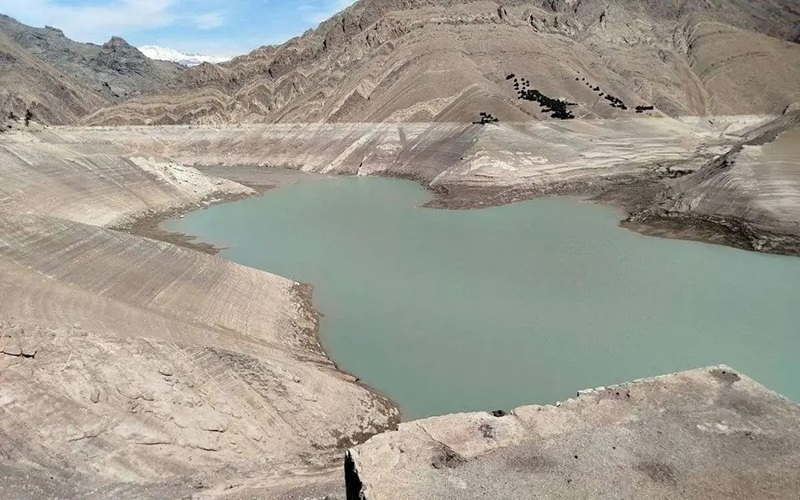

As renewable water resources shrink and groundwater reserves collapse, experts warn that the Iran regime’s policies—not just climate change—are driving the country toward an unprecedented water security crisis.
The steady decline of Iran’s renewable water resources has once again exposed one of the country’s most serious long-term crises. While regime officials often blame drought and climate change for worsening water shortages, mounting scientific evidence points to a far deeper problem: decades of unsustainable resource management under the Iran regime.
Recent warnings from water experts make clear that the country is no longer facing a temporary shortage caused by fluctuating rainfall. Instead, Iran is confronting a structural water crisis driven by excessive groundwater extraction, poor agricultural policies, politically motivated development projects, and a system of governance that has consistently prioritized short-term political objectives over long-term environmental sustainability.
The result is a crisis that threatens not only drinking water supplies but also agriculture, food security, economic stability, and social cohesion.
Renewable Water Resources Continue to Shrink
The latest assessment presented by Banafsheh Zahraei, head of the Water Institute at the University of Tehran, illustrates the scale of the deterioration.
According to Zahraei, Iran’s renewable water resources have fallen from approximately 110 billion cubic meters to just 92 billion cubic meters in recent years.
That decline represents far more than a statistical adjustment. It reflects a steady depletion of the country’s natural capacity to replenish its water reserves—a trend that experts warn cannot be reversed simply by experiencing wetter years.
Although parts of Iran received above-average rainfall during the current water year, specialists emphasize that improved precipitation does not mean the crisis has ended. Reservoirs may temporarily recover, but depleted aquifers require decades—or even centuries—to regenerate once they have been overexploited.
The Real Crisis Lies Underground
The most alarming aspect of Iran’s water emergency is hidden beneath the surface.
Scientific studies show that between 2003 and 2019, Iran lost more than 211 billion cubic meters of total water storage despite periods of relatively favorable rainfall.
Researchers have concluded that excessive pumping of groundwater—not declining precipitation alone—is primarily responsible for this loss.
Across much of the country, groundwater extraction has exceeded natural recharge rates for decades. Wells have been drilled faster than aquifers can recover, causing water tables to collapse, springs to disappear, and groundwater quality to deteriorate.
This pattern has transformed what might have been manageable drought cycles into a nationwide environmental emergency.
Water Mismanagement Has Become a Governance Crisis
The shrinking water supply is inseparable from the Iran regime’s broader failures of governance.
Rather than adopting sustainable resource management, successive governments expanded water-intensive agriculture, encouraged inefficient irrigation, tolerated widespread illegal well drilling, and approved industrial projects in some of Iran’s driest regions.
Agriculture alone consumes approximately 85 to 90 percent of the country’s available freshwater.
Much of that water is still used through outdated irrigation systems while water-intensive crops continue to be cultivated in provinces that lack sufficient natural resources to support them.
Even regime officials have repeatedly acknowledged the need to reform agricultural practices and improve water efficiency. Yet meaningful reforms have largely failed to materialize, allowing overconsumption to continue year after year.
The same pattern is evident in industrial policy.
Major steel plants, petrochemical facilities, and mining operations have been established in water-stressed regions for political or economic reasons, placing additional pressure on already depleted aquifers and intensifying competition between provinces over limited water supplies.
Engineering Projects Cannot Solve Structural Failures
Faced with growing shortages, the regime has increasingly promoted ambitious engineering projects such as inter-basin water transfers and desalination.
While these projects may temporarily alleviate shortages in selected cities or industrial zones, many experts argue they fail to address the root causes of the crisis.
Without reducing consumption, improving efficiency, regulating groundwater extraction, modernizing irrigation systems, expanding wastewater recycling, and reforming water governance, transferring water merely shifts environmental pressures from one region to another.
Infrastructure alone cannot compensate for decades of unsustainable management.
A Country Approaching Extreme Water Stress
International assessments reinforce the seriousness of Iran’s situation.
According to global water stress indicators, Iran consumes more than 80 percent of its renewable water resources annually, placing it among the world’s most water-stressed countries.
At the same time, renewable water availability per capita has fallen dramatically—from roughly 7,000 cubic meters per person several decades ago to less than 1,200 cubic meters today.
This figure places Iran dangerously close to the internationally recognized threshold for absolute water scarcity.
The implications extend well beyond water availability itself.
Declining groundwater reserves contribute directly to land subsidence, one of the fastest-growing environmental hazards across many Iranian provinces. Entire agricultural regions are becoming less productive, while villages face increasing pressure to abandon farming altogether.
Water Is Becoming a National Security Challenge
The consequences of continued water depletion will reach far beyond environmental degradation.
Experts increasingly warn that persistent shortages could accelerate rural migration, deepen economic inequality, intensify regional disputes over water allocation, undermine food production, and fuel broader social unrest.
These risks are particularly significant at a time when the Iran regime is already confronting severe economic difficulties, energy shortages, inflation, and declining public confidence.
Water insecurity is therefore emerging as both an environmental and political challenge.
A Crisis Created by Policy, Not Nature Alone
Climate change has undoubtedly made Iran’s water situation more difficult. Rising temperatures and increasingly erratic rainfall have placed additional pressure on limited natural resources.
Yet climate alone cannot explain the scale of today’s crisis.
The evidence points instead to decades of policy failures that encouraged overexploitation while delaying meaningful reforms. Temporary increases in rainfall may refill reservoirs, but they cannot restore depleted aquifers or reverse years of environmental degradation.
The Iran regime now faces a crisis largely of its own making—one that illustrates how poor governance can transform natural resource constraints into a national emergency.
Unless fundamental reforms replace politically driven water management, Iran’s water crisis will continue to deepen, threatening not only the country’s environment but also its economic resilience, agricultural future, and long-term social stability.