


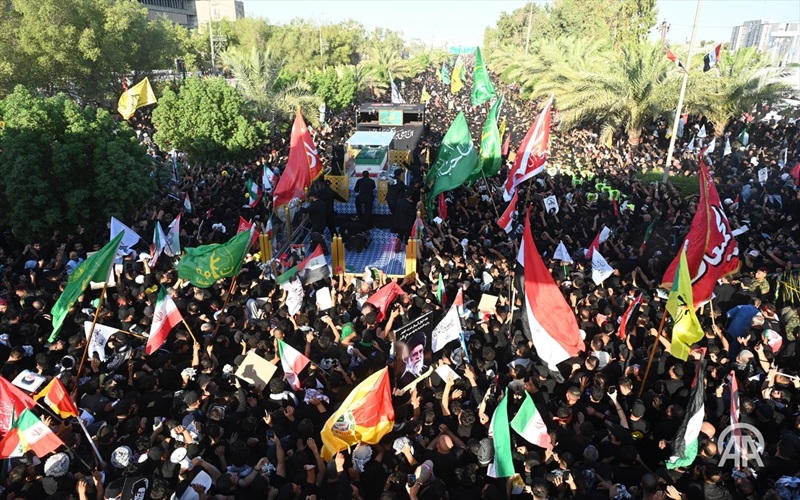

The massive state-organized funeral projected an image of unity and resilience, but the absence of key insiders, mounting regional setbacks, and a worsening economic crisis exposed a regime entering one of the most uncertain periods in its history.
Authoritarian regimes have long understood the political value of grand ceremonies. Funerals, military parades, and mass rallies are designed not merely to honor the dead but to reassure supporters, intimidate opponents, and project continuity at moments of uncertainty. The funeral of Ali Khamenei, the former Supreme Leader of Iran, fit squarely within that tradition.
The regime invested enormous political capital in transforming the ceremony into a carefully choreographed display of resilience following months of military confrontation with Israel and the United States. State media portrayed millions of mourners as proof that the system remained united, confident, and firmly in control. The intended message was unmistakable: despite war, sanctions, and leadership transition, the regime had emerged intact.
Yet beneath the carefully managed spectacle lay a very different reality.
Far from demonstrating unquestioned strength, the funeral highlighted the vulnerabilities that the regime can no longer conceal. The symbolism of mass crowds was overshadowed by conspicuous political absences, growing signs of internal fragmentation, increasing regional pressure, and an economy that continues to deteriorate. The ceremony may have succeeded as political theater, but it failed to erase the profound structural challenges confronting the Islamic Republic.
The Missing Heir
Perhaps the most striking feature of the funeral was not who attended, but who did not.
Mojtaba Khamenei, widely viewed for years as one of the most influential figures within the regime and now successor to his father, was absent from the public ceremony.
Security concerns may offer a reasonable explanation. Any potential successor would undoubtedly face significant security threats during such a high-profile event. Nevertheless, prolonged absence from public view carries political costs.
Leadership in the regime has never depended solely on constitutional authority. It also relies on carefully cultivated symbolism and visible demonstrations of control. Remaining largely invisible during one of the most important political events in the regime’s history inevitably fuels speculation about confidence within the leadership and raises questions about the new balance of power.
At a moment intended to project stability, uncertainty became part of the story.
The Missing Faces of the Regime
The absence of former presidents Mohammad Khatami, Hassan Rouhani, and Mahmoud Ahmadinejad from the main funeral ceremony proved equally revealing.
For decades, the regime has sought to present itself as a unified political establishment despite its factional rivalries. State ceremonies traditionally provide an opportunity to reinforce that image by bringing together competing political currents under a single national banner.
Instead, the funeral exposed those divisions.
Even commentators within the regime questioned why such a historic event lacked an official photograph bringing together the country’s surviving former presidents alongside representatives of deceased presidents such as Akbar Hashemi Rafsanjani and Ebrahim Raisi.
The criticism reflected a broader reality: the political consensus that once helped sustain the regime has become increasingly difficult to display, even during moments carefully designed to emphasize national unity.
Regional Confidence Meets Regional Reality
On the sidelines of the funeral, senior officials—including parliamentary speaker Mohammad Bagher Ghalibaf and Foreign Minister Abbas Araghchi—held meetings with representatives of Palestinian factions, Hezbollah, the Amal Movement, and Yemen’s Houthis.
The message was familiar.
Iranian regime officials reaffirmed their commitment to the so-called “Axis of Resistance,” pledged continued support for allied armed groups, and suggested that recent regional confrontations had strengthened Tehran’s strategic position. Officials also indicated that future negotiations with Washington would remain linked to broader regional developments, including the ceasefire in Lebanon and the future of Gaza.
This rhetoric projected confidence.
Reality is considerably more complicated.
Despite the government’s optimistic messaging, the regime faces a far less favorable regional environment than before the recent conflict. Israel maintains a military presence in southern Lebanon, coordination between Israel and the Lebanese government has expanded, and political pressure continues to grow inside both Lebanon and Iraq to limit or dismantle the influence of regime-backed militias.
For Tehran, preserving its regional network has become more difficult and more expensive at precisely the moment when domestic resources are under unprecedented strain.
Economic Crisis Cannot Be Hidden
No political spectacle, regardless of its scale, can disguise the everyday realities confronting ordinary Iranians.
Inflation remains high. The national currency has suffered repeated collapses. Investment continues to stagnate, while unemployment, poverty, and declining purchasing power have intensified public frustration.
These economic pressures existed before the recent military confrontation. They have only become more acute afterward.
The leadership transition therefore arrives at a particularly dangerous moment. Unlike previous periods of succession, today’s leaders inherit not only political uncertainty but also an economy burdened by sanctions, structural mismanagement, capital flight, and declining public confidence.
These problems cannot be resolved through carefully staged ceremonies.
The Real Test Begins Now
The regime demonstrated that it retains the organizational capacity to mobilize large crowds. It still commands a loyal social base, a powerful security apparatus, and extensive state institutions capable of producing impressive displays of political unity.
But the ability to organize a funeral should not be mistaken for evidence of long-term stability.
The challenges awaiting the regime’s new leadership are substantially more difficult than managing a single public event. They include growing factional rivalries within the ruling elite, increasing uncertainty over the future direction of the state, mounting regional pressures, persistent international isolation, and an economy that continues to erode the living standards of millions of Iranians.
These are problems that cannot be solved through symbolism alone.
Indeed, the funeral may ultimately be remembered less as a demonstration of the regime’s enduring strength than as the moment when its underlying weaknesses became impossible to ignore. The regime sought to project continuity after the death of its most powerful leader. Instead, it inadvertently revealed how much of the system’s cohesion had depended on him—and how uncertain the post-Khamenei era may prove to be.