



The nationwide uprising that erupted over economic hardship and evolved into a direct challenge to the regime was met with one of the deadliest crackdowns in modern Iranian history, yet the true number of victims remains unknown.
Six months have passed since the nationwide protests of January 2026, a period that witnessed what many observers describe as one of the bloodiest crackdowns on civilians in Iran’s modern history. Conducted largely behind a near-total internet blackout and severe restrictions on communications, the suppression of the protests left behind a legacy of unanswered questions, disputed casualty figures, and growing calls for accountability.
While the political and social significance of the January uprising continues to shape discussions about Iran’s future, one issue remains particularly contentious: how many people were killed during the crackdown?
Despite the passage of time, conflicting reports and the absence of official transparency have made it impossible to establish a universally accepted death toll. Yet the scale of the violence itself is no longer in dispute.
From Economic Grievances to Nationwide Revolt
The protests began in early January 2026 amid growing frustration over the continuing collapse of Iran’s currency, soaring inflation, and worsening living conditions.
What initially emerged as demonstrations among traders and citizens in Tehran’s Grand Bazaar rapidly transformed into a broader anti-government movement. Within days, protests spread across numerous cities and provinces, reflecting widespread anger over economic hardship and dissatisfaction with the ruling establishment.
Security forces moved quickly to suppress demonstrations. Fatalities were reported from the earliest days of unrest, but according to numerous accounts, the most violent phase of the crackdown occurred on January 8 and 9 (18 and 19 Dey), when security forces launched large-scale operations against protesters in multiple cities.
Reports from opposition sources, activists, and human rights advocates describe those two days as the deadliest period of the uprising.
The Battle Over the Numbers
As with previous nationwide protests in Iran, determining the number of victims has become a major source of controversy.
Human rights organizations, media outlets, and political opponents of the Iranian regime have offered sharply different estimates. Some reports suggest that several thousand people were killed, while others place the number significantly higher.
The discrepancies have fueled debates over the reliability of sources, methods of data collection, and the challenges of documenting casualties in a country where independent investigations face severe restrictions.
The lack of transparency from the regime authorities has only deepened uncertainty. Officials have not released a comprehensive list of those killed, nor have they provided verifiable nationwide casualty figures.
For human rights advocates, however, the issue extends far beyond statistics.
The death toll is not merely a number. It forms part of the historical record, serves as evidence for future investigations into human rights abuses, and may ultimately play a role in efforts to hold perpetrators accountable.
Information Blackouts and Hidden Evidence
One of the defining characteristics of the January 2026 protests was the regime’s extensive effort to restrict the flow of information.
Internet access was severely disrupted across much of the country, making it difficult for journalists, human rights groups, and independent observers to document events in real time.
Despite these restrictions, a limited number of videos emerged from inside Iran.
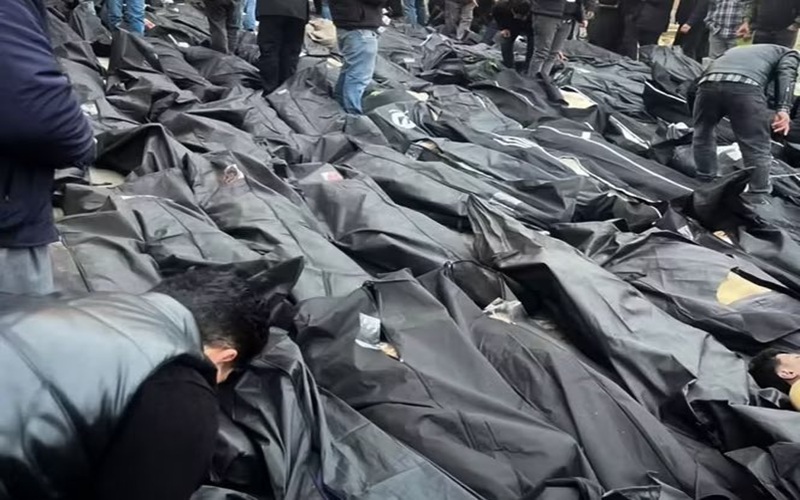
Among the most widely discussed were recordings reportedly showing large numbers of casualties in Karaj’s Fardis district. Additional footage allegedly taken at the Kahrizak Forensic Center circulated online, showing rows of black body bags and distraught families searching among the dead for missing relatives.
Because of the restrictions on independent verification, many of these images remain difficult to authenticate fully. Nevertheless, they contributed significantly to international concerns about the scale of the violence.
Contradictory Statements From Officials
The controversy surrounding the casualty figures was further intensified by conflicting statements from senior regime officials.
On January 27, 2026, former Supreme Leader Ali Khamenei addressed the protests and once again blamed foreign governments for the unrest, describing the events as an “American sedition.” He claimed that agents linked to the United States and Israel had been responsible for the deaths of “several thousand people.”
The statement drew attention because it appeared to acknowledge, for the first time, that the number of fatalities may have reached into the thousands.
Only days earlier, however, Iranian Foreign Minister Abbas Araghchi had presented a dramatically different assessment during an interview with Fox News, stating that the death toll amounted to only “a few hundred” people.
The discrepancy highlighted the uncertainty surrounding the events and raised further questions about what Iranian authorities knew regarding the true scale of the casualties.
A Warning That Raised New Questions
Additional controversy emerged during the subsequent Iran-Israel conflict.
According to reports, members of the Islamic Revolutionary Guard Corps (IRGC) sent warning messages to citizens threatening that any future anti-government demonstrations would be met with consequences “stronger than January 8.”
The wording of these warnings attracted attention because critics interpreted them as an implicit acknowledgment of the severity of the earlier crackdown.
For many observers, the messages reinforced concerns that the regime viewed the January protests not as an isolated incident but as a continuing threat to its authority.
An Unfinished Chapter
The January 2026 protests joined a growing list of nationwide uprisings that have shaken Iran over the past decade, including the protests of 2017, 2019, 2021, 2022, and subsequent waves of unrest.
In each case, disputes over casualty figures have been compounded by government secrecy and restrictions on independent investigations.
Six months later, many questions remain unanswered. The identities of numerous victims remain unknown, the exact death toll is still disputed, and families continue to seek information about relatives who disappeared during the unrest.
What is clear, however, is that the events of January 2026 marked a defining moment in Iran’s contemporary history. The scale of the crackdown, the allegations of mass casualties, and the ongoing uncertainty surrounding the victims ensure that the protests remain not only a political issue but also a human rights challenge whose full dimensions have yet to be documented.