


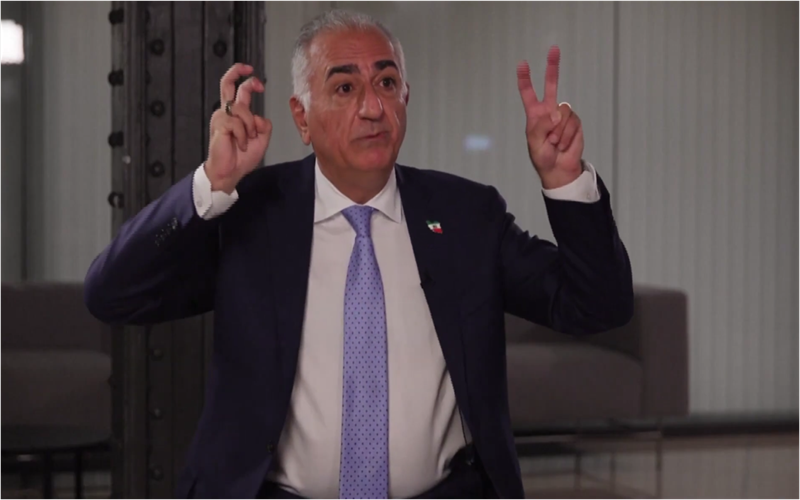
A Reuters investigation into Reza Pahlavi’s political campaign reveals a widening gap between his democratic image and his record of leadership, coalition-building, and political effectiveness.

For years, Reza Pahlavi has presented himself as the figure best positioned to guide Iran through a democratic transition. Describing himself as neither a politician seeking office nor a claimant to power, he has instead portrayed himself as a unifying bridge capable of bringing together the country’s fragmented opposition before handing Iran’s future over to its people.

A recent Reuters special report, however, presents a far more complicated picture.

Based on interviews with more than 50 people, hundreds of pages of legal documents, and months of reporting across Europe and North America, Reuters examined Pahlavi’s political campaign, his relationships with supporters and critics, and his efforts to establish himself as the leading alternative to the Iranian regime. Rather than reinforcing the carefully cultivated image of a disciplined democratic leader, the investigation documents repeated contradictions between Pahlavi’s public claims and his political record.

The report does not accuse Pahlavi of corruption or criminal conduct. Nor does it argue that he cannot play any role in Iran’s future. Instead, Reuters raises a more fundamental question: whether his record supports the leadership role he increasingly claims for himself.

Taken together, Reuters’ findings reveal a recurring pattern. Throughout the report, Pahlavi presents himself as a unifier, an organizer, and the accepted leader of a democratic transition. Yet Reuters repeatedly documents fractured alliances, disappointed supporters, failed political initiatives, and claims that independent reporting could not verify.

That gap between image and demonstrated political performance is the report’s central theme.

From “Bridge” to Claimant

One of the defining themes of Reuters’ investigation is the contrast between how Pahlavi describes his role and what his own statements imply.

During his interviews, Pahlavi insists that “it has never been about me” and repeatedly describes himself as “a bridge” rather than the destination for Iran’s future. According to him, the Iranian people alone must determine the country’s political system after the regime falls.

Yet elsewhere in the same interviews and in public statements quoted by Reuters, he declares that “The Iranian people have called on me to lead the transition after the regime is gone” and that he has accepted this responsibility.

These are not identical ideas.

A bridge facilitates a transition without becoming its center. A political leader who publicly accepts responsibility for directing that transition inevitably occupies a much more central role.

Reuters does not suggest that these statements are mutually exclusive. Nevertheless, they reveal an important ambiguity at the heart of Pahlavi’s political messaging. While he rejects the image of a politician seeking office, he simultaneously presents himself as the individual already entrusted with leading Iran’s post-regime future.

For a figure whose political legitimacy rests largely on public trust rather than electoral support or an organized movement inside Iran, that distinction matters.

Recognition Is Not the Same as Leadership

Reuters acknowledges something that few observers dispute: Reza Pahlavi is today the best-known Iranian opposition figure living abroad.

He is regularly invited to international conferences, receives significant media attention, and has cultivated relationships with influential politicians in Washington and Europe. During the recent conflict involving Iran, he appeared before enthusiastic audiences at the Conservative Political Action Conference (CPAC), where supporters greeted him with a lengthy standing ovation.

Recognition, however, is not the same as political influence.

Much of Reuters’ reporting focuses on the gap between Pahlavi’s international visibility and his ability to translate that visibility into meaningful political support.

As the report notes, President Donald Trump publicly questioned how much support Pahlavi actually enjoyed inside Iran. Behind the scenes, senior American officials reportedly discouraged Iranian-American activists from even mentioning his name during a United Nations Security Council session devoted to the Iranian regime’s repression. When the United States later reached a ceasefire understanding with Tehran, the agreement made no reference to regime change, while Vice President JD Vance publicly dismissed suggestions that Washington intended to install Pahlavi as Iran’s future leader.

These developments are significant not because foreign governments should determine Iran’s future—they should not—but because they illustrate the limited political leverage that accompanied Pahlavi’s considerable international profile.

The same contrast appears elsewhere in Reuters’ reporting.

Pahlavi claims to communicate with more than a thousand groups inside Iran spanning labor, academia, religious communities, and ethnic organizations. Reuters, however, states that it was unable to independently verify those claims.

This distinction is important.

Reuters does not conclude that Pahlavi lacks supporters inside Iran. Rather, it notes that one of his central assertions—that he has built an extensive organized network capable of guiding a transition—could not be independently confirmed.

For a politician asking to be recognized as the leader of a future democratic transition, the difference between public claims and independently verified organizational capacity is substantial.

Independence from Foreign Governments—or Reliance on Their Recognition?

Throughout the Reuters interviews, Pahlavi repeatedly argues that no foreign government should decide Iran’s future leadership.

“It is not for a foreign government to decide who or what should be the alternative for Iran,” he tells Reuters. “That’s up to the Iranian people.”

Few would disagree with that principle.

Yet Reuters simultaneously documents how deeply Pahlavi’s political campaign has become intertwined with Western political circles.

The report follows his meetings with American lawmakers, his growing profile among conservative organizations in the United States, and the efforts of prominent Iranian-American donors who contributed millions of dollars hoping he could emerge as the leader of a transitional government.

Reuters also notes how quickly those expectations began to erode.

Several donors became frustrated after concluding that Pahlavi ignored repeated advice to broaden opposition unity and respond more forcefully to the behavior of some of his supporters. One donor summarized the growing disappointment in blunt business terms: “We’re all business people. You want to have a return on investment.”

Equally revealing was Pahlavi’s muted response after President Trump spoke of “blasting Iran into oblivion.” Reuters reports that some of his own financial supporters expected an immediate public condemnation but were disappointed when it did not come.

None of this demonstrates dependence on foreign governments in the formal sense.

It does, however, expose a political reality that runs throughout Reuters’ investigation: although Pahlavi argues that Iran’s future should be determined exclusively by Iranians, much of his campaign has depended on recognition, funding, and political acceptance abroad.

When those sources of support weakened, Reuters suggests, so too did the momentum behind his leadership bid.

A Record of Division Rather Than Unity

Perhaps no aspect of Reuters’ investigation challenges Pahlavi’s political narrative more directly than his repeated claim to be the figure capable of uniting Iran’s fragmented opposition.

Throughout the report, Pahlavi describes unity as one of his principal achievements. He tells Reuters that he has worked to bring together people “from all walks of life” and even reached out to individuals who had once been among his father’s fiercest opponents. According to him, many of those figures are now working alongside him.

Reuters’ reporting presents a far less encouraging picture.

Rather than documenting a steadily expanding coalition, the investigation describes repeated attempts at opposition unity that ultimately collapsed. The most prominent example was the Georgetown Coalition, formed in 2023 to unite leading opposition figures behind a common democratic platform. Within months, however, disagreements and personal tensions brought the initiative to an end.

Reuters reports that three participants alleged Yasmine Pahlavi entered a room before a public event and referred to the other opposition leaders as “nobodies” compared with her husband. She categorically denied making the remark, calling the allegation a complete fabrication. Reuters presents both the allegation and the denial without reaching a conclusion.

Whether or not the exchange occurred exactly as described, Reuters documents a broader reality: relationships between Pahlavi’s camp and other opposition figures steadily deteriorated rather than strengthened.

The report also highlights increasingly confrontational rhetoric from some of Pahlavi’s closest associates.

One of his senior aides, Saeed Ghasseminejad, declared on social media:

“You’re either with Prince Reza Pahlavi or with the Islamic Republic. If you’re weakening the field commander for any reason whatsoever, you’re an agent of the enemy.”

Such language leaves little room for legitimate political disagreement. Instead of encouraging pluralism within the opposition, it frames criticism itself as collaboration with the regime.

Reuters notes that Pahlavi later acknowledged concerns about this rhetoric, saying he had instructed close aides that they would have to operate under “a much stricter protocol” and could “no longer act independently.”

That response is significant because it implicitly recognizes that the conduct of his own political circle had become part of the problem.

Leadership is measured not only by the ability to attract supporters but also by the ability to build lasting coalitions among equals. Reuters’ investigation suggests that this has been one of the weakest aspects of Pahlavi’s political campaign.

Leadership Means Responsibility

Reuters is careful to distinguish between Reza Pahlavi himself and the actions of some of his supporters.

The report explicitly states that there is no evidence he directed, encouraged, or organized acts of violence or intimidation committed by individuals who support him.

That distinction is important.

At the same time, Reuters documents a series of incidents involving self-identified Pahlavi supporters that raise broader questions about leadership and political responsibility.

In London, Kurdish journalist Dilovan Emadaldin Silashor was allegedly assaulted after covering a confrontation involving monarchist activists. Reuters reports that he was repeatedly kicked and punched, requiring hospital treatment.

In the Netherlands, Reuters describes a campaign of online harassment in which a software engineer was publicly portrayed as a regime loyalist after attending a protest. According to Reuters, the campaign included efforts to contact Dutch authorities and his employer, causing severe anxiety.

In Vienna, Reuters reports that supporters threatened the owner of a Persian restaurant after he refused to display the pre-revolutionary lion-and-sun flag. One participant was later convicted of making dangerous threats and coercion.

Reuters also recounts allegations that participants leaving an opposition conference in London were spat upon, intimidated, and pressured to recite monarchist slogans by a crowd of Pahlavi supporters outside the venue. Reuters notes that it could not independently verify every aspect of that account.

Taken individually, these incidents do not establish responsibility on Pahlavi’s part.

Collectively, however, they reveal a recurring problem.

A democratic political movement is judged not only by its leader’s words but also by the culture that develops around it. Reuters’ investigation raises the question of whether Pahlavi has exercised sufficient authority to discourage intimidation carried out in his name.

That question becomes even more significant when viewed alongside the confrontational rhetoric of some of his closest advisers.

The Masjoody Case and the Question of Credibility

Among the most sensitive issues examined by Reuters is the legal dispute involving the late Masood Masjoody, an Iranian-born academic who had once supported Pahlavi before becoming one of his most outspoken critics.

Masjoody filed several lawsuits in Canada alleging that Pahlavi and members of his network were responsible for campaigns targeting dissident activists. Reuters emphasizes that these were allegations contained in civil litigation and that Pahlavi denied them.

The issue Reuters focuses on is different.

After default judgments were entered against him, Pahlavi filed sworn affidavits stating:

“I do not know the plaintiff Masood Masjoody.”

Reuters subsequently documents evidence that the two men had, in fact, participated together in a Zoom discussion in 2021 and that Masjoody had appeared in additional online meetings involving Pahlavi’s political network. Pahlavi responded that he had participated in thousands of Zoom meetings over the years and simply did not remember any specific conversation with Masjoody.

Reuters does not conclude that Pahlavi deliberately misled the court.

Nor does it speculate about his intentions.

Nevertheless, the discrepancy between a categorical sworn statement and Reuters’ documented evidence of prior interaction raises legitimate questions about accuracy and credibility.

For a political figure whose principal source of legitimacy rests on public trust rather than elected office, credibility is not a peripheral issue—it is fundamental.

Reuters later reports that Masjoody warned friends he feared for his life before his murder. Two individuals he had accused in his legal filings were eventually charged with first-degree murder. Reuters is equally explicit that there is no indication Pahlavi had any involvement in the crime, and Pahlavi himself described the killing as “tragic.”

The significance of the Masjoody case therefore lies not in the murder itself but in the broader questions it raises about transparency, accountability, and trust within Pahlavi’s political movement.

The Gap Between Rhetoric and Political Effectiveness

One of Reuters’ most revealing findings concerns not what Reza Pahlavi says, but what he does—or, according to many former allies, what he often chooses not to do.

A recurring example involves the international campaign to designate the Islamic Revolutionary Guard Corps (IRGC) as a terrorist organization. Pahlavi has consistently expressed support for such a designation and publicly welcomed decisions by governments to move in that direction.

Yet Reuters reports that when organizers of one of the campaign’s most significant initiatives repeatedly invited him to participate, he declined. According to campaign organizers, Pahlavi initially expressed interest, promised to respond, and then never did. He neither attended nor signed the initiative, despite being approached multiple times.

Reuters does not suggest that Pahlavi opposed the campaign. On the contrary, it notes that he later praised the designation when it gained momentum internationally.

The contrast lies elsewhere.

For organizers who hoped his participation would help unify the opposition around a common objective, public endorsement after the fact was not a substitute for active leadership when it mattered most.

Taken together, Reuters portrays a recurring pattern: support in principle, but hesitation when sustained political engagement is required.

For critics interviewed by Reuters, this pattern reinforced a broader concern that Pahlavi often preferred symbolic positioning over the difficult work of coalition-building and collective action.

Visibility Without Results

Throughout the Reuters investigation, one contrast appears again and again.

Reza Pahlavi enjoys extraordinary visibility.

He is perhaps the most internationally recognized Iranian opposition figure. He speaks before influential audiences, receives extensive media coverage, and attracts significant financial backing from wealthy supporters abroad.

Yet Reuters repeatedly documents how little of that visibility has translated into measurable political achievements.

  • The Georgetown Coalition collapsed.
  • Major donors grew frustrated.
  • Important opposition initiatives proceeded without his participation.
  • Claims of an extensive organizational network inside Iran could not be independently verified.

Even during one of the most consequential periods in Iran’s recent history, Reuters found little evidence that international governments regarded Pahlavi as an indispensable political actor.

Several experts interviewed by Reuters draw similar conclusions.

Ali Vaez of the International Crisis Group argues that Pahlavi has never demonstrated the leadership qualities necessary to build a broad political movement. Scott Anderson, a fellow at the Brookings Institution, similarly describes him as “a political lightweight” whose international profile has exceeded his practical influence.

Reuters does not endorse these assessments.

It presents them alongside Pahlavi’s own responses and those of his supporters.

Nevertheless, their inclusion reflects a broader theme running throughout the investigation: despite decades in public life and considerable international exposure, Pahlavi has struggled to convert recognition into sustained political organization.

That distinction is critical.

Visibility can elevate a political figure.

Leadership must ultimately be measured by results.

Reuters’ Larger Question

Reuters’ investigation does not argue that Reza Pahlavi lacks supporters.

Nor does it deny that many Iranians admire him or see him as a symbol of opposition to the regime.

Instead, the report challenges a different proposition: that he has already demonstrated the qualities required to lead a democratic transition.

Across nearly every major issue examined by Reuters, the same pattern emerges.

Pahlavi presents himself as a bridge rather than a claimant to power, yet increasingly speaks as the accepted leader of a future transition.

He calls for national unity, yet coalition-building efforts repeatedly fracture around him.

He argues that Iran’s future should be decided by Iranians alone, yet his political fortunes remain closely tied to recognition, funding, and legitimacy abroad.

He enjoys unparalleled international visibility, yet Reuters documents repeated questions about his political effectiveness, organizational capacity, and leadership.

Individually, none of these issues is necessarily decisive.

Collectively, however, they form a consistent pattern that is difficult to ignore.

Conclusion

The significance of Reuters’ investigation lies not in any single allegation but in the cumulative picture it presents.

Rather than depicting a democratic leader steadily building the foundations of a broad national movement, Reuters describes a political figure whose public image has frequently outpaced his demonstrated political achievements.

The report documents fractured alliances, disappointed donors, contested claims, organizational weaknesses, and repeated instances in which Pahlavi’s own rhetoric sits uneasily alongside his political record.

It also carefully distinguishes between verified facts, disputed allegations, and Pahlavi’s own responses—an approach that lends additional weight to its overall findings.

For Iranians seeking a democratic alternative to the clerical regime, the question is not whether Reza Pahlavi is well known. His international profile is undeniable.

The more consequential question is whether recognition alone constitutes leadership.

Reuters does not answer that question directly.

Its reporting, however, provides readers with substantial evidence to reach their own conclusions.

And that evidence points toward a striking gap between political branding and demonstrated leadership—a gap that may ultimately prove more significant than decades of international visibility or the legacy of a royal name.