


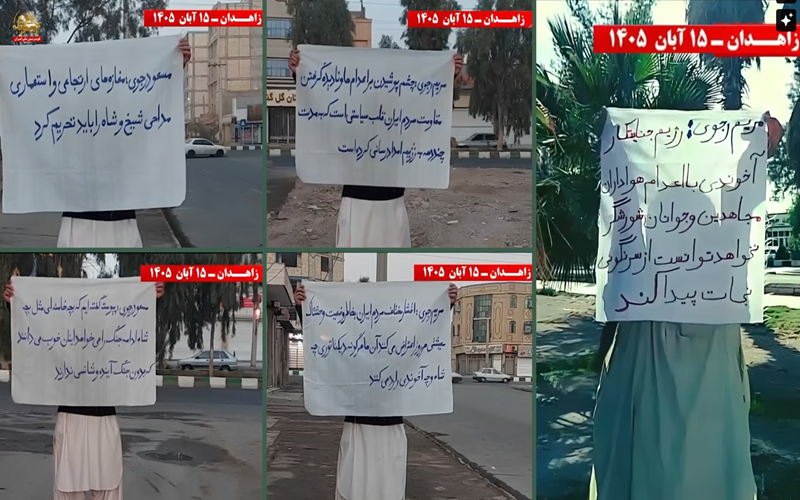

Resistance activities in Zahedan denounce the execution of political prisoners, call for continued uprising, and reaffirm the demand for a democratic republic. Commemorative actions in Tehran, Isfahan, and Shahin Shahr also honor executed uprising protesters Amirhossein Ebrahimi and Amirhossein Maleki.
Resistance youth in Zahedan have carried out a new series of activities condemning the Iranian regime’s executions of political prisoners and its suppression of dissent, reaffirming their determination to resist dictatorship and continue the struggle for freedom and democracy.
Through messages, slogans, and public displays, the young activists emphasized that the response to executions and repression must be continued resistance and uprising rather than fear or accommodation. Their activities also highlighted the principle of “No to Shah, No to Mullahs,” rejecting both the former monarchy and the current religious dictatorship as incompatible with the Iranian people’s aspirations for freedom.
The messages reflected statements by Massoud Rajavi and Maryam Rajavi, emphasizing the need to confront executions, sustain organized resistance, and establish a democratic republic based on the sovereignty of the people.
Resistance against executions and political repression
Messages attributed to Massoud Rajavi stressed that the appropriate response to executions and repression was continued uprising and perseverance, not surrender or fear.
He also underscored the importance of drawing a clear distinction from both monarchical and religious dictatorship, warning against attempts to revive authoritarian political models under either royalist or clerical banners. The principle of “No to Shah, No to Mullahs” was presented as a fundamental political boundary in the struggle for a free Iran.
The messages further rejected slogans associated with both the former monarchy and the ruling establishment, stressing that Iran’s future must not be shaped by either form of authoritarian rule.
Maryam Rajavi’s statements, also highlighted in the activities, condemned the execution of PMOI supporters and rebellious youth, stressing that such executions would not save the regime from its eventual overthrow. She described those executed or facing death sentences as people who refused to accept the continued subjugation of the Iranian population.
She also emphasized that international silence toward executions and disregard for the Iranian people’s resistance have helped sustain the regime’s repression over the years.
According to her statements, the solution to Iran’s crisis lies in the overthrow of the current regime through a democratic revolution led by the Iranian people and their organized resistance.
Organized uprising and the rejection of all forms of dictatorship
Another central theme of the Zahedan activities was the importance of organized resistance. Maryam Rajavi stressed that superficial displays of public support could not counter an organized uprising, calling on the international community to recognize the Iranian people’s struggle for regime change and the confrontation between rebellious youth and the Islamic Revolutionary Guard Corps (IRGC).
Her statements also emphasized that Iranians rising against the current dictatorship reject every form of authoritarian rule, whether under a crown or a clerical turban.
The slogans displayed by the resistance youth in Zahedan made this position explicit:
- “Dictatorship is dictatorship, whether wearing a turban or a crown.”
- “Monarchy and theocracy: a century of crimes.”
- “We want neither the Shah nor the mullahs. Down with dictators!”
- “From Zahedan to Tehran, death to the oppressor, whether Shah or supreme leader.”
These messages underscored the activists’ insistence that the struggle for freedom must lead to a democratic republic rather than the restoration of another dictatorship.
Commemorating executed protesters in Tehran, Isfahan, and Shahin Shahr
In a related series of activities, resistance supporters in Tehran, Isfahan, and Shahin Shahr commemorated Amirhossein Ebrahimi and Amirhossein Maleki, two prisoners arrested in connection with the December uprising who were executed by the Iranian regime in Isfahan’s Dastgerd Prison.
The commemorative actions included distributing leaflets and displaying photographs of the two executed protesters. The messages recalled Maryam Rajavi’s condemnation of their executions and her warning that the regime’s repeated executions of PMOI supporters and courageous rebellious youth would only strengthen the determination of younger generations to continue resisting.
One of the messages highlighted in the commemorations declared that the executions would not deter the struggle but would further reinforce the resolve of rebellious youth.
The campaign also carried the message: “No to executions, no to oppression,” directly connecting the fate of Ebrahimi and Maleki to the broader campaign against the regime’s use of capital punishment to intimidate society and prevent renewed protests.
A common message: No to Shah, No to Mullahs
The activities in Zahedan and the commemorations in Tehran, Isfahan, and Shahin Shahr conveyed a common political message: executions and repression will not erase the demand for freedom, and opposition to the current regime does not mean accepting the return of monarchy.
By combining condemnation of political executions with the rejection of both religious and royalist dictatorship, the resistance youth reiterated their demand for a democratic republic and the right of the Iranian people to determine their own future.
The message of “No to Shah, No to Mullahs” remains central to these activities, reflecting the stated objective of ending dictatorship in all its forms and establishing a free and democratic Iran.