


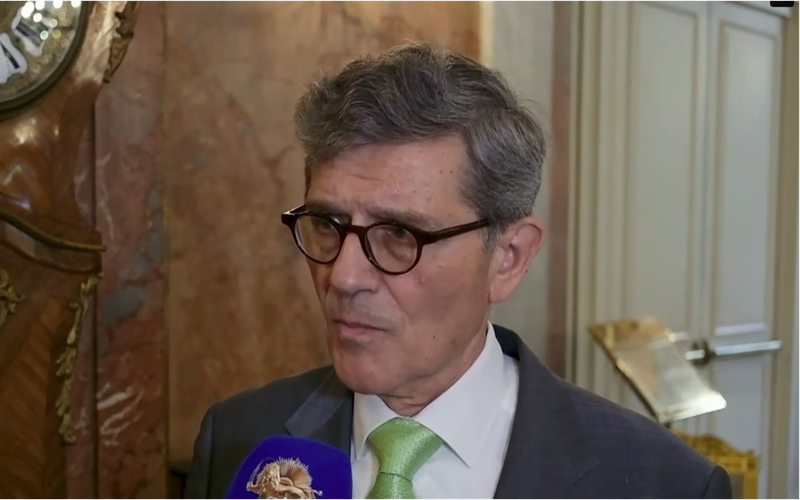

Speaking alongside an international conference on Iran’s future, former German diplomat Hans-Ulrich Seidt argued that the regime’s increasing repression signals weakness and urged Europe to support Iran’s democratic opposition instead of pursuing war or appeasement.
Former German Diplomat Links Rising Executions to Regime Insecurity
As international concern grows over the Iranian regime’s escalating human rights violations, former German ambassador Hans-Ulrich Seidt said the recent surge in executions reflects a government struggling to preserve its grip on power rather than one acting from a position of strength.
Speaking on the sidelines of an international conference in Rome, Seidt argued that Tehran’s intensifying repression—including the sharp increase in executions of political prisoners and protesters—should be understood as evidence of the regime’s growing internal vulnerability.
According to the former diplomat, authoritarian governments typically resort to harsher repression when they perceive themselves to be under increasing pressure, making the current wave of executions an indication of political insecurity rather than confidence.
Looking Beyond War Toward a Democratic Future
Reflecting on the conference’s central message, Seidt said discussions focused not only on the current regional conflict but also on the long-term future of Iran.
He emphasized that international policymakers should look beyond the immediate military crisis and instead consider the prospects for a democratic and free Iran. In that context, he argued that meaningful international engagement requires support for Iran’s democratic opposition, particularly the National Council of Resistance of Iran (NCRI), which he described as a long-standing movement advocating democratic change.
Human Rights and Political Change Are Closely Connected
Seidt argued that Iran’s deteriorating human rights situation cannot be separated from the broader question of political transformation.
In his assessment, the regime’s increasing reliance on executions, arbitrary repression, and intimidation reflects concern over mounting domestic challenges. As pressure inside the country grows, authorities have expanded the use of coercive measures in an effort to deter dissent.
He maintained that protecting human rights in Iran ultimately requires addressing the political structures responsible for systematic repression.
Europe Should Reject Both War and Appeasement
Addressing European policy toward Iran, Seidt argued that governments should move beyond what he described as the false choice between military confrontation and continued appeasement.
Instead, he called for a third approach centered on active political support for Iran’s democratic opposition inside the country.
He also referred to proposals presented during the Rome conference by former Belgian Prime Minister Guy Verhofstadt, which focused on ways the European Union could strengthen its engagement with democratic Iranian opposition forces.
According to Seidt, a more constructive European policy would involve recognizing and supporting those who have consistently campaigned for democratic change rather than searching for externally promoted alternatives.
Rejecting Externally Manufactured Alternatives
Seidt also cautioned against efforts to present figures outside Iran’s organized democratic opposition as viable alternatives to the current regime.
He argued that sustainable political change must be rooted in genuine domestic opposition movements with a long history of advocating democracy and freedom. Promoting alternatives that lack such foundations, he suggested, risks complicating prospects for a peaceful democratic transition.
A Message of Support to the Iranian People
Concluding his remarks, Seidt expressed admiration for Iranians who continue to struggle for freedom despite severe repression.
He said the sacrifices made by activists, political prisoners, and ordinary citizens seeking democratic change are meaningful and contribute to the country’s future. Stressing that their efforts are directed toward securing freedom for future generations, he praised those who continue to pursue democracy despite the personal risks involved.
His remarks echoed a broader theme that emerged from the Rome conference: that lasting stability in Iran depends not on war or accommodation with the ruling establishment, but on supporting the Iranian people’s aspirations for democracy, human rights, and political freedom.