


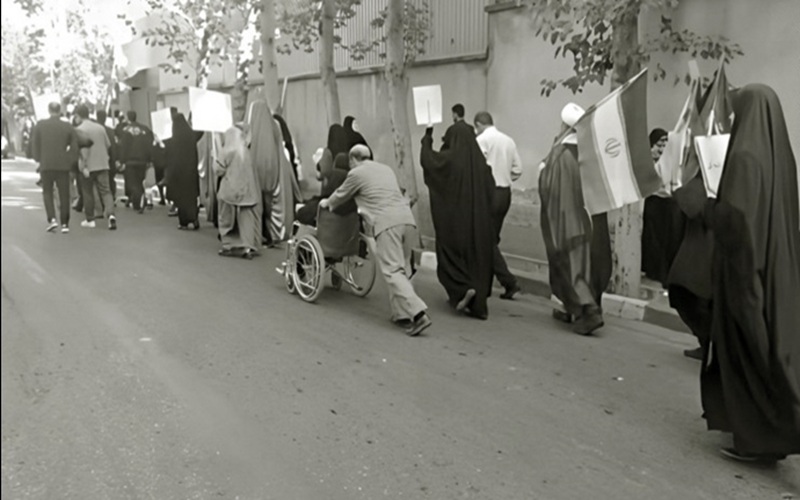

Diplomatic isolation, restrictions on regional access, and mounting pressure on the IRGC are exposing the vulnerabilities behind the Iran regime’s decades-long strategy of projecting power beyond its borders.
For decades, Iran’s regime has presented its intervention beyond the country’s borders as a matter of national security. From the doctrine of exporting the revolution to the creation of an extensive network of armed proxies, the regime has invested heavily in building what its leaders have described as “strategic depth.”
But that strategy is increasingly facing pressure.
The severing of diplomatic relations by Colombia, the designation of the Islamic Revolutionary Guard Corps (IRGC) as a terrorist organization by the Colombian government, restrictions affecting Iranian aviation, and mounting international scrutiny of the regime’s regional activities are not merely separate diplomatic developments.
Taken together, they raise a larger question: what happens to a regime when the external networks it built as instruments of power and survival increasingly become sources of diplomatic, security, and economic vulnerability?
Strategic Depth Was Never Just Foreign Policy
The regime’s regional strategy did not emerge simply from conventional foreign-policy calculations.
From the beginning of the clerical dictatorship, Ruhollah Khomeini promoted the idea of exporting his revolution. Under Ali Khamenei, the policy evolved into a far-reaching system of military and political influence extending through Iraq, Syria, Lebanon, Yemen, and elsewhere.
The regime’s argument was that confronting perceived threats outside Iran was necessary to prevent them from reaching the country’s borders.
This logic was repeatedly used to justify the expansion of the IRGC’s role, the deployment of forces abroad, support for armed groups, missile development, and the creation of networks of influence across the region.
In practice, however, this strategy also created an external security architecture for a regime facing profound internal opposition.
The more the regime invested in regional power projection, the more its survival became tied to maintaining access to territory, partners, armed networks, diplomatic relationships, and logistical routes beyond Iran.
That dependency is now becoming increasingly visible.
When the External Shield Starts to Contract
The reported decision by Colombia to sever diplomatic relations with Iran on September 19 represents one example of the changing environment.
According to Colombia’s stated rationale, the decision involved concerns including human-rights violations, attacks beyond the Middle East conflict zone, national and regional security concerns, restrictions involving the Strait of Hormuz, and problems surrounding international verification of Iran’s nuclear activities.
Colombia also separately designated the IRGC as a terrorist organization, describing it as a serious threat to international peace and security.
Regardless of how Tehran responds diplomatically, the significance of such measures goes beyond the relationship between two governments.
The IRGC is not an ordinary institution of the Iranian state. It is one of the central pillars of the regime’s political, military, economic, and regional power structure.
Consequently, international measures targeting the IRGC can affect an important component of the regime’s external power projection.
Pressure Is Reaching the Regime’s Lines of Communication
The pressure also extends beyond diplomatic relations. Restrictions on Iranian aviation and access to regional airspace have created additional obstacles for a system that has depended heavily on regional connectivity.
Reports included the refusal by Turkmenistan to permit an Iranian flight traveling from Tehran toward Dushanbe to cross its airspace, forcing the aircraft to return to Tehran. Iranian flights have also faced suspensions or restrictions involving airports in Iraq, while the United Arab Emirates has suspended Iranian airline operations to and from the country.
These measures matter because regional connectivity is not merely a commercial issue for Tehran.
For a regime whose regional strategy depends on maintaining relationships and logistical links across neighboring countries, restrictions on transportation and access can impose additional costs on an already heavily pressured system.
The issue, therefore, is not whether any single aviation restriction will fundamentally change the regime’s behavior.
It is whether the cumulative contraction of the regime’s operating space makes its traditional model of regional influence increasingly expensive and difficult to sustain.
The Foreign Policy and Domestic Repression Are Connected
This is the central analytical point. The regime’s external activities cannot be completely separated from its domestic system of rule.
Inside Iran, the regime has relied on the IRGC, Basij, police, intelligence agencies, imprisonment, executions, and other coercive mechanisms to suppress political opposition.
Outside Iran, the same governing structure has invested in military and political networks designed to project influence and deter threats.
These are different instruments, but they serve a common strategic objective: preserving the ruling system.
This helps explain why the regime has continued to invest resources in regional power projection despite severe economic problems at home.
For Tehran, the question has never simply been whether regional intervention produces an economic return.
It has been whether external influence strengthens the regime’s ability to survive.
Why Losing External Space Matters
A regime with strong domestic legitimacy can normally afford to treat foreign-policy setbacks as conventional diplomatic problems.
A regime confronting sustained domestic opposition has a different calculation.
External alliances, proxy networks, military capabilities, and diplomatic relationships can provide additional leverage. They can create deterrence, shift confrontation away from Iran’s borders, and give the leadership tools for managing threats.
The erosion of those instruments can therefore have consequences beyond foreign policy.
If diplomatic relationships become more difficult, regional access becomes more restricted, and the IRGC faces increasing international isolation, Tehran has fewer opportunities to use its external network as a strategic buffer.
That does not automatically translate into political change inside Iran.
But it can expose a structural vulnerability: the regime has built part of its survival strategy around an external environment that it can no longer assume will remain available on the same terms.
From “Strategic Depth” to Strategic Exposure
For years, the regime’s regional network was presented as evidence of its strength.
Today, the same network increasingly carries another dimension.
Its expansion has generated international scrutiny, sanctions, terrorist designations, diplomatic confrontation, and restrictions on the regime’s regional operating environment.
In other words, the architecture Tehran built to extend its power beyond Iran can also provide international governments with additional points at which to constrain that power.
This creates a strategic paradox.
The regime expanded abroad because it regarded regional influence as essential to its survival. Yet the very policies used to establish that influence have contributed to the international pressure now surrounding the regime.
The result is not necessarily the immediate collapse of its regional networks. Rather, it is a gradual narrowing of the space in which those networks can operate freely.
The Strategic Problem Facing Tehran
The deeper problem for the regime is that external pressure is arriving while its domestic vulnerabilities remain unresolved.
Economic hardship, inflation, social discontent, political repression, and recurring protests cannot be permanently solved through foreign-policy maneuvering.
Nor can regional influence substitute for domestic legitimacy.
The regime’s decades-long strategy effectively attempted to compensate for its internal vulnerability by building power outside Iran.
That strategy is now facing a more restrictive international environment.
As diplomatic relationships deteriorate, access becomes more difficult, and the IRGC comes under greater international scrutiny, Tehran is confronted with a problem it has repeatedly attempted to avoid: the central threat to its survival is ultimately inside Iran, while some of the external mechanisms it built to manage that threat are becoming increasingly constrained.
For the Iranian people and the organized resistance to the regime, this distinction is crucial.
The question is not simply how much regional influence Tehran retains.
It is whether a system that has relied on repression at home and power projection abroad can continue indefinitely when both its domestic legitimacy and its external operating space are under increasing pressure.
That is the strategic vulnerability now emerging behind the regime’s foreign-policy posture.