


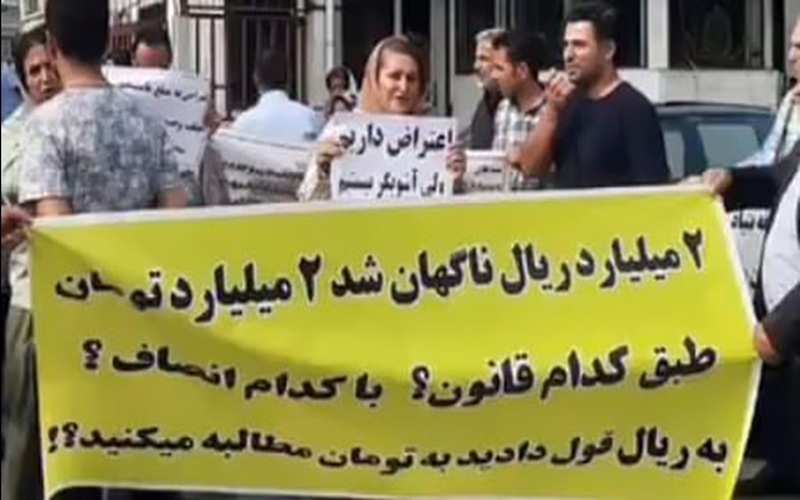

Repeated warnings from Iran’s security establishment reveal growing concern that economic grievances, social tensions, and public anger could turn into a new wave of nationwide unrest.
A series of increasingly alarmed warnings from Iran’s security and military officials is exposing the regime’s deep concern about the situation inside the country. Rather than projecting confidence in its ability to control society, senior officials are repeatedly warning that a seemingly minor incident could trigger a much larger confrontation.
The language is striking. Former police commander Esmail Ahmadi-Moghaddam recently warned the regime’s intelligence, Basij, Islamic Revolutionary Guard Corps (IRGC), and police forces to remain vigilant because adversaries could turn “every spark” into a “flame” and set parts of the country alight. He also stressed that officials, politicians, and media figures must avoid sending any signal of weakness or internal disagreement.
The warning points to a central vulnerability for the regime: its ability to maintain control increasingly depends not only on repression, but also on preventing the population from seeing divisions or weakness within the ruling establishment.
A Regime Afraid of Its Own Society
Ahmadi-Moghaddam described the current period as exceptionally sensitive and called for political, economic, and social measures to help the regime navigate it.
His most revealing warning concerned the possibility that isolated incidents could develop into a broader movement. He called on the regime’s security institutions to coordinate closely and prevent any “spark” from becoming a “flame.”
The former police commander also emphasized the importance of avoiding public displays of disagreement.
That concern is significant. In a system that relies heavily on its security apparatus to contain dissent, an open perception of division among officials can itself become a political liability. The regime is therefore attempting to project unity precisely when its officials are publicly acknowledging serious internal pressures.
A recent analysis by the National Council of Resistance of Iran noted that the same interview linked the security concerns to worsening economic conditions, including severe pressure on oil exports, shortages of strategic goods, and energy problems.
Internal Threats Seen as More Dangerous Than Foreign Ones
The concern is not limited to security officials.
On September 20, regime-aligned analyst Bijan Abdolkarimi told a gathering of regime supporters that he feared internal problems more than foreign threats. He specifically pointed to two major fractures within Iranian society: a cultural divide and a huge class gap.
His remarks went further. Referring to the January protests, Abdolkarimi acknowledged that protesters included people from economically deprived sections of society and rejected the idea that they could all simply be dismissed as PMOI members or foreign agents.
He warned that if people became tired, “dangers” would once again surround the country.
The significance of such remarks lies in their source. These are not opposition figures describing the regime’s vulnerabilities. They are comments emerging from within the regime’s own political and ideological environment.
That makes the repeated warnings particularly revealing.
From Economic Grievances to Political Confrontation
The regime’s fear is also rooted in the deteriorating economic environment.
On September 26, the Central Bank governor acknowledged that point-to-point inflation remained at 83.8 percent, while monthly inflation stood at 3.9 percent. The same day, a survey published by the regime-aligned Donyaye Eghtesad found that economists and business figures expected exceptionally high inflation under several scenarios.
These pressures are increasingly difficult to separate from the regime’s security concerns.
A regime-aligned social researcher recently acknowledged that the initial “spark” of the January unrest was economic and related to livelihoods, before the protests became explicitly political. The same analysis warned that a system focused only on identifying defenders can be surprised by protesters.
This is precisely the dynamic that worries the security establishment: an economic grievance does not necessarily remain an economic grievance.
A shortage, price increase, unpaid wage, fuel crisis, or other local grievance can provide the initial trigger. Once people take to the streets, however, the confrontation can quickly become political.
The Security Apparatus Is Being Mobilized Against a Social Threat
The regime’s response reflects this fear.
Ahmadi-Moghaddam called for the intelligence ministry, Basij, IRGC, and police to remain on high alert. Other officials have similarly framed economic, social, cultural, and political developments as components of a broader security threat.
On September 26, IRGC Ground Forces commander Mohammad Karami described the situation as an “all-out hybrid war” encompassing economic, social, cultural, political, security, military, and cognitive dimensions. At the same time, regime officials have increasingly treated issues ranging from compulsory hijab to university unrest as matters of national security.
The breadth of this security framework is itself revealing.
When a regime begins treating ordinary social behavior, economic grievances, university dissent, and criticism as interconnected security threats, it indicates how broadly the leadership perceives the potential sources of instability.
Fear of Weakness Is Becoming a Weakness in Itself
The repeated insistence that officials must not transmit “signals of weakness” points to another problem facing the regime.
The leadership understands that public perceptions matter.
If the population believes that the ruling establishment is divided, economically incapable, or unable to maintain control, fear can begin shifting from society toward the authorities themselves. That is why the regime is attempting to suppress not only dissent but also visible disagreements within its own ranks.
The warning about “every spark” becoming a “flame” captures this dilemma.
The regime can suppress individual incidents, but it cannot easily eliminate the economic and social conditions producing them. Nor can it guarantee that the next protest will remain isolated.
A Regime Increasingly Focused on Preventing the Next Uprising
The pattern of official statements therefore points to a regime operating under persistent internal pressure.
Its security officials are warning against any appearance of weakness. Its ideological figures are acknowledging deep social and economic divisions. Its economic institutions are reporting extraordinary inflationary pressure. Its security apparatus is being instructed to monitor an increasingly broad range of social activity.
Taken together, these developments reveal a government deeply concerned about what could happen if accumulated grievances find a common point of ignition.
The regime’s own language is increasingly centered on sparks, flames, vigilance, weakness, internal divisions, and the danger of renewed unrest.
That language is important because it exposes the limits of the regime’s claim to stability. Its principal concern is no longer merely managing individual protests. It is preventing the convergence of widespread economic hardship, social discontent, and political opposition into a force that its security apparatus may find increasingly difficult to contain.