



A Crowned Revisionist
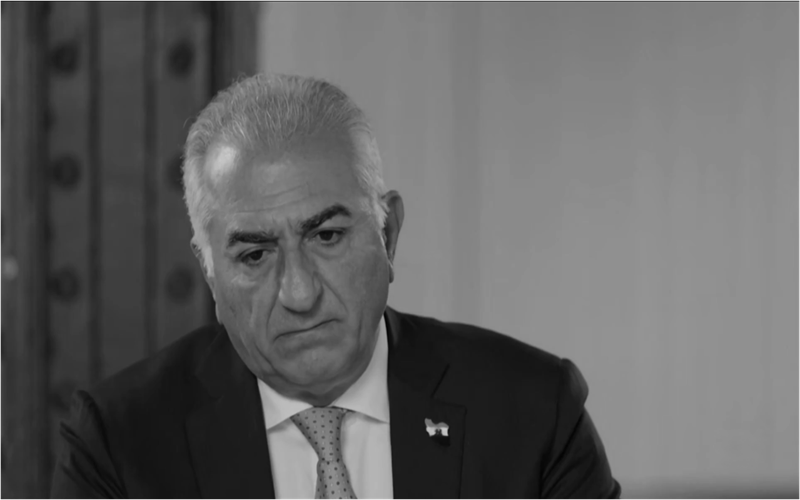
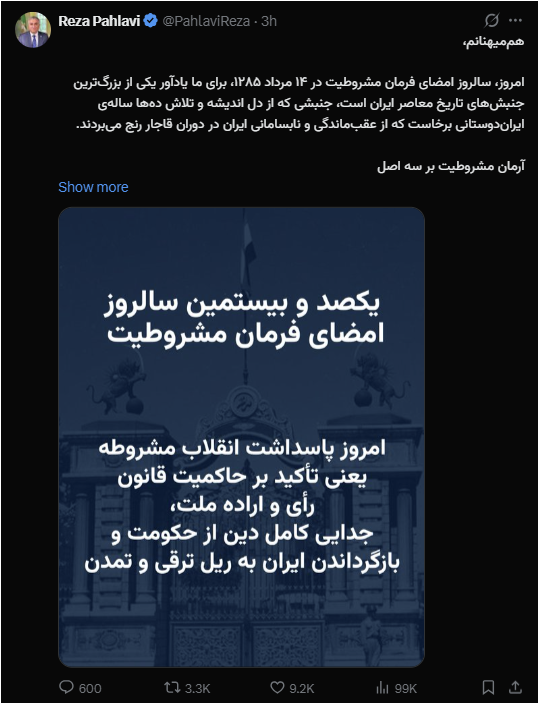
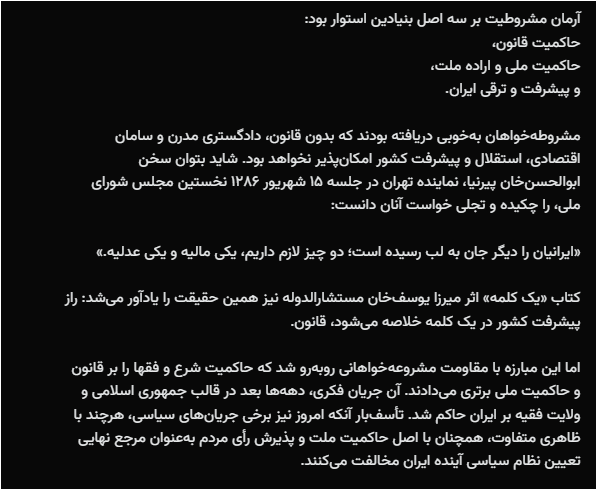
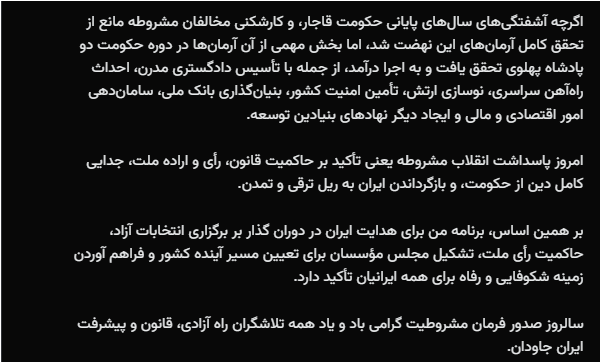
In a recent post on X marking the anniversary of the 1906 Constitutional Decree, Reza Pahlavi, the self-styled crown prince of Iran’s defunct monarchy, claimed that “a large part of [the Constitutionalists’] ideals were realized and implemented during the rule of the two Pahlavi kings.” He praised his grandfather, Reza Shah Pahlavi (r. 1925–1941), and his father, Mohammad Reza Shah Pahlavi (r. 1941–1979), as executors of constitutionalism, modern justice, and national sovereignty.
The historical record tells a different story. Far from upholding the 1906 Constitution, both Pahlavi monarchs systematically violated its text, subverted its institutions, and crushed the very movements that sought to realize its promises. What Reza Pahlavi now celebrates as “achievements” were, in fact, the spoils of authoritarian rule—built on coups, constitutional amendments engineered for dynastic power, and the suppression of parliament, press, and political dissent.
The 1906 Constitutional Decree: What It Actually Required
The 1906–1907 constitutional framework was Iran’s first serious attempt to limit monarchical absolutism and establish a rule-of-law state. Key provisions included:
- Obligation of the Shah to uphold the constitution (Article 51 of the Fundamental Law).
- Establishment of an elected parliament (Majles) with legislative authority and cabinet accountability.
- Guarantees of civil liberties, including freedom of the press and freedom of association (subject to religious constraints in the 1907 Supplement).
- Judicial independence, with judges protected from arbitrary dismissal (Articles 81–82 of the 1907 Supplement).
The constitution was not a decorative document. It was a contract between the monarchy and the nation—one that both Pahlavi rulers repeatedly broke.
Reza Shah Pahlavi (1925–1941): The Constitutional Usurper
1. The 1925 Transfer of Power: A Constitutional Coup
Reza Shah did not inherit the throne through constitutional succession. He seized it.
- In 1925, a constituent assembly—convened under questionable legality—deposed Ahmad Shah Qajar and amended Articles 36–38 of the 1906 Constitution to install Reza Pahlavi as Shah and make the throne hereditary in his family.
- A 2025 legal-historical study concludes this transfer “contradicted constitutional principles” and was achieved through a “semi-authoritarian process with minimal popular participation.”
- Another analysis notes that Reza Khan, commander of the Persian Cossack Brigade, staged a coup in 1921 and subsequently induced the parliament to unconstitutionally proclaim itself a constituent assembly.
This was not constitutional continuity. It was constitutional rupture.
2. The 1931 Judicial Violation: Undermining Judicial Independence
The 1907 Supplement guaranteed judicial independence. Reza Shah dismantled it.
- In 1931, on Reza Shah’s order, Articles 81 and 82 of the Supplement were reinterpreted to allow judges to be more easily displaced or dismissed, eroding the constitutional guarantee of judicial independence.
- A 2025 peer-reviewed study in The Quarterly Journal of Public Law Research concludes that under Reza Shah, “both the text and spirit of the Constitution were systematically distorted to serve an authoritarian will,” and that the interpretations of 1931 and 1938 were “undeniably clear violations of the Constitution.”
3. The 1938 Succession Manipulation: Dynastic Convenience Over Constitutional Text
Reza Shah did not respect the constitution’s succession rules when they conflicted with his family’s interests.
- In 1938, Article 37 (which regulated the crown prince’s mother’s origin) was reinterpreted to allow Reza Shah’s Egyptian daughter-in-law’s children to be eligible for succession—via interpretation, not formal amendment.
- This was constitutional engineering to serve dynastic needs, not constitutional fidelity.
4. Authoritarian Governance: Parliament as Rubber Stamp, Press as Muzzle
Reza Shah’s rule was characterized by the systematic sidelining of constitutional institutions:
- He “increasingly relied on strong-arm tactics, which stood in violation of the Constitution—which he increasingly sidelined—and suggested that rather than a constitutional government, his regime was based on arbitrary rule.”
- He banned political parties, suppressed revolts, curtailed the power of the clergy, and turned parliament into a rubber stamp.
- The free press was suppressed, and political leaders like Mohammad Mosaddeq were incarcerated, while others were murdered or driven to suicide.
- Trade unions were banned, and 150 labor organizers were arrested between 1927 and 1932.
This is not the record of a constitutional monarch. It is the record of a dictator who used the constitution as a facade.
Mohammad Reza Shah Pahlavi (1941–1979): The Constitutional Autocrat
1. The 1949 Constitutional Amendment: Power to Dissolve Parliament
In 1949, Mohammad Reza Shah engineered a constitutional amendment that fundamentally altered the balance of power:
-
Article 48 was amended to give the Shah the right to dissolve both houses of parliament (Majles and Senate), provided he called new elections within three months.
-
This turned the legislature—the central institution of constitutionalism—into a body the monarch could unilaterally dismiss.
-
The amendment was passed by a constituent assembly convened at the Shah’s behest, following an attempted assassination that he used to declare martial law and suppress opposition.
2. The 1953 Coup: Overthrowing Constitutional Government
The most infamous anti-constitutional act of Mohammad Reza Shah’s reign was the 1953 coup against Prime Minister Mohammad Mosaddeq:
- In August 1953, the Shah collaborated with British and American intelligence to overthrow Mosaddeq, an act described as having “undermined the Constitution, smashed democracy, and destroyed all civil liberties.”
- The coup was triggered by Mosaddeq’s referendum to dissolve parliament—a move that gave him near-dictatorial powers, but which was itself a response to parliamentary obstruction of his nationalization agenda.
- The immediate consequence of the coup was the Shah’s suppression of all republicanist political dissent, especially the liberal and nationalist opposition umbrella group National Front as well as the communist Tudeh Party, and concentration of political power in the Shah and his courtiers.
- Between 1953 and 1958, the Shah outlawed the National Front, arrested most of its leaders, and oversaw the execution, torture, and life imprisonment of thousands of political activists.
3. Post-1953 Dictatorship: Martial Law, Censorship, and Terror
After the coup, Mohammad Reza Shah ruled as an autocrat:
- The autocracy of his rule was amplified after the 1953 coup, in which the United States and the United Kingdom helped restore him to power after a two-year standoff with the Majles forced him to flee the country.
- He enacted martial law that continued through 1953, and his lieutenants began executing hundreds of citizens including members of Parliament, bankers, government employees, and landowners.
- Free press, workers’ rights, and political expression were restricted and limited under both Pahlavi shahs.
- During the early 1960s, the Shah suspended parliament and launched the White Revolution—an aggressive westernization program that bypassed democratic institutions.
4. The 1967 Constitutional Changes: Entrenching Dynastic Power
In 1967, further constitutional changes entrenched the Pahlavi dynasty:
-
Articles 38, 41, and 42 of the Supplement were changed to clarify and expand the role of the crown prince’s mother as regent, further consolidating dynastic control.
The Pahlavi “Achievements”: Modernization Without Constitutionalism
Reza Pahlavi’s post lists a series of “achievements” under the Pahlavis:
“The establishment of a modern judiciary, construction of the transnational railway, modernization of the army, securing the country’s safety, founding of the National Bank, organization of economic and financial affairs, and creation of other fundamental development institutions.”
- Reza Shah was selective on what forms of modernization and secularization he would adopt. He banned trade unions and political parties and firmly muzzled the press.
- Parliament became a rubber stamp, the press was censored, and the Communist Party and trade unions were banned.
- During that time two monarchs—Reza Shah Pahlavi and his son Mohammad Reza Shah Pahlavi—employed secret police, torture, and executions to stifle political dissent.
Modernization without constitutionalism is not progress. It is development under dictatorship.
A Crown Without a Conscience
Reza Pahlavi’s X post is not a tribute to constitutionalism. It is a revisionist manifesto—a attempt to rewrite his family’s authoritarian legacy as a constitutional one. The facts are clear:
- Reza Shah seized power through a constitutional coup, violated judicial independence, manipulated succession rules, and ruled through arbitrary decrees.
- Mohammad Reza Shah amended the constitution to dissolve parliament, orchestrated a coup against an elected government, and ruled through martial law, censorship, and terror.
- Both monarchs suppressed political parties, banned trade unions, muzzled the press, and turned parliament into a rubber stamp.
These are not the actions of constitutional monarchs. They are the actions of autocrats who used the constitution as a tool when convenient and discarded it when not.
Reza Pahlavi’s claim that his father and grandfather “realized and implemented” the ideals of the 1906 Constitutional Decree is not just inaccurate. It is a deliberate distortion of history—one that steals the legacy of Iran’s constitutionalists and crowns it on the heads of those who crushed them.
References
- “Democracy or State-Building? 1906–1941,” Oxford Academic.
- “The Fate of the Constitution in the First Pahlavi Period,” Quarterly Journal of Public Law, 2025.
- “Reza Shah,” Wikipedia.
- “Persian Constitution of 1906,” Wikipedia.
- “Constitutional Revolution iii. The Constitution,” Encyclopædia Iranica.
- “1953 Iranian coup d’état,” Wikipedia.
- “1949 Iranian Constituent Assembly election,” Wikipedia.
- “Pahlavi dynasty,” Britannica.
- “Human rights in Pahlavi Iran,” Wikipedia.
- “Monarchism in Iran,” Wikipedia.
- “Celebrating The Constitutional Revolution Of 1905-1911 And The Constitution Of 1906,” IranScope.
- “On the Unconstitutionality of Iran’s Current Constitution,” Lawfare.
This article is based on publicly available historical sources and academic research. All claims are documented and verifiable.