


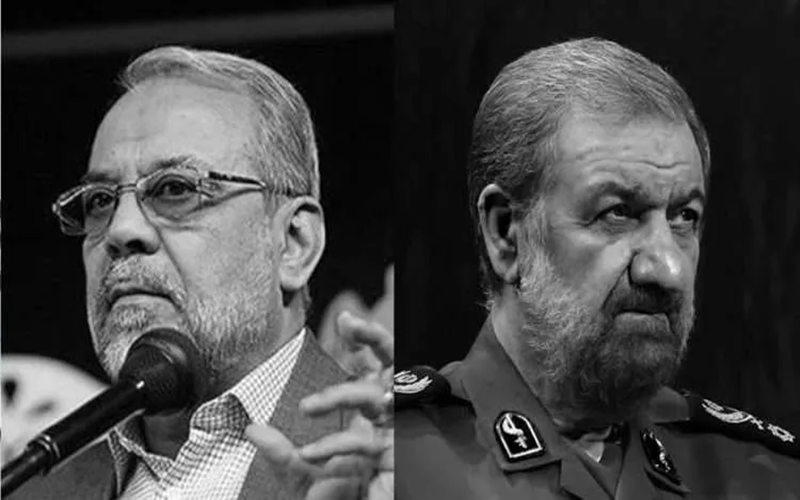

The abrupt replacement of Mohammad Bagher Zolghadr by IRGC commander Mohsen Rezaei has exposed deepening tensions between the presidency and the emerging power structure around Mojtaba Khamenei.
The abrupt replacement of Mohammad Bagher Zolghadr by Mohsen Rezaei as secretary of Iran’s Supreme National Security Council has exposed growing tensions at the highest levels of the regime and highlighted its increasing reliance on the Islamic Revolutionary Guard Corps (IRGC) to manage mounting political and security crises.
The appointment came after several days of conflicting reports, denials, and unexplained reversals concerning Zolghadr’s position. The contradictory accounts have fueled speculation that the change was not a routine administrative decision but the outcome of a power struggle between President Masoud Pezeshkian and the emerging power structure surrounding Supreme Leader Mojtaba Khamenei.
According to reports published inside Iran on Sunday, August 9, an order attributed to Mojtaba Khamenei appointed Rezaei as his representative on the Supreme National Security Council. Hours later, Pezeshkian formally appointed Rezaei as secretary of the council.
The sequence of events was significant. It suggested that the presidency was effectively compelled to accommodate a decision originating from the new leadership structure.
Contradictory accounts expose tensions at the top
The circumstances surrounding Zolghadr’s departure have been unusually confused.
Mojtaba Khamenei’s reported order praised Zolghadr for his “round-the-clock efforts” and separately appointed him as a political adviser. Meanwhile, Mehdi Tabatabaei, Pezeshkian’s deputy for communications and information, said Zolghadr had resigned from his position and that Pezeshkian had appointed Rezaei as his replacement.
But Pezeshkian himself had offered a markedly different indication the previous day.
Asked by reporters about Zolghadr’s departure, he said:
“There are some differences that we are trying to resolve.”
The statement was an unusual acknowledgment that disagreements existed at the highest levels of the regime’s security apparatus.
Adding to the confusion, the reformist-leaning newspaper Sazandegi reported, citing an informed source, that Zolghadr had not resigned. According to the report, Pezeshkian had asked him to continue working “with strength and power.”
The contradictory narratives raise a fundamental question: if Zolghadr voluntarily resigned, why was there a dispute over his continuation in office, and why did the announcement require several competing explanations?
The episode points to a regime struggling to maintain even the appearance of unified decision-making.
Mojtaba Khamenei’s influence reaches deeper into the security apparatus
The appointment of Rezaei is particularly significant because it places a veteran IRGC commander at the center of the regime’s highest security decision-making body.
Rezaei served as commander-in-chief of the IRGC during the Iran-Iraq War and subsequently spent years as secretary of the Expediency Discernment Council. He has also served as an adviser to Ali Khamenei.
Following Mojtaba Khamenei’s emergence as the regime’s new supreme leader, Rezaei was appointed as his military adviser. His new position at the Supreme National Security Council therefore represents a further consolidation of experienced IRGC figures around the new leadership.
The move also illustrates how quickly the regime’s security and political institutions are being reshaped following the transition in leadership.
Rather than broadening the political base of the new order, the latest appointment appears to reinforce the centrality of military and security figures.
From one IRGC veteran to another
Zolghadr himself was also a veteran IRGC commander. He served during the Iran-Iraq War and later became deputy commander of the IRGC. He subsequently held senior positions in the Interior Ministry and judiciary and served as a member and secretary of the Expediency Discernment Council.
He was appointed secretary of the Supreme National Security Council earlier this year following the killing of Ali Larijani in an attack near Tehran.
His replacement by another senior IRGC figure therefore does not represent a departure from the security establishment. Instead, it amounts to a further concentration of power among individuals with long-standing military and security backgrounds.
Before Zolghadr, the council had included figures such as Ali Larijani and Saeed Jalili as representatives of the previous supreme leader.
Rezaei’s appointment now places yet another veteran IRGC commander in a position with major influence over the regime’s security and strategic policies.
A struggle over who controls the security apparatus
The timing of the change is crucial.
The regime is confronting a combination of severe domestic pressures, external security challenges, economic deterioration, social discontent, and growing tensions within its own leadership structure. Against this backdrop, control over the Supreme National Security Council carries particular importance.
The conflicting reports surrounding Zolghadr suggest that Pezeshkian may have sought to retain him while the leadership around Mojtaba Khamenei favored a different arrangement.
Iran analysts have consequently described the episode as a major contest between Mojtaba Khamenei and Pezeshkian, with the president apparently attempting to preserve Zolghadr in his position before ultimately accepting Rezaei’s appointment.
If accurate, the episode illustrates the increasingly limited room for maneuver available to the presidency.
Pezeshkian may formally head the executive branch, but the latest developments indicate that the decisive weight in security and strategic matters remains concentrated in the hands of the supreme leadership and the military-security establishment.
A regime increasingly dependent on force
The significance of Rezaei’s appointment extends beyond an individual personnel change.
The return of a longtime IRGC commander to one of the regime’s most important strategic posts reflects a broader pattern: as political and social pressures intensify, the regime is increasingly relying on the institutions that have historically served as its principal instruments of coercion and control.
That dependence is also a sign of weakness.
A confident political system does not normally require increasingly opaque chains of authority, contradictory explanations, and the rapid repositioning of senior security officials to maintain control.
The confusion surrounding Zolghadr’s departure instead suggests that competing centers of power are struggling to define their respective authority.
The episode also highlights the unresolved question of how power is being distributed under Mojtaba Khamenei. The appointment of Rezaei—first as his representative and then as secretary of the Supreme National Security Council—suggests that the new leadership is moving rapidly to place trusted military-security figures in key positions.
Internal contradictions are becoming harder to conceal
The latest reshuffle comes at a time when the regime can ill afford visible divisions at the top.
Its leadership is facing mounting pressure from multiple directions, while popular discontent continues to challenge its political legitimacy. At the same time, the transition from Ali Khamenei to Mojtaba Khamenei has created new questions about the distribution of power among the presidency, the supreme leadership, the IRGC, and other centers of authority.
The Zolghadr-Rezaei episode has brought those tensions into the open.
What was initially presented as a personnel change quickly became a story of conflicting announcements, unexplained disagreements, and an apparent struggle over control of the regime’s security apparatus.
The appointment of Rezaei may temporarily settle the immediate dispute, but it does not resolve the underlying conflict.
On the contrary, it demonstrates that beneath the regime’s official claims of unity, power is increasingly contested at the very top—and the more the leadership turns to its military-security apparatus to manage these contradictions, the more clearly its underlying political weakness becomes visible.