


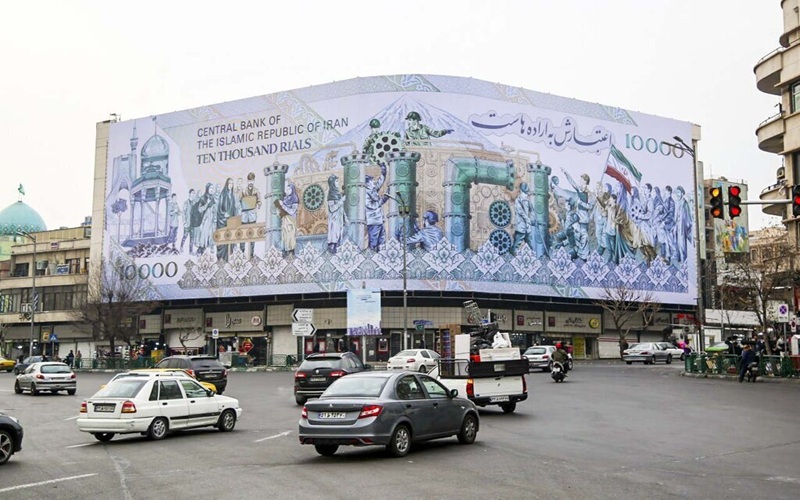

Official statistics show annual inflation reaching 66 percent, while the misery index approaches 96 percent and 19 provinces reportedly exceed the 100-percent threshold.
Iran’s economic crisis is entering a new and increasingly dangerous phase. Official statistics cited by Iranian economists show annual inflation reaching 66 percent, while inflation in some income groups and disadvantaged provinces has reportedly entered three-digit territory.
At the same time, unemployment is rising, productive activity is weakening, and household purchasing power continues to erode. The combination has pushed Iran’s so-called misery index—the combined rate of inflation and unemployment—to approximately 96 percent, according to data for Tir 1405 (July 2026).
The figures point to more than a conventional inflation crisis. They suggest an economy in which persistent price increases are increasingly interacting with unemployment, declining production, shrinking real incomes, and weakening social stability.
Economist Farshad Momeni, a regime-affiliated economist, warned on August 13 that Iran had entered what he described as a period of economic misery. Referring to the latest Statistical Center of Iran inflation report, he acknowledged that three-digit inflation had appeared among some income groups and in some disadvantaged provinces.
He also warned that high inflation has strongly anti-production and anti-employment effects, arguing that when inflation and unemployment converge, the country enters a “realm of misery.”
Inflation Reaches a Post-Revolution Record
The latest figures indicate that Iran’s inflation problem has moved well beyond the already elevated levels that have characterized the economy for years.
According to data cited from the Statistical Center of Iran, annual inflation rose by four percentage points to 66 percent. This represents the highest annual inflation rate recorded in the years following the 1979 revolution, according to the reports cited.
The trajectory is particularly significant because inflation had already reached 53.1 percent in 1401 (2022), then regarded as a post-revolution record.
Iran’s Annual Inflation Rate
| Year | Annual inflation |
|---|---|
| 1400 (2021–22) | 46.2% |
| 1401 (2022–23) | 53.1% |
| 1402 (2023–24) | 47.4% |
| 1403 (2024–25) | 35.8% |
| 1404 (2025–26) | 48.3% |
| Tir 1405 (July 2026) | 66% |
The average annual inflation rate between 1400 and 1404 was approximately 46 percent. This means that exceptionally high inflation has not been a temporary phenomenon but a persistent structural feature of Iran’s economy.
The latest increase nevertheless marks a new deterioration.
Inflation in Tir 1405 was also reported at 87.9 percent year-on-year, demonstrating the extraordinary speed at which consumer prices have been rising.
Three-Digit Inflation Appears in Vulnerable Areas
The most alarming aspect of the latest data is not simply the national average.
Momeni pointed to the Statistical Center’s report showing that inflation has reached three-digit levels in some income groups and disadvantaged provinces.
This distinction is critical. A national inflation figure already imposes enormous pressure on households, but inflation is not distributed evenly across society. Lower-income households typically devote a much larger proportion of their income to food, housing, transportation, healthcare, and other essential goods and services.
Consequently, when prices for necessities rise faster than the overall consumer basket, the effective inflation experienced by poorer households can be substantially higher than the national average.
The emergence of three-digit inflation among some income groups therefore signals an especially severe deterioration in living standards for vulnerable households.
The Misery Index Nears 100 Percent
The latest economic data also reveal the combined impact of inflation and unemployment.
The misery index is calculated by adding the inflation rate to the unemployment rate. While it is a relatively simple indicator and does not capture every dimension of economic hardship, it provides a useful measure of the combined pressure generated by rising prices and weak employment.
For Tir 1405, the figures cited in the report were:
| Indicator | Latest figure |
| Annual inflation | 66% |
| Point-to-point inflation | 87.9% |
| Unemployment, spring 1405 | 9.1% |
| Annual increase in unemployment | +1.8 percentage points |
| National misery index | ~96% |
| Provinces with misery index above 100% | 19 |
The unemployment rate reached 9.1 percent in spring 1405, an increase of 1.8 percentage points compared with the same period a year earlier.
Although unemployment is clearly contributing to the deterioration, inflation remains the dominant component of the misery index.
The situation is considerably worse in some provinces.
Misery Index in Selected Areas
| Area | Misery index |
| Tehran | 83.5% |
| Iran, national estimate | ~96% |
| Ilam | 120.6% |
| Provinces above 100% | 19 provinces |
The fact that 19 provinces reportedly crossed the 100-percent threshold demonstrates the uneven geographic distribution of economic hardship.
In Ilam, for example, the reported misery index reached 120.6 percent, dramatically higher than the national figure.
Inflation Is Becoming a Structural Economic Threat
Persistent inflation does more than raise household expenses. It distorts economic decision-making, discourages productive investment, reduces the real value of wages and savings, and creates incentives to move capital away from productive activities.
Momeni highlighted precisely this destructive effect, arguing that high inflation is both anti-development and anti-production, while strengthening economic mafias and oligarchic interests.
When prices become unpredictable, businesses have increasing difficulty determining their future costs. Investment decisions become riskier, long-term contracts become harder to negotiate, and companies may prioritize survival and asset preservation over expansion and employment.
The result can become a vicious cycle:
Inflation → falling real incomes → weaker consumption → declining production → reduced employment → greater economic insecurity → stronger inflationary expectations.
Chronic Budget Deficits and Banking Imbalances
Several structural weaknesses contribute to the inflationary environment.
The regime’s chronic budget deficits are one of the most important. Rising government expenditures—including wages, subsidies, pension obligations, and other current spending—continue to place pressure on public finances while sustainable sources of government revenue remain constrained.
At the same time, the banking system suffers from significant imbalances. Rapid liquidity growth without a corresponding expansion in productive output increases the amount of money circulating relative to available goods and services.
When monetary expansion outpaces production, the resulting gap creates additional upward pressure on prices.
This is particularly damaging when financial resources are diverted away from productive investment and toward speculative activities or the financing of government deficits.
Currency Shocks and Sanctions Intensify the Pressure
Exchange-rate instability is another major transmission mechanism for inflation.
Iranian producers remain dependent on imported raw materials, machinery, components, intermediate goods, and technology. Consequently, a depreciation of the national currency does not only make imported consumer goods more expensive; it also raises the production costs of domestic companies.
Sanctions can compound these pressures by increasing the cost of international trade, restricting access to financial resources, reducing foreign investment, and limiting the country’s ability to earn and transfer foreign currency.
The result is an economy vulnerable to repeated currency and price shocks.
If these pressures persist, further increases in inflation are likely to intensify the already severe pressure on household budgets.
Households Are Abandoning Cash
Persistent inflation also changes how households and businesses manage their savings.
As confidence in the purchasing power of the national currency declines, people tend to convert cash into assets perceived as stores of value, including gold, foreign currency, housing, and durable goods.
This behavior can itself reinforce inflationary expectations.
Businesses may also begin setting prices according not to their current production costs, but to the expected future cost of replacing raw materials and inventory. In a high-inflation environment, this creates a feedback loop in which expectations of higher prices contribute to actual higher prices.
The economy consequently becomes increasingly difficult to stabilize.
The Official Unemployment Rate Does Not Tell the Whole Story
The 9.1-percent unemployment figure also understates the full extent of the labor-market crisis.
Official unemployment statistics do not fully capture:
- declining labor-force participation;
- informal and precarious employment;
- falling real wages;
- job insecurity;
- unemployment among young people and graduates;
- underemployment; and
- the departure of skilled workers from the country.
A person who leaves the labor force may no longer be counted as unemployed, even though their inability to find suitable employment remains an important indicator of economic distress.
Similarly, employment itself does not necessarily mean economic security. A worker may technically have a job while earning substantially less in real terms and struggling to afford basic necessities.
This distinction is particularly important in assessing the real impact of the economic crisis.
Declining Production Is Threatening Employment
Economist Mohammad Tabibian has also warned about the effects of declining business activity on employment.
Problems obtaining raw materials, restrictions on industrial activity, and falling production capacity can reduce both output and the ability of businesses to create jobs.
The danger is therefore not limited to current unemployment. A sustained decline in production can undermine the economy’s future employment capacity.
When factories and businesses operate below capacity, investment falls, hiring declines, and workers face greater insecurity.
At the same time, workers who leave the labor market can disappear from unemployment statistics without disappearing from the economic crisis.
Iran’s Digital Economy Is Also Under Pressure
The economic crisis is extending into technology and knowledge-based businesses.
Internet restrictions and unstable communications infrastructure can directly affect companies whose operations depend on digital connectivity. Reduced access can undermine productivity, sales, customer services, international business, and the ability of technology companies to operate normally.
For an economy seeking to generate employment and diversify beyond traditional sectors, restrictions on the digital economy represent an additional self-inflicted constraint.
The damage can extend beyond individual technology companies by limiting investment, innovation, and the creation of higher-skilled jobs.
From Inflation to Social Breakdown
The significance of the latest figures extends beyond economics.
A prolonged period of extreme inflation can undermine the social contract by eroding the population’s ability to plan for the future, maintain living standards, save money, purchase housing, or provide adequate food and healthcare.
When inflation and unemployment rise together, economic insecurity becomes widespread. When the burden is disproportionately concentrated among poorer households and disadvantaged provinces, social inequality deepens further.
The appearance of three-digit inflation among some income groups and regions is therefore particularly alarming.
Iran is no longer dealing simply with an increase in the cost of living. The available figures point toward a broader crisis in which inflation, unemployment, declining production, currency instability, financial imbalances, and falling purchasing power are reinforcing one another.
The reported misery index of approximately 96 percent—and above 100 percent in 19 provinces—illustrates the scale of the pressure.
The central question is consequently no longer whether Iranian households are experiencing economic hardship. The data make that evident. The deeper question is how long an economy can sustain such levels of inflation and economic insecurity before the damage extends from household finances and business activity into the country’s wider social and political stability.