


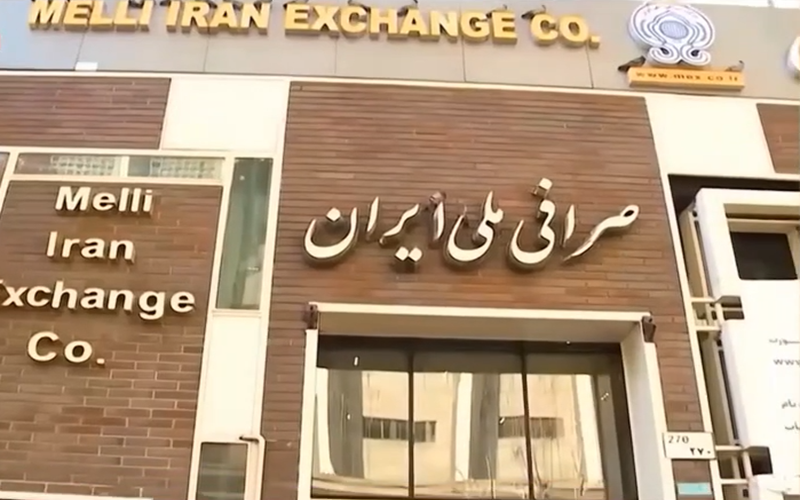

The dollar’s rise from 155,000 to around 260,000 tomans in 2026 has eroded workers’ purchasing power, while accelerating inflation, stagnant wages, and mounting social discontent expose the limits of the regime’s economic interventions.
Dollar’s Temporary Decline Fails to Ease Iran’s Cost-of-Living Crisis
The Iranian regime’s attempt to stabilize the currency through a reported $2 billion injection into the foreign-exchange market has done little to ease the economic pressure on ordinary households. Although the dollar has retreated from above 270,000 tomans to around 260,000 tomans, its value remains far above its level at the beginning of 2026, and inflation continues to erode household purchasing power.
At the start of the year, the dollar traded at approximately 155,000 tomans. Its rise to around 260,000 tomans represents an increase of roughly 68 percent. The decline from its recent peak therefore offers little relief to consumers facing sharply higher prices for food, medicine, housing, and other necessities.
The gap between official assurances and economic conditions is also reflected in inflation figures. According to figures published by Donya-ye Eqtesad on May 7, 2026, Iran’s year-on-year inflation rate reached 73.5 percent in April, while annual inflation stood at 53.7 percent.
By September, the situation had deteriorated further. Figures from Iran’s Statistics Center, reported by Entekhab on September 30, put year-on-year inflation at 89.8 percent, monthly inflation at 4.2 percent, and annual inflation at 73.6 percent. The annual rate had risen by 3.7 percentage points compared with the previous month.
These figures underscore the limitations of short-term currency interventions. A temporary decline in the dollar’s exchange rate does not reverse the accumulated rise in prices or restore the purchasing power households have already lost.
Currency Depreciation Destroys Workers’ Purchasing Power
The consequences are particularly severe for workers and salaried employees whose incomes do not rise in line with inflation.
Iran’s monthly minimum wage, including the wage figure used in this comparison, stands at approximately 16.6 million tomans. At the April 2026 exchange rate of 155,000 tomans per dollar, that income was equivalent to roughly $107. At an exchange rate of 260,000 tomans per dollar, the same salary is worth only about $64.
The dollar value of a worker’s monthly earnings has therefore fallen by approximately 40 percent, even before accounting for the additional burden of rising domestic prices.
This comparison illustrates how currency depreciation reduces the real value of fixed incomes. Workers may continue to work the same hours and receive the same nominal salary, yet find that their earnings cover a progressively smaller share of their basic expenses.
The pressure extends beyond the exchange rate itself. Higher import costs and the rising cost of production feed into prices across the economy, affecting food, medicine, consumer goods, and services. Families on limited incomes are left with fewer options as essential expenses consume an increasing proportion of their earnings.
For low-income households, the consequences can mean buying cheaper food, postponing medical treatment, and cutting spending on children’s needs. The deterioration in living standards is not simply a matter of reduced financial comfort; it affects nutrition, healthcare, and the ability to meet basic household needs.
Why the Dollar’s Decline Is Unlikely to Deliver Lasting Relief
Iran’s currency has experienced repeated cycles of sharp depreciation and temporary recovery over the past 47 years. The dollar’s movement from approximately seven tomans in the early years after the 1979 revolution to around 260,000–270,000 tomans today illustrates the scale of the long-term collapse in the rial’s value.
Short-term interventions may influence market expectations and temporarily reduce demand for foreign currency. However, without sustained improvements in the underlying economy, such measures cannot establish lasting stability.
A durable recovery would require conditions that support productive investment, domestic production, monetary stability, and confidence in economic policy. Persistent inflation, monetary expansion, and policies that undermine producers work against those objectives.
The reported $2 billion injection must therefore be assessed against the broader economic trajectory. Even if it temporarily moderates the exchange rate, it does not by itself address the structural factors driving depreciation and inflation.
Nor does a lower dollar rate automatically translate into lower retail prices. Businesses facing higher replacement costs, production expenses, and other accumulated increases may continue charging more, leaving households with little immediate relief.
The central issue is not whether the exchange rate falls by a few thousand tomans over several days. It is whether incomes and purchasing power can recover in an economy where prices have risen dramatically and confidence in the currency remains under pressure.
Economic Hardship Fuels Social Discontent
The worsening cost-of-living crisis also has implications beyond household finances. Under conditions of political repression, measuring the full extent of public dissatisfaction is difficult. Economic grievances may emerge through labor protests, pensioners’ demonstrations, and other professional or sector-specific actions rather than through openly political mobilization.
However, economic demands can develop into broader challenges to the authorities when people see little prospect of improving their living conditions. Protest slogans that move beyond wages and benefits to address the regime’s policies reflect this wider dimension of social discontent.
The regime has repeatedly faced nationwide unrest, including the uprisings of 2017–2018, November 2019, 2022, and 2025. Each episode unfolded in a distinct context, but the recurring combination of economic grievances and political anger remains relevant to understanding the pressures confronting the authorities.
Statements by senior officials have also reflected concern about the relationship between the state and the public. On October 8, 2026, President Masoud Pezeshkian addressed security personnel, saying that people should understand that they were not there to rule over the public but to serve them. In discussing fuel conservation, he also argued that employees should be asked to cooperate rather than simply ordered to do so.
Such remarks do not, on their own, establish the scale of public opposition. They nevertheless provide a window into the government’s efforts to address compliance and public cooperation amid mounting economic and social pressures.
The economic crisis is unfolding alongside continued activity by the opposition’s Resistance Units, which seek to connect public grievances with organized resistance to the regime. Their operations have continued despite heightened security measures and the presence of government forces on the streets, according to opposition accounts.
A Currency Intervention Cannot Resolve a Structural Crisis
Iran’s falling currency and accelerating inflation are reinforcing one another, with fixed-income households bearing much of the cost. The dollar’s retreat from its recent peak has not undone its roughly 68 percent rise since the beginning of 2026, while official inflation figures indicate that price pressures have intensified.
For workers and salaried employees, the result is a widening gap between income and the cost of basic necessities. For the regime, the challenge extends beyond managing the exchange rate: persistent economic hardship can deepen public dissatisfaction and turn demands for relief into broader political grievances.
Without changes that address the underlying causes of currency depreciation, inflation, and declining real wages, temporary interventions are unlikely to provide lasting relief. A few thousand tomans shaved off the dollar’s price cannot compensate households for the purchasing power they have already lost.