


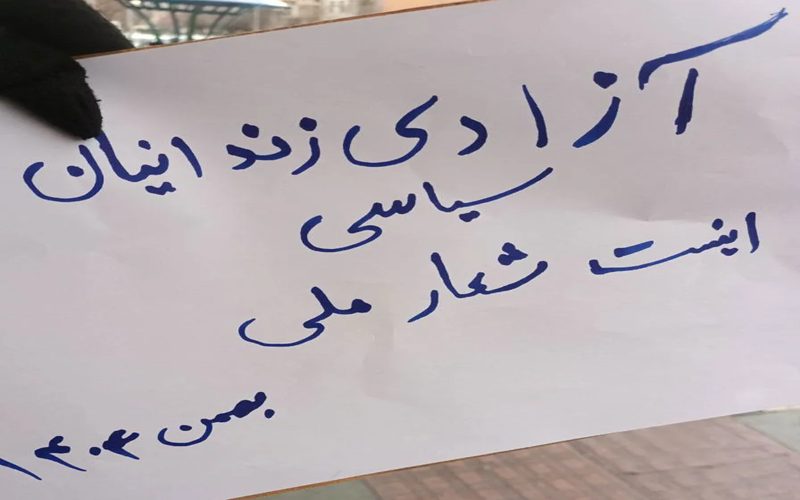

Prison authorities are reportedly denying political prisoners basic necessities, withholding medication, and imprisoning relatives to force detainees to abandon their political positions.
Iranian prison authorities are intensifying pressure on political prisoners and their families through a combination of deprivation, punitive transfers, denial of medical care, and arbitrary detention, according to reports from the Iranian Resistance.
The reported abuses include harsh conditions in Ward 7 of Evin Prison, the transfer of political prisoners to facilities far from their home provinces, withholding of medication and personal belongings, and the detention of relatives in apparent attempts to force prisoners to abandon their political positions.
The cases highlight the broader use of Iran’s prison system as an instrument of political repression, where deprivation and collective punishment are reportedly employed alongside imprisonment and prosecution.
Evin’s Ward 7 Turned Into a “Living Hell”
Political prisoners held in Ward 7 of Evin Prison are reportedly being subjected to extremely harsh living conditions.
According to the reports, prison authorities have denied prisoners access to cooling devices despite temperatures exceeding 40 degrees Celsius. The prisoners are also reportedly deprived of adequate basic living and sanitary facilities, while insect infestations have become widespread.
The conditions are particularly concerning during the summer months, when extreme heat inside poorly ventilated prison facilities can pose serious risks to prisoners’ health.
Authorities have also reportedly placed political prisoners alongside common criminals, a measure described as part of an effort to increase psychological pressure and intimidation.
Rather than treating political prisoners according to their specific circumstances, the reported practice appears designed to expose them to additional risks and make prison conditions even more difficult.
Political Prisoner Hojjat Alizadegan Faces Punitive Transfer
Another case concerns Hojjat Alizadegan, a political prisoner who supports the People’s Mojahedin Organization of Iran (PMOI/MEK).
Alizadegan was reportedly transferred from Yazd Prison to Saravan Prison, effectively placing him in exile far from his previous place of detention and community.
Following the transfer, prison authorities reportedly placed him among common criminals and refused to provide him with his medication and personal belongings.
Alizadegan has been sentenced to five years in prison and exile.
The reported denial of medication is particularly serious because access to necessary medical treatment is a fundamental component of humane detention conditions. Withholding prescribed medication as a means of exerting pressure can place a prisoner’s health at risk while adding another layer of punishment beyond the formal sentence.
His transfer to Saravan and placement among common prisoners also illustrates the use of prison transfers as an additional punitive mechanism against political detainees.
Sister of Political Prisoner Detained to Pressure Her Brother
In another reported case of collective punishment, Iran’s intelligence authorities arrested Atefeh Hasani, the sister of political prisoner Mohammad Hasani.
According to the report, authorities have conditioned her release on her brother abandoning or backing down from his political positions.
Hasani is currently being held in Fardis Prison in Karaj.
If confirmed, the case represents a particularly stark form of coercion: rather than limiting repression to the individual targeted by the authorities, the security apparatus is reportedly using a family member as leverage to force a political prisoner to change his views.
Such practices can have a chilling effect far beyond the immediate victim, creating fear among prisoners’ families and discouraging relatives from publicly supporting political detainees.
Father of Executed Protester Imprisoned for Seeking Justice
The reported repression also extends to the families of young people executed following protests.
The father of Abbas Akbari Faizabadi, a young man who was executed on May 25, has reportedly been arrested and sentenced to three years in prison for seeking justice for his son.
He is currently detained in Naeen Prison.
Abbas Akbari Faizabadi had been accused by the authorities of being one of the “armed leaders” of the uprising in Naeen. He was charged with moharebeh—“enmity against God”—and with attacking the governorate and security centers during the uprising.
He was subsequently executed.
The imprisonment of his father over efforts to seek justice adds another dimension to the repression surrounding the case. Instead of allowing families to pursue information, accountability, or legal remedies concerning the deaths of their relatives, the authorities are reportedly responding with further arrests and imprisonment.
A Pattern of Pressure Beyond Formal Sentences
The cases from Evin, Saravan, Karaj, and Naeen point to a broader pattern in which imprisonment itself is only one component of the punishment imposed on political opponents.
Reported measures include:
| Form of pressure | Reported practice |
|---|---|
| Deprivation | Lack of cooling equipment and inadequate sanitary conditions |
| Environmental pressure | Extreme heat and insect infestations |
| Forced association | Political prisoners held alongside common criminals |
| Punitive transfers | Political prisoners transferred far from their original prison |
| Medical deprivation | Medication reportedly withheld |
| Confiscation | Personal belongings reportedly withheld |
| Family coercion | Relatives detained to pressure political prisoners |
| Collective punishment | Family members prosecuted or imprisoned for seeking justice |
These practices, taken together, raise serious concerns about the treatment of political prisoners and the extent to which prison authorities are using conditions of detention to impose punishment beyond judicial sentences.
International Action Urgently Needed
The Iranian Resistance has called on the UN Human Rights Council, the UN High Commissioner for Human Rights, the UN Special Rapporteur on the situation of human rights in Iran, and international human rights organizations to immediately condemn the reported pressure against political prisoners.
It has also renewed its call for an international fact-finding mission to visit Iranian prisons and investigate the conditions faced by political prisoners and other detainees.
Independent access to Iranian prisons is particularly important given the restrictions placed on international observers and the difficulty of independently verifying conditions inside many detention facilities.
The reported cases demonstrate why prison conditions cannot be examined separately from the wider system of political repression. When authorities allegedly combine harsh detention conditions with denial of medication, punitive transfers, family arrests, and prosecution of relatives seeking justice, the prison system becomes an extension of the security apparatus.
For political prisoners and their families, the consequences can extend well beyond the prison sentence itself.