


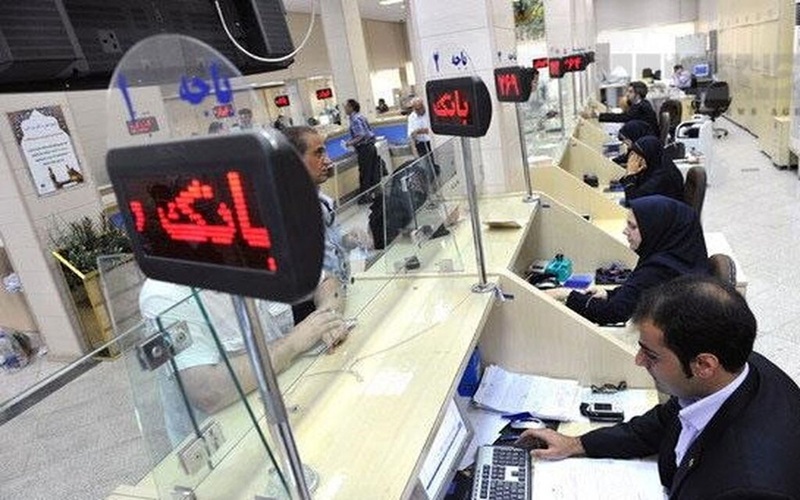

A rare admission by a senior regime oversight official exposes deep weaknesses in Iran’s banks, from inadequate capital and non-performing loans to frozen assets and billions of dollars in unresolved foreign-exchange obligations.
Iran’s banking system is facing a combination of capital weakness, bad loans, frozen assets, inadequate oversight, and foreign-exchange irregularities, according to an unusually revealing report carried by the regime’s state-run Mehr News Agency.
The report quoted Zabihollah Khodaiian, head of the regime’s General Inspection Organization, during a meeting with Central Bank officials, bank executives, banking technology managers, and other government inspectors. While Khodaiian framed the discussion around strengthening the banking system and supporting the economy, his remarks exposed a far more serious picture: a financial system struggling to recover its own resources while being expected to finance production, households, and an economy already under severe pressure.
The revelations are particularly significant because they come from inside the regime’s own supervisory apparatus.
More than half of banks fail to meet the stated capital threshold
One of the clearest indications of systemic weakness is the disclosure concerning capital adequacy.
Khodaiian said that of 27 active banks and credit institutions, only 13 have an adequate capital-adequacy ratio meeting the minimum 8 percent threshold.
That leaves 14 institutions—more than half of the total—below the stated minimum.
Capital adequacy is a fundamental measure of a bank’s ability to absorb losses. A weak capital buffer leaves a bank more vulnerable when borrowers default, asset values fall, or economic conditions deteriorate.
The disclosure is particularly troubling because independent analysis has also found that Iranian banks have struggled with inadequate capital. A 2026 study published in the Iranian Journal of Finance noted that Iran’s banking sector faces structural challenges including high non-performing loans and limited access to foreign capital, while examining the relationship between liquidity creation and capital adequacy.
Earlier Central Bank figures also showed how far the sector has struggled to reach the 8 percent benchmark. In August 2025, the Central Bank said only 14 of 29 banks had exceeded the threshold, while the sector’s average capital adequacy ratio remained far below the required level.
The latest admission therefore points to a banking system in which a substantial portion of institutions remain inadequately capitalized.
The official bad-loan figure may conceal a much larger problem
Even more revealing is Khodaiian’s discussion of non-performing loans.
According to the official statistics he cited, non-performing loans account for approximately 10 percent of total lending. But he immediately qualified that figure, saying the actual level is considerably higher, particularly in the area of foreign-currency loans.
This distinction is critical.
Rather than merely acknowledging a high level of bad debt, the regime’s own chief inspection official is effectively warning that the published figure does not capture the full scale of the problem.
Khodaiian attributed the problem primarily to weak credit assessment. When borrowers are not properly evaluated before receiving loans, banks end up extending credit to individuals or entities that lack the ability to repay.
That creates a damaging cycle:
poor credit assessment → bad loans → unrecovered bank resources → reduced liquidity → weaker lending capacity.
The consequences extend beyond the banking sector because banks are simultaneously being instructed to increase lending to businesses, families, and other priority sectors.
Banks are sitting on assets they were supposed to sell years ago
Another major problem identified in the report is the enormous stock of excess bank assets.
Under Articles 16 and 17 of Iran’s Law on Removing Barriers to Competitive Production, banks were required to dispose of surplus assets within three years.
Khodaiian said that more than six years later, some banks have not reduced their excess assets. In some cases, he said, the volume has actually increased.
Between 2022 and 2024, total asset disposals amounted to approximately 155 trillion tomans, which Khodaiian described as a very small figure.
The significance goes beyond inefficient balance sheets.
The regime wants banks to provide more credit to production and to applicants for marriage loans. But banks cannot freely deploy resources that are tied up in illiquid or surplus assets. At the same time, funds tied up in non-performing loans cannot easily be recycled into new lending.
Khodaiian therefore acknowledged an uncomfortable reality: before banks can substantially expand lending, they need to recover their outstanding claims and release liquidity by selling surplus assets.
More than 1.1 million people are waiting for mandatory loans
The consequences are already visible to ordinary Iranians.
According to Khodaiian, 614,000 people are currently waiting for marriage loans, while another 515,000 applicants are waiting for childbearing loans.
Combined, that amounts to 1.129 million applicants waiting for these government-mandated forms of credit.
The official characterized the situation as unacceptable and acknowledged that, although the loan amounts may not be particularly large, they can be crucial for young people beginning their lives.
The backlog demonstrates how banking-system weaknesses have become a social problem. The regime continues to impose lending obligations on banks while simultaneously acknowledging that banks lack the resources and liquidity to fulfill them efficiently.
Productive loans can be diverted into speculation
Khodaiian also acknowledged another problem with the allocation of credit: loans intended to support production can end up in brokerage, speculation, and other non-productive activities.
He warned that such diversion defeats the purpose of government-supported lending and contributes to increased liquidity and inflation.
This is a significant admission in an economy already struggling with persistent inflation.
Credit that should finance factories, working capital, machinery, employment, and production can instead fuel speculative activity. The result is that the banking system can simultaneously fail to provide adequate financing to productive enterprises while contributing to inflationary pressures.
The problem is therefore not simply a shortage of credit. It is also the inefficient and potentially distorted allocation of credit.
A $15 billion foreign-exchange problem
Perhaps the most striking figure in the report concerns foreign-exchange obligations.
Khodaiian said a special judicial committee was established to investigate foreign-exchange violations and follow up on unfulfilled obligations.
He said that the amount of unfulfilled banking obligations at Iran’s official foreign-exchange market had fallen from $1.7 billion to approximately $300 million following the committee’s intervention.
But the report then revealed a much larger problem.
According to Khodaiian, only 3 percent of recipients of import-related foreign currency had failed to fulfill their obligations, yet the total amount of foreign currency involved in those cases exceeded $15 billion.
The figures raise serious questions about the supervision of foreign-exchange allocations.
If a small fraction of recipients can account for more than $15 billion in unresolved obligations, the issue is not simply individual misconduct. It raises questions about how foreign currency was allocated, how recipients were vetted, how banks monitored the transactions, and why legal action was allegedly delayed.
Khodaiian explicitly questioned why banks had failed to take timely legal action against recipients who did not fulfill their obligations.
Money is also reportedly being left with financial intermediaries
The report raises further concerns over the Trustees. Khodaiian said the General Inspection Organization and judiciary had entered the issue and insisted that the Central Bank could not avoid responsibility for managing and supervising these entities.
He also criticized the accumulation of resources with some intermediaries, saying authorities were investigating both the amount of money involved and how long those funds had remained there.
The authorities also announced the removal of non-bank intermediaries under a special committee decision, insisting that such entities should operate under bank supervision.
Again, the issue points to a broader problem of weak oversight and control over financial flows.
Cyberattacks expose another vulnerability
The report also highlights a different but increasingly important weakness: the banking system’s cybersecurity infrastructure.
Khodaiian acknowledged that several banks had been subjected to cyberattacks during recent periods of conflict and that some were temporarily taken offline.
He emphasized that it was unacceptable for banks holding the public’s financial resources to become inaccessible because of inadequate cybersecurity, disrupting basic activities such as purchases and installment payments.
The warning is significant because modern banking depends almost entirely on digital infrastructure. A bank that lacks adequate backup systems, cybersecurity defenses, and disaster-recovery capacity can quickly become incapable of providing even basic services.
Khodaiian called for regular security exercises and system testing by specialized cybersecurity personnel.
A banking crisis beneath the regime’s call for economic support
Taken together, the revelations paint a picture of a banking system caught in a structural contradiction.
The regime expects banks to finance economic production, prevent factories from closing, provide mandatory household loans, and support employment. Yet the same system is burdened by:
- inadequate capital at more than half of the institutions cited;
- non-performing loans that officials acknowledge are likely understated;
- weak credit assessment;
- poor recovery of outstanding loans;
- years of failure to dispose of surplus assets;
- diversion of productive credit into speculation;
- foreign-exchange obligations involving billions of dollars;
- questionable supervision of financial intermediaries; and
- vulnerabilities in banking technology and cybersecurity.
This is more than a problem of individual bank management. It reflects structural weaknesses in financial governance and supervision.
Recent research likewise describes Iranian banks as facing structural difficulties involving high non-performing loans and limited access to foreign capital, while finding a significant relationship between liquidity creation and capital adequacy.
The deeper problem is a shortage of functioning financial capacity
The most revealing aspect of the Mehr report is that the regime is effectively asking the banking system to solve problems that the banking system itself is struggling to absorb.
Banks are expected to provide more loans, but a large share of their resources is tied up in bad loans and excess assets.
They are expected to support production, yet officials acknowledge that some production loans are diverted toward speculation.
They are expected to facilitate foreign trade, yet authorities report billions of dollars in unfulfilled foreign-exchange obligations.
They are expected to serve millions of households, yet more than 1.1 million applicants remain in queues for basic government-mandated loans.
And they are expected to function continuously, while officials acknowledge that inadequate cybersecurity has already caused disruptions.
The regime’s own account therefore provides an unusually candid picture of a banking sector struggling with capital inadequacy, deteriorating asset quality, liquidity constraints, weak oversight, and governance failures.
The significance extends far beyond the banks themselves. When a banking system cannot efficiently recover loans, allocate credit, maintain adequate capital, or control foreign-exchange flows, the consequences are transmitted throughout the economy—in the form of weaker investment, reduced production, unemployment, inflation, and growing financial insecurity.
The latest admissions from the regime’s own inspection authorities suggest that Iran’s banking problems are not a temporary liquidity squeeze. They are symptoms of a deep structural crisis in the country’s financial system.