


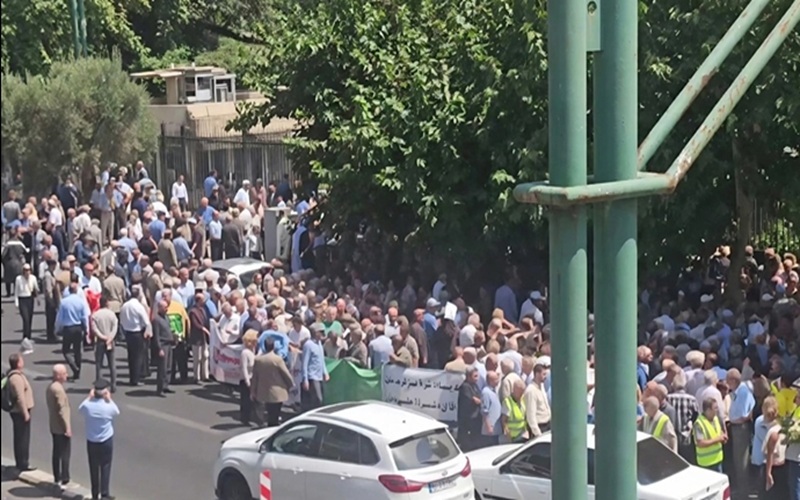

Months after the 40-day war, the regime continues staging nightly rallies, revealing a deeper fear: the return of nationwide protests.
For months after the end of the 40-day war with the United States and Israel, the Iranian regime has continued organizing nightly rallies and gatherings in cities across the country. State media portray these events as demonstrations of “deterrence” against external enemies.
But the regime’s own statements suggest another explanation.
The persistent emphasis on keeping its supporters in the streets appears increasingly connected to a domestic concern: the fear that the streets could once again become the center of nationwide protests.
The regime is not simply trying to demonstrate strength to its external adversaries. It appears determined to keep control of public spaces that have repeatedly become the focal point of popular uprisings.
The shadow of the December 2025 uprising
The roots of this fear can be traced to the nationwide uprising that began in Tehran on December 28, 2025, and rapidly spread to more than 400 cities and towns across all 31 provinces.
The scale of the protests deeply alarmed the regime. Thousands of people were reportedly killed during the crackdown, according to different accounts.
The regime’s response demonstrated how seriously it viewed the uprising. On February 1, 2026, Ali Khamenei described the protests in terms comparable to a “coup” or “quasi-coup.” On January 11, Masoud Pezeshkian, responding to the protests on state television, referred to protesters as “rioters” and even “terrorists.”
Such statements reveal that the regime did not regard the demonstrations as ordinary social unrest. It viewed them as a direct threat to its survival.
That fear has apparently persisted long after the protests themselves subsided.
In August 2026, an audio recording reportedly associated with a meeting of the media and cyberspace headquarters in Pakdasht revealed concerns among officials affiliated with the Basij and IRGC about the possibility of renewed protests, expanding online activism, and attacks against regime symbols and forces.
Another revealing indication came from a report published by Khamenei’s official website on February 18, 2026. It claimed that nearly 500,000 calls and reports concerning alleged violations of public security and suspected acts of sabotage had been received by the end of January.
These figures should be treated as claims made by the regime, but they nevertheless demonstrate the extent of its concern.
The regime’s anxiety was reportedly serious enough that the Supreme National Security Council held an emergency meeting on April 27 following intelligence warnings about the possible resumption of protests.
Why did the regime tell people to stay in the streets?
The regime’s instructions immediately following the ceasefire are particularly revealing.
On April 8, the day the ceasefire took effect, the Armed Forces General Staff and Khatam al-Anbiya Central Headquarters called on the population to maintain their presence in squares and streets during subsequent nights, supposedly to discourage the enemy from “conspiracy.”
The following day, a message attributed to Mojtaba Khamenei reportedly emphasized that the ceasefire should not be interpreted as meaning that people no longer needed to remain in the streets. Supporters were urged to maintain an even stronger presence in their neighborhoods.
Mohammad Bagher Ghalibaf had already repeatedly emphasized the importance of street mobilization. On March 29, he reportedly declared that supporters should not “abandon the streets,” describing street presence as a form of “obligatory jihad” and presenting it as a complement to military operations.
The persistence of these instructions after the fighting had ended raises an obvious question:
If the primary purpose was military deterrence, why did the regime continue emphasizing street mobilization long after the ceasefire?
The answer may lie closer to home.
The presence of proxy forces
Reports of the deployment of forces affiliated with regional proxy groups provide another important element of the picture.
Reports indicated the presence of members of groups including Afghanistan’s Fatemiyoun and Iraq’s Popular Mobilization Forces in different parts of Tehran.
The human rights organization Hengaw also warned on April 8 about a significant increase in the presence of forces affiliated with the Iranian regime’s regional proxy networks in parts of Kurdistan, Sistan and Baluchestan, and Khuzestan.
The combination of organized regime rallies and the reported deployment of forces in urban areas is significant.
It suggests that the regime’s concern was not limited to external military threats. It was also concerned about maintaining control over the domestic security environment.
The regime’s media keep invoking the street
State-controlled media have continued reinforcing the same message months after the war.
On August 28, 2026, Mehr News Agency described nighttime gatherings as a “barrier against conspiracy” and emphasized the need for continued public presence in squares.
IRNA had similarly described nighttime gatherings on June 26 as a “defensive tactic” against external calls for protest.
The repeated use of terms such as “conspiracy,” “outside calls,” and the need to remain in the streets serves another purpose: it keeps the population mobilized around the regime while portraying any independent use of the streets as a potential security threat.
In this context, the regime appears to be trying to occupy the political space of the street before its opponents can reclaim it.
The real fear: an empty street
The paradox is striking.
The regime presents its nightly rallies as demonstrations of strength. Yet the insistence that supporters must remain in the streets can equally be interpreted as a sign of insecurity.
A confident government does not normally need to repeatedly instruct its supporters not to leave public spaces.
The regime experienced what happens when the streets escape its control during the December 2025 uprising. It confronted protests on an unprecedented scale, responded with massive repression, and subsequently faced a major military crisis.
It therefore has strong reasons to fear a repetition.
The street represents a unique political danger because it allows individual grievances to converge. Workers, teachers, retirees, students, and young people can transform separate grievances into a nationwide movement once they occupy the same political space.
That is precisely what the regime appears determined to prevent.
A strategy of preemptive control
The continuation of regime-organized gatherings months after the war therefore deserves to be viewed through the lens of domestic political security rather than solely external deterrence.
The regime is attempting to ensure that when people look toward the streets, they see an already occupied space controlled by the state and its networks.
Its repeated message that supporters must “not abandon the streets” may consequently reveal more than mobilization.
It may reveal fear.
The December uprising may not be viewed inside the regime as a closed chapter. Instead, it appears to remain a potential threat that could return whenever economic, political, and social conditions converge.
For the regime, the street is therefore not simply a place for demonstrations of strength. It is the battlefield where the future of its rule could ultimately be decided.
And the regime’s continued insistence on controlling it suggests that it knows the next uprising could begin the moment the people take it back.