

Oil export restrictions, European banking measures, warnings over nuclear verification, and calls to designate the Houthis as a terrorist organization are narrowing Tehran’s economic and diplomatic room for maneuver.
The developments point to growing scrutiny of the regime’s conduct across several distinct areas. Restrictions on oil revenues threaten a major source of foreign currency, European measures are tightening the financial environment, and international institutions are raising concerns about nuclear verification and support for regional armed groups. Meanwhile, executions, torture, and the repression of political opponents remain central to international criticism of the regime.
Together, these pressures are creating a more restrictive environment for Tehran, limiting its options across economic, diplomatic, and security policy.
Oil Export Restrictions Threaten a Critical Source of Revenue
Oil exports remain one of the regime’s principal sources of foreign currency, making restrictions on oil shipments particularly consequential for its finances.
According to U.S. Central Command (CENTCOM), measures associated with the recent maritime blockade had prevented the export of more than $25 billion worth of the regime’s oil. If sustained, such restrictions could significantly constrain the flow of foreign currency available to Tehran.
Oil revenue is central to the regime’s ability to finance government operations, sustain its security apparatus, and pursue policies beyond Iran’s borders. Reduced access to these earnings would intensify pressure on its financial resources and complicate efforts to maintain spending across competing priorities.
The impact extends beyond the immediate value of shipments prevented from reaching their destinations. Restrictions on maritime transport and oil sales can also complicate logistics, payments, and access to international buyers, increasing the obstacles facing the regime’s oil trade.
For a government already confronting multiple economic and political challenges, limitations on its principal sources of foreign currency can narrow the resources available to respond to mounting demands at home and abroad.
European Banking Measures Tighten Financial Constraints
Financial restrictions are adding another layer of pressure. Germany revoked the operating authorization of Bank Saderat Iran in Hamburg, with German authorities linking the decision to sanctions recently adopted by the European Union.
Measures targeting Iranian banks and their branches have also been taken in the United Kingdom, further restricting the regime’s access to financial networks.
Banking restrictions matter because international transactions depend on financial institutions capable of processing payments, maintaining accounts, and facilitating commercial relationships. When access to these channels contracts, cross-border trade becomes more difficult, and the costs and risks of conducting business can increase.
The consequences can extend to transactions involving oil, other exports, and imports, particularly where payments require links to European financial institutions.
These developments form part of a broader pattern in which the regime faces obstacles not only in generating revenue but also in moving money through international channels. Combined with restrictions on oil shipments, reduced banking access could further complicate its efforts to convert export earnings into usable funds.
Border Disruptions Add to Trade Difficulties
The reported difficulties have not been confined to Europe. Trade and transport problems have also emerged along Iran’s borders with neighboring countries.
Pakistan reportedly prevented trucks originating in Iran from entering its territory, while similar difficulties were reported at the Iraqi border. Such disruptions add practical obstacles to the movement of goods and complicate commercial links with neighboring markets.
Although these border measures differ in nature from financial sanctions and maritime restrictions, their cumulative effects can increase uncertainty for exporters and transport operators. Delays, interrupted routes, and reduced access to markets can raise costs and hinder the movement of goods.
For Tehran, which relies on regional commercial connections to sustain trade under international restrictions, problems along neighboring borders create additional challenges.
The combined picture is one of pressure across several stages of international commerce: transporting oil, accessing financial services, and moving goods through regional trade routes.
Nuclear Verification Remains an International Concern
The regime’s nuclear activities remain another major source of international scrutiny.
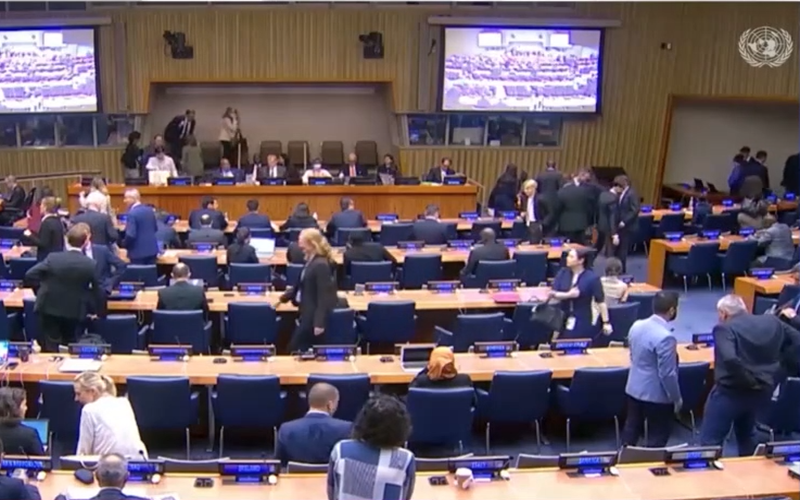
During the week, the First Committee of the United Nations General Assembly issued a statement warning about Iran’s lack of cooperation with the International Atomic Energy Agency (IAEA) and the absence of the necessary verification of its nuclear activities.
Effective verification is central to assessing the nature and status of a country’s nuclear program. When the IAEA cannot carry out the required verification work, questions about the program remain unresolved, sustaining international concerns and complicating diplomatic efforts.
For Tehran, continued disputes over cooperation with the agency create a further point of friction with the international community. These concerns also interact with the broader economic and diplomatic pressures facing the regime, limiting its ability to separate the nuclear file from other disputes over its conduct.
The issue is therefore not simply technical. Cooperation with international inspectors and the provision of verifiable information are important elements in addressing concerns about nuclear activities and determining whether outstanding questions can be resolved.
European Parliament Targets the Regime’s Regional Network
The regime’s support for armed groups in the Middle East has also drawn renewed attention.
The European Parliament adopted a resolution calling on the European Union to designate Yemen’s Houthi movement as a terrorist organization. The Houthis are widely described as a regional partner of Tehran and a component of the network of armed groups through which Iran exercises influence beyond its borders.
The resolution adds to pressure for a more restrictive European approach to the movement and highlights continuing concerns about the regional consequences of Iran’s support for allied armed groups.
A parliamentary resolution calling for a designation is not, by itself, the same as the EU formally adopting that designation. Nevertheless, it places the issue on the European political agenda and increases pressure on EU institutions to consider further action.
For the Iranian regime, the debate over the Houthis is part of a broader challenge to its regional strategy. Its relationships with armed groups have repeatedly become a source of international tension, linking Tehran’s regional activities to security concerns extending well beyond Iran’s borders.
Human Rights Abuses Remain a Central Issue
Alongside economic and security-related measures, the regime’s human rights record continues to attract international criticism.
Executions, torture, and the killing and repression of opponents and protesters remain major concerns for human rights organizations and international institutions. Calls for action are increasingly directed not only at condemning abuses but also at holding the officials responsible accountable.
This distinction is important. Public condemnation can document abuses and increase diplomatic pressure, while measures aimed at individual officials can seek to impose consequences on those implicated in torture, executions, and violent repression.
The continued prominence of human rights concerns also underscores that the international dispute with Tehran extends beyond its nuclear activities or regional policies. The treatment of Iran’s population remains an independent and significant dimension of international scrutiny.
Multiple Pressures Narrow Tehran’s Room for Maneuver
The developments across oil exports, banking, regional trade, nuclear verification, armed groups, and human rights reveal the breadth of the challenges facing Iran’s regime.
Each pressure operates through a different mechanism. Restrictions on oil exports can reduce access to foreign currency; banking measures can obstruct international payments; border disruptions can complicate trade; nuclear concerns can deepen diplomatic disputes; and scrutiny of regional armed groups can increase pressure on Tehran’s external policies. Human rights criticism, meanwhile, continues to challenge the regime’s conduct toward its own population.
These measures should not be treated as interchangeable, nor does their simultaneous emergence necessarily establish a single coordinated strategy. Their significance lies in the cumulative constraints they impose across different areas of the regime’s operations.
For Tehran, the challenge is to navigate these pressures while maintaining its financial resources, regional relationships, and domestic security apparatus. As restrictions and international scrutiny persist across multiple fronts, the regime faces a more difficult environment in which to pursue its policies and preserve its freedom of action.