


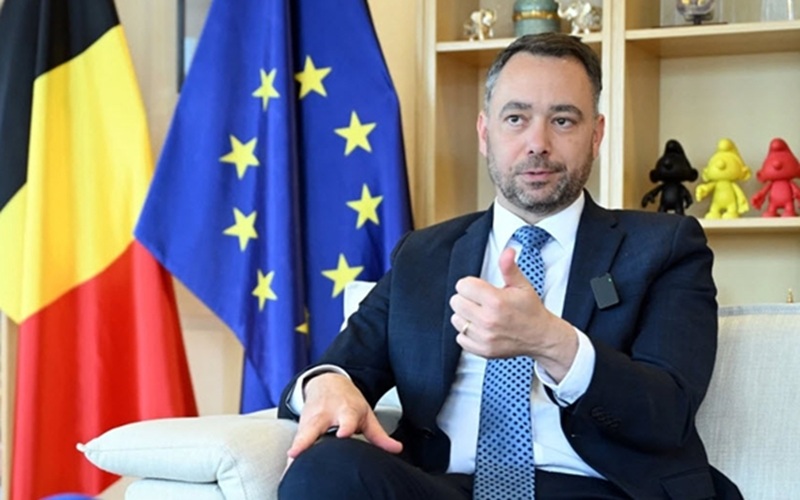

Belgium’s Deputy Prime Minister and Foreign Minister says deciding who should lead Iran belongs exclusively to the Iranian people, rejecting calls to recognize the son of Iran’s deposed shah as the legitimate representative of the Iranian people and unifying leader of the democratic opposition.
Belgium’s Deputy Prime Minister and Minister of Foreign Affairs, European Affairs and Development Cooperation, Maxime Prévot, has rejected calls for the Belgian government to recognize Reza Pahlavi as the legitimate representative of the Iranian people and the unifying leader of Iran’s democratic opposition. In a public response on X to Melissa Amirkhizy, a municipal councillor in Ganshoren and vice-president of Belgium’s Reformist Movement (MR), Prévot stressed that the choice of Iran’s future leadership belongs exclusively to Iranians.
“You have chosen to take Reza Pahlavi’s side, and I have no business passing judgment on your choice. But precisely in the name of democracy, deciding who should lead Iran is a choice that must belong solely to the Iranians,” Prévot wrote.
His response directly addressed a request for Belgium to grant Pahlavi political recognition as the legitimate representative of the Iranian people and the unifying leader of the democratic opposition. Prévot made clear that the Belgian government would not endorse that demand, emphasizing that other individuals and political movements also claim to represent Iran’s opposition.
Madame @AmirkhizyMeliss,
Vous m’avez écrit deux fois et je vous prie de m’excuser de ne pas y avoir encore répondu autrement que dans mes declarations publiques et dans mes actes. Bien que je tienne à répondre à chaque personne qui m’écrit, je suis extrêmement sollicité.
Vous… https://t.co/lE38RDyZsh
— Maxime PREVOT (@prevotmaxime) October 23, 2026
Belgium Rejects Exclusive Recognition of Reza Pahlavi
Prévot also clarified Belgium’s position on the controversy surrounding Pahlavi’s proposed visit to the Belgian Parliament. He said he had not opposed the original invitation, explaining that he respected Parliament’s autonomy and its freedom to maintain contacts with foreign political figures.
Rather than advocating an exclusive platform for Pahlavi, Prévot had suggested inviting a broader range of Iranian opposition voices to ensure greater balance and reflect democratic pluralism. The decision not to receive Pahlavi was ultimately made by Parliament itself.
The distinction is important: Prévot did not claim responsibility for the parliamentary decision. His response instead challenged the demand that Belgium politically recognize Pahlavi as the sole legitimate representative of Iran’s democratic opposition.
His position also drew a line between an individual’s freedom to support a political figure and the authority to speak on behalf of an entire people. Support for Pahlavi by some Iranian exiles or foreign political figures does not establish a democratic mandate to represent all Iranians.
Prévot said he shared the principles of Iran’s territorial integrity, human rights, and democracy. He nevertheless maintained that determining Iran’s political future cannot be settled by the Belgian government or by the endorsement of a particular opposition figure abroad.
Belgium Defends Sanctions While Maintaining Diplomatic Channels
The Belgian foreign minister also responded to calls by the MR for the expulsion of Iran’s ambassador. He described such a proposal as an overly simplistic approach, arguing that diplomacy is more complicated and that maintaining diplomatic channels can help convey firm messages to Tehran and monitor developments inside Iran.
Prévot reaffirmed Belgium’s condemnation of human rights violations in Iran, including violations targeting women. He said Belgium supports the Iranian people’s call for democracy and pointed to the European Union’s designation of the Islamic Revolutionary Guard Corps (IRGC) as a terrorist organization in January, alongside the extensive sanctions imposed by the EU, including asset freezes.
He also said Belgium remained prepared to consider additional sanctions while preserving diplomatic dialogue.
These remarks reflect a distinction between maintaining diplomatic channels and accepting the Iranian regime’s conduct. Prévot presented continued engagement as a means of delivering pressure and monitoring the situation, rather than as a retreat from Belgium’s stated support for human rights and democracy.
Iran’s Political Future Must Be Decided by Iranians
The dispute over Pahlavi’s proposed parliamentary visit has exposed a broader question facing European policymakers: how to support democratic change in Iran without granting one political figure a mandate that only the Iranian people can confer.
Prévot’s response rejects the demand for Belgium to recognize Pahlavi as the exclusive representative of the Iranian opposition. It also reinforces the principle that the legitimacy of any future leadership must derive from the will of Iran’s people, not from diplomatic recognition by foreign governments.
For Iranians seeking an end to repression and a democratic political system, the right to determine the country’s future is fundamental. European governments can condemn human rights abuses, impose sanctions, and support democratic principles, but they cannot decide in advance who should lead Iran.
The central issue is therefore not whether an individual or political movement can seek support abroad. It is whether Iran’s diverse population will retain the freedom to choose its own future through a genuinely democratic process.
Prévot’s position is clear: Belgium will not recognize Reza Pahlavi as the legitimate representative of the Iranian people and the unifying leader of the democratic opposition at the request of a political supporter. The decision over Iran’s future leadership belongs to Iranians themselves.