
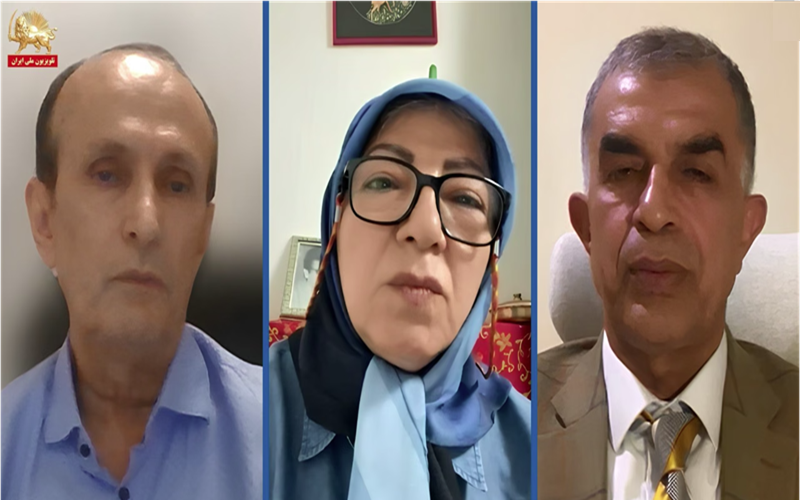

Former political prisoners recount executions, torture, death sentences, and the systematic destruction of an entire generation of political prisoners in Iran’s prisons.
The 1988 massacre of political prisoners remains one of the darkest chapters in Iran’s modern history. Thousands of political prisoners were executed after being subjected to brief interrogations by commissions whose questions centered not on established criminal charges, but on their political beliefs, affiliations, and willingness to renounce their opposition.
Decades later, survivors continue to recount what they witnessed inside prisons such as Evin and Gohardasht. Their testimonies describe not only the executions themselves, but also the preparations that preceded them, the terror imposed on prisoners, and the determination of many victims to maintain their political convictions even when they knew that doing so could cost them their lives.
In an interview broadcast by INTV, former political prisoners and supporters of the People’s Mojahedin Organization of Iran (PMOI/MEK) described their experiences and those of their fellow prisoners. Their accounts provide a deeply personal record of a massacre that the Iranian regime attempted to conceal from the outside world.
“We Heard the Gunfire and Counted the Shots”
Batoul Majani, a former political prisoner now living in Austria, said she was arrested four times and spent seven years in prison. Her first arrest came in 1980, followed by another arrest in 1982 that resulted in three years of imprisonment.
She recalled the extraordinary overcrowding in the women’s ward where she was held. At one point, she said, between 1,000 and 1,200 prisoners were being held there, forcing women to sleep in shifts.
But the most terrifying memories were the nights when prisoners were taken away for execution.
“We would hear the gunfire at night,” Majani recalled, explaining that the prisoners would count the shots to estimate how many people had been executed.
Majani’s testimony is also deeply personal. Seven members of her extended family, she said, were executed because of their association or support for the PMOI. Some were executed in the early 1980s, while others were killed during the 1988 massacre.
Among them were Zahra Nazemi and Abdolrasoul Majani, as well as siblings Farah and Amir Aghayan.
Majani recalled receiving information about the massacre at Semnan Prison, where, according to a surviving relative who witnessed the events, approximately 37 of 40 prisoners were executed. The remaining three were also reportedly in danger of execution before the process was halted.
The scale of the killings was therefore not an abstraction for Majani. It was reflected in the destruction of her own family.
A New Wave of Arrests During the Massacre
Majani herself was arrested again on August 5, 1988, after security forces raided her home. She described being taken in a minibus alongside other former prisoners who had previously been released.
The authorities, she said, had lists of former prisoners and went from house to house to locate them.
She was first taken to the Joint Committee prison, where she spent two weeks undergoing interrogation, beatings, and torture, before being transferred to Evin.
There, she encountered long lines of blindfolded prisoners being taken toward what authorities called a “court.”
Majani immediately realized that something extraordinary was happening.
A prisoner standing ahead of her told her that they were being taken before the commission responsible for the massacre.
The prisoners were eventually taken into a large hall, with men and women separated. Majani described the enormous number of people waiting there and the practice of taking prisoners one by one before the commission.
After her own interrogation, she was placed in an old cell. On the walls she discovered the names of prisoners who had apparently been held there before her.
They had left behind names, dates, poems, and farewell messages.
“The wall was covered,” she recalled. “It was clear that many people had come into that cell and left.”
For Majani, those inscriptions were among the most painful remnants of the massacre: the final words of people who understood that they might never return.
Children and Young Prisoners Were Among the Victims
Majani also remembered the treatment of young prisoners.
She described meeting a 17-year-old girl whose feet had been severely injured through torture. Majani helped her as best she could, massaging her damaged feet and giving her something with which to tie her hair.
The young prisoner later told her that the torture had been so severe that the bone in her foot had become visible.
Another prisoner Majani remembered was Nahid Afshar, who had reportedly been only 12 years old when arrested.
According to Majani, two of Nahid’s 14-year-old friends were executed, while Nahid herself was subjected to prolonged pressure and torture. Authorities allegedly took her to a guard’s home for months in an attempt to force her to abandon her political beliefs.
She refused.
Majani recalled Nahid telling her:
“Brother Massoud is in my heart. I cannot remove him from my heart.”
Nahid was eventually sentenced to death, later had her sentence reduced to 15 years, and ultimately became another victim of the 1988 massacre.
The stories illustrate the extent to which the prison system targeted not only adults, but also very young political activists and supporters.
Gohardasht: Prisoners Realized They Were Waiting for Death
Akbar Bandali, a former political prisoner living in Germany, provided another eyewitness account from Gohardasht Prison.
He said prison authorities had already identified the political positions of many prisoners before the massacre began. In late July 1988, prisoners were transferred between wards, while outside communication was increasingly cut off.
Television and newspapers disappeared. Family visits were suspended. Access to medical facilities was restricted.
At the same time, rumors circulated that a pardon commission had been established to release prisoners.
Instead, the executions began.
Bandali recalled being told by a prison official, Hamid Abbasi, that prisoners were being transferred so that those already in the other section could be executed.
On August 8, the executions at Gohardasht began.
As prisoners watched from inside their wards, they gradually understood what was happening. Groups of prisoners were called away and did not return.
Bandali remembered several of his fellow prisoners with whom he had shared those final days. Some joked about hiding in suitcases. Others recited poetry or sang songs. One prisoner even said he had prayed that his legs would not tremble when he was executed.
These were not expressions of ignorance. The prisoners increasingly knew that death was approaching.
Bandali described seeing trucks leaving the prison late at night.
On one occasion, he said, a truck stopped beneath a light. From the third floor, he could see that it was filled with bodies.
“We watched these bodies in absolute silence,” he recalled, “waiting for ourselves.”
The prisoners were not simply witnessing the massacre. They were waiting to become its next victims.
Evidence That the Massacre Was Planned in Advance
Former prisoner Ahmad Ebrahimi, now living in Britain, emphasized another crucial aspect of the testimony: the indications that the killings had been prepared before they began.
Ebrahimi had been transferred from Qom Prison to Gohardasht in early 1988. Prisoners from different cities were also transferred there.
In late July, shortly before the executions began, his ward was moved to another section.
Ebrahimi said that he and other prisoners protested the transfer. A senior prison guard named Faraj reportedly warned them to stop resisting.
Ebrahimi replied that they had already experienced the mass executions of the early 1980s.
According to his testimony, the guard answered:
“You will see days when you will long for the days of 1981.”
Ebrahimi stressed that this statement was made before the military operation that the authorities subsequently used as the justification for the massacre.
For him, this was an important indication that the killings were not simply a spontaneous reaction to events, but had been prepared in advance.
His account is consistent with other survivor testimony documenting transfers, interrogations, segregation of prisoners, and preparations inside Gohardasht before the executions.
“None of the Prisoners From Qom Survived”
After his release in 1991, Ebrahimi returned to Qom seeking information about the prisoners he had known there.
He could not find any of them.
Eventually, through the brother of one of the prisoners, he learned that the political prisoners from Qom had been executed during the massacre.
Ebrahimi deliberately read out several of their names during the INTV program, including Mehdi Amshaspand, Abolhasan Sadeghi, Hossein Arabi, Javad Mohseni, Habib Ghaeini, Ruhollah Ramezani, Hossein Salehi, Akbar Ashtiani, and Reza Anousheh.
He stressed that these names must be preserved.
The same insistence runs through all three testimonies: the victims must not become anonymous numbers.
A Memory the Regime Could Not Erase
The accounts of Majani, Bandali, and Ebrahimi converge on several crucial points.
They describe a prison system in which torture and intimidation were routine; a mass killing process preceded by transfers and interrogations; prisoners being summoned in groups before commissions; and victims being executed despite having existing prison sentences.
Independent documentation has likewise recorded eyewitness accounts describing the so-called retrials at Gohardasht as political interrogations rather than genuine judicial proceedings, with prisoners questioned about their political affiliation and willingness to renounce their organizations.
But the most powerful element of these testimonies is not simply the description of the machinery of repression. It is the human memory behind it.
Majani remembers the names of relatives who never returned. She remembers the messages written on prison walls. She remembers a 12-year-old girl who refused to surrender her convictions.
Bandali remembers the friends with whom he waited for death and the trucks carrying their bodies away.
Ebrahimi remembers returning to Qom and discovering that an entire group of prisoners he had known had disappeared.
These memories survived when the regime attempted to erase the evidence.
The victims had names. They had families, hopes, friendships, beliefs, and futures. Their final words were sometimes written on prison walls, sometimes spoken to fellow prisoners, and sometimes carried by survivors who lived to tell the story.
More than three decades later, those testimonies continue to challenge silence and impunity. They preserve the memory of the victims and reinforce a demand that has never disappeared: that those responsible for the killings, and those who ordered and implemented them, must ultimately face justice.