
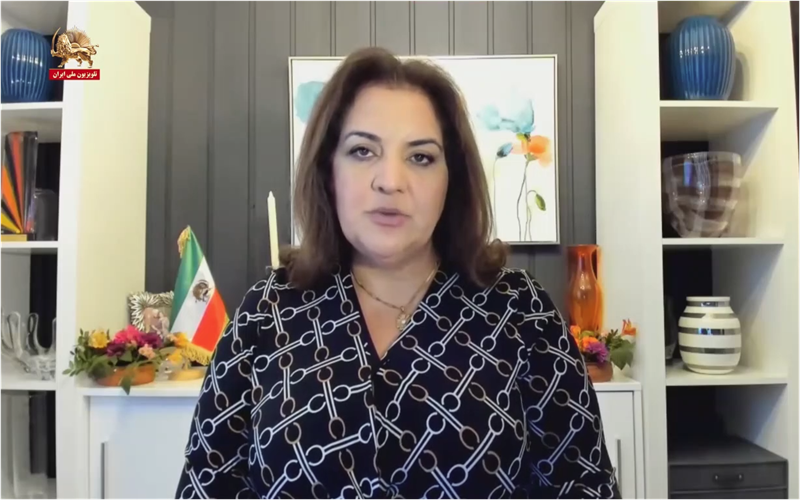

Delaram Dashti describes how supporters of the Iranian Resistance in Norway are campaigning against executions, engaging politicians, and urging Norwegian society to reject silence and appeasement toward the Iranian regime.
The Iranian regime’s escalating use of executions as a tool of repression has prompted growing opposition both inside Iran and abroad. While prisoners across Iran continue to participate in the “No to Execution Tuesdays” campaign, supporters of the Iranian Resistance in European countries are organizing demonstrations, exhibitions, and political meetings to challenge the regime’s execution machine and prevent its crimes from being met with silence.
In Norway, these activities have included repeated demonstrations in Oslo, commemorations of the 1988 massacre of political prisoners, meetings with politicians and civil society representatives, and efforts to raise public awareness about the continuing wave of executions in Iran.
In an interview, Delaram Dashti, a supporter of the Iranian Resistance in Norway, described these activities and their reception among Norwegian citizens and political figures.
Two Fronts of Resistance in Norway
According to Dashti, the activities of Resistance supporters in Norway over recent weeks have largely revolved around two interconnected areas: public activism and political engagement.
The first consists of demonstrations and public actions organized by Resistance supporters, particularly around the demand for an end to executions.
“These actions have not been limited to demonstrations against executions,” Dashti explained. They have also included commemorations of the 1988 massacre of political prisoners, which she described as a major crime whose legacy remains directly relevant to the present.
A large exhibition was held in Oslo, Norway’s capital, focusing on the massacre and the regime’s continuing human rights abuses. According to Dashti, the exhibition attracted considerable attention from Norwegian citizens and left a strong impression on those who visited it.
Regular demonstrations have also been held in central Oslo, including in front of the Norwegian Parliament, to draw attention to executions and political repression in Iran.
The second area of activity involves meetings with Norwegian politicians as well as representatives of civil society and human rights organizations.
The message delivered during these meetings, Dashti said, is centered on executions and repression and on the need to understand why the regime continues to intensify its use of capital punishment.
She argued that the regime has accelerated executions out of fear of another major uprising, using executions to spread fear and suppress popular resistance.
“Silence Gives the Regime a Free Hand”
A central message of the campaign is that international silence cannot be separated from the continuation of executions inside Iran.
Dashti emphasized that Resistance supporters are urging Norwegian politicians, civil society organizations, and the wider public not to remain silent in the face of executions.
“Silence in the face of executions and the regime’s crimes gives the regime a freer hand,” she said, arguing that failing to respond to executions risks allowing further abuses to take place.
For the activists, opposing executions is therefore not simply a humanitarian appeal. It is also a political demand directed at governments and international institutions.
Their message combines a clear rejection of executions with broader demands concerning Iran’s future.
Dashti described this as both a “No” and a “Yes”: a decisive No to executions, appeasement, and foreign war, alongside a Yes to supporting the organized resistance of the Iranian people.
She called on Norwegian politicians and civil society to support the organized resistance and the Resistance Units inside Iran, arguing that fundamental political change in Iran must ultimately come from the Iranian people themselves.
Norwegian Public Response
The demonstrations have also provided an opportunity for Resistance supporters to engage directly with Norwegian citizens.
Dashti said that the public actions, frequently held in central Oslo and near the Norwegian Parliament, have received positive reactions from members of the public.
She pointed to expressions of sympathy and support from Norwegian citizens who encounter the demonstrations and learn about the executions and repression taking place in Iran.
Political participation has also been an important component of these events.
Organizers invite politicians to attend demonstrations and speak publicly in support of the campaign against executions.
Among those who recently participated was Rasmus Hansson, a former representative of Norway’s Green Party. According to Dashti, Hansson expressed support for the Iranian people’s resistance and stressed that the crimes committed by the Iranian regime, both past and present, must not be forgotten.
She said Hansson also emphasized that those responsible for such crimes should ultimately face prosecution before international courts.
Another political figure who participated in one of the demonstrations was Åse Kleveland, a former Norwegian Minister of Culture and Arts.
According to Dashti, Kleveland condemned the regime’s use of executions as an instrument of repression designed to prevent the voices of the Iranian people from reaching the international community.
Her participation, Dashti said, reflected continued support for the Iranian people’s resistance and opposition to the regime’s use of capital punishment to silence dissent.
Taking the Message Beyond Demonstrations
The campaign has not been confined to the streets of Oslo.
Dashti also described participation in an annual political and human rights festival held in August in Arendal, where political figures and representatives of different sectors of Norwegian society gather.
Resistance supporters had an opportunity to maintain a presence there throughout the week and engage directly with politicians attending the event.
For Dashti, the festival demonstrated the openness of Norwegian political debate. Different political parties and currents—from the far left to the far right—were represented, despite their significant disagreements on many political questions.
This environment provided an opportunity for activists to raise the issue of Iran’s executions and repression directly with representatives from across Norway’s political spectrum.
The strategy is therefore based not only on mobilizing supporters but also on bringing the situation in Iran into mainstream political and civil society discussions.
From “No to Executions” to Breaking the Silence
The activities described by Dashti illustrate how the campaign against executions has developed on two parallel levels.
Inside Iran, prisoners participating in the “No to Execution Tuesdays” campaign continue to challenge the regime’s use of capital punishment despite the risks they face.
Outside Iran, supporters of the Resistance are attempting to ensure that these voices are heard beyond prison walls.
In Norway, this has meant taking the campaign into public spaces, organizing exhibitions and demonstrations, engaging politicians, and speaking with civil society representatives.
The objective, as presented by Dashti, is to prevent executions from becoming a routine statistic and to keep international attention focused on the individuals and families affected by the regime’s repression.
The message is straightforward: when the execution machine continues to operate, silence is not neutrality.
For the activists campaigning in Norway, breaking that silence is itself a form of solidarity with those inside Iran who continue to resist repression—and a demand that governments and political leaders refuse to look away.