


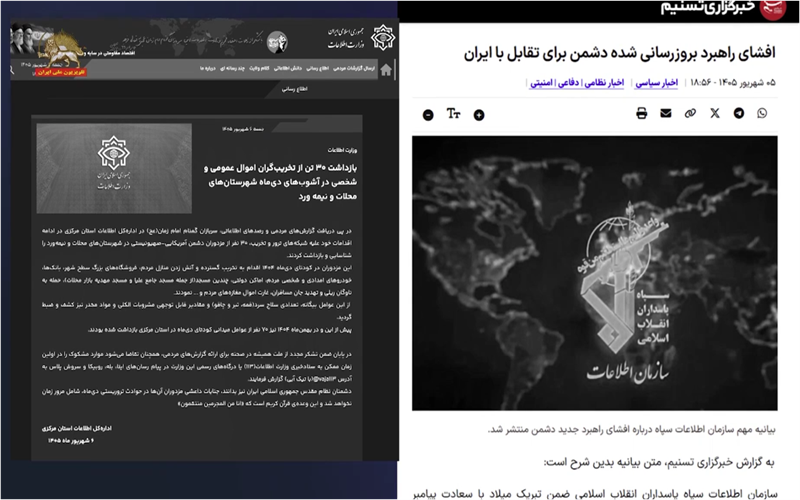

As gasoline pressures, worsening living conditions, and social protests intensify, separate statements by the regime’s Intelligence Ministry and IRGC Intelligence Organization expose growing concern over renewed unrest.
The Iranian regime’s security apparatus has once again provided a revealing glimpse into its fears about the future. As economic pressures mount, the gasoline crisis deepens, and social discontent continues to spread, the regime’s Ministry of Intelligence and the Islamic Revolutionary Guard Corps (IRGC) Intelligence Organization have issued separate statements warning against activities they describe as threats to “public calm.”
Despite their attempts to project confidence and control, the statements reveal a regime increasingly preoccupied with the possibility that accumulated public anger could erupt into another nationwide uprising.
The timing is significant. Rather than announcing measures to address the economic hardships confronting millions of Iranians, the regime’s security agencies are focusing on arrests, surveillance, and preventing protests before they gain momentum.
Intelligence Ministry Announces Arrests Over December Uprising
The regime’s Ministry of Intelligence announced the arrest of 30 people allegedly involved in the December 2025 uprising in Markazi Province.
According to the regime-affiliated Mehr news agency, the detainees had participated in protests in the cities of Mahallat and Nimvar during December 2025 and were accused by the authorities of attacking or setting fire to various public and government-related locations.
The announcement comes months after another wave of arrests in the same province. In February 2026, the authorities reportedly announced the detention of 70 people whom they described as participants in the December unrest.
The decision to publicize additional arrests months after the protests is itself revealing. It indicates that the security apparatus continues to investigate and pursue participants in previous uprisings rather than considering the unrest a closed chapter.
The Ministry of Intelligence also appealed to the public to report “suspicious cases” to its intelligence offices as quickly as possible.
Such appeals are a familiar component of the regime’s internal-security strategy. They seek to turn society itself into an extension of the surveillance apparatus by encouraging citizens to monitor and report one another.
But the broader significance of the announcement lies in what it says about the regime’s assessment of the current situation.
Why Is the Regime Still Hunting Protesters?
The continued pursuit of people associated with previous protests suggests that the authorities remain concerned about the possibility of renewed mobilization.
When a government continues making arrests months after an uprising, it indicates that it sees the networks, experiences, and political consciousness created during those protests as potential catalysts for future unrest.
The regime’s concerns are particularly acute amid worsening economic conditions.
The gasoline crisis and rising cost of living are adding to longstanding grievances over inflation, unemployment, declining purchasing power, corruption, and economic mismanagement.
Instead of resolving these problems, the authorities are once again relying on their security institutions.
This approach reflects a fundamental contradiction: the regime claims stability while simultaneously warning its security forces to prepare for challenges to that stability.
IRGC Intelligence Issues a Carefully Worded Warning
The IRGC Intelligence Organization issued a separate and more extensive statement that sought to project strength while simultaneously revealing concern about internal threats.
The statement claimed that Iran had supposedly moved beyond the stage of merely preserving the survival and existence of the regime and its allied forces, and had entered a phase of consolidating its “resilience.”
It also claimed that Iran’s asymmetric capabilities had been preserved, that the United States had failed to impose its will, and that Iranian control over the Strait of Hormuz remained intact.
These assertions were designed to portray a government that had overcome recent challenges and emerged stronger.
Yet the security priorities outlined in the same statement tell a different story.
The Real Priority: Preventing “Disruption of Calm”
Alongside its claims of strength, the IRGC Intelligence Organization called for vigilance against any action that could “disrupt calm, solidarity, and national cohesion.”
It also called for preventing what it described as hostile security activities inside the country and along the borders and urged continued vigilance against groups labeled by the regime as terrorist organizations.
The language is significant.
If the regime truly believed that it had decisively overcome threats to its survival, there would be little reason to emphasize the need to prevent “disruption” of the internal situation.
The emphasis instead suggests that the security apparatus is preparing for a potentially volatile domestic environment.
The phrase “maintaining calm” is particularly revealing in the context of Iran’s recent history. For the regime’s security institutions, “calm” does not necessarily mean that social grievances have been resolved. It means that those grievances have not yet translated into sustained mass mobilization.
Economic Crisis and Political Fear
The two statements must therefore be viewed against the backdrop of the broader crisis facing the regime.
The gasoline crisis is not an isolated economic problem. Fuel prices and availability directly affect transportation, household expenses, production, and the cost of basic goods. Any further deterioration can quickly translate into broader social anger.
At the same time, economic hardship is occurring alongside political repression and the regime’s continuing use of executions as an instrument of intimidation.
The combination creates a combustible environment: economic grievances provide the immediate trigger, while years of political and social repression have produced deeper resentment.
The regime’s security agencies clearly understand this dynamic.
Their response is not to remove the underlying causes of anger, but to identify potential organizers, arrest participants in earlier protests, intensify surveillance, and warn against any activity capable of bringing different grievances together.
The Contradiction at the Heart of the Regime’s Message
The most revealing aspect of the latest statements is the contradiction between their rhetoric and their security priorities.
On one hand, the IRGC Intelligence Organization claims that the regime has moved beyond the stage of merely ensuring its survival and is becoming increasingly resilient.
On the other hand, the same organization warns of activities capable of disturbing domestic calm and calls for intensified preventive security measures.
The Ministry of Intelligence, meanwhile, continues arresting people months after their participation in an uprising.
This is hardly the behavior of a government confident that its political foundations are secure.
Rather, it points to an apparatus that understands that the next uprising could emerge from the convergence of multiple unresolved crises.
Repression Cannot Arrest Public Anger
The regime can arrest individuals accused of participating in previous protests. It can increase surveillance and threaten citizens with prosecution. It can attempt to prevent demonstrations before they begin.
But none of these measures addresses why people are angry in the first place.
The gasoline crisis, economic hardship, corruption, repression, and lack of political freedoms remain unresolved.
The latest statements from the Ministry of Intelligence and IRGC Intelligence Organization therefore provide an unintended admission: the regime is not simply managing a security problem; it is preparing for the possibility of another confrontation with an increasingly dissatisfied society.
Its warnings about “disrupting calm” and its continuing arrests demonstrate that beneath the rhetoric of resilience lies a profound fear of renewed popular mobilization.
The more the regime relies on preventive repression instead of addressing the grievances driving social unrest, the more clearly it exposes the depth of the crisis it is trying to contain.