
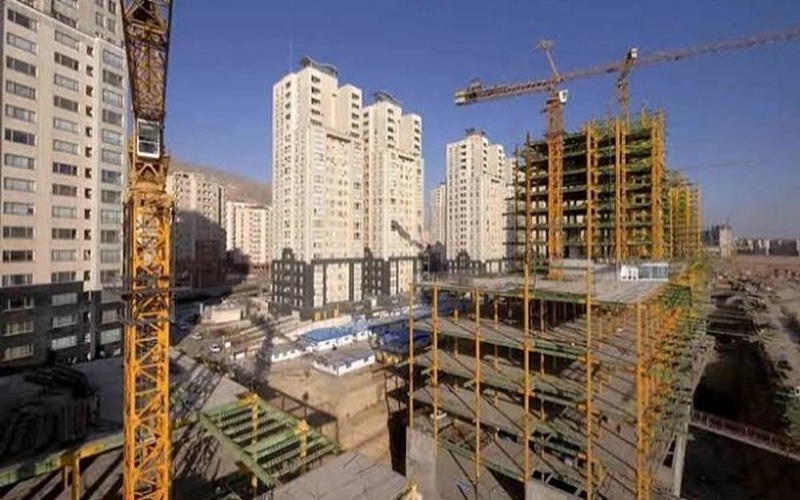

Soaring property prices, collapsing purchasing power, and the regime’s “Khaneh-Riz” scheme expose the depth of Iran’s housing crisis.
Housing, one of the most basic necessities of life and a fundamental component of a dignified existence, has become increasingly inaccessible to ordinary Iranians. Under the regime’s economic policies, a home is no longer primarily treated as a place for families to live. It has become a vehicle for speculation, rent-seeking, and preserving wealth for those with access to capital and political power.
For millions of Iranians, the dream of buying an apartment has already disappeared. Increasingly, even renting a modest home in the country’s major cities is becoming unaffordable.
The depth of the crisis is reflected in an extraordinary response from the authorities: instead of making housing affordable, institutions are promoting schemes that allow citizens to purchase tiny fractions of property. Tehran Municipality has unveiled a scheme known as “Khaneh-Riz”, in which people can effectively invest in housing projects in units as small as one-hundredth of a square meter.
The concept itself illustrates how far the housing crisis has deteriorated. A society that once aspired to own a home is now being offered the opportunity to buy a fraction of a square meter.
Inflation and Economic Contraction Push Housing Beyond Reach
Iran’s housing crisis cannot be separated from the broader economic collapse.
According to World Bank estimates, consumer inflation in Iran reached 42.2 percent in 2025, while economic growth contracted by 2.8 percent. The combination of rapidly rising prices and economic contraction has further widened the gap between household incomes and the cost of housing.
The result is a deeply distorted housing market. Nominal property prices remain extraordinarily high, while the real purchasing power of households continues to deteriorate.
Reports from 2025 describe a market characterized simultaneously by falling transactions and rising nominal prices. This apparent contradiction is in fact a defining feature of the crisis. Ordinary buyers can no longer afford to enter the market, while property owners, viewing their homes as investment assets, have little incentive to reduce prices in an inflationary economy.
The result is a form of stagflation in the housing market: prices remain elevated while transactions and genuine housing demand collapse.
In Tehran, market reports in 2025 placed the average price of residential property at approximately 110 million to 125 million tomans per square meter. At such levels, even households with relatively stable incomes face an increasingly impossible calculation. Saving for a down payment becomes unrealistic as property prices rise faster than wages and the national currency loses value.
Renters Bear the Brunt of the Crisis
The consequences are particularly severe for renters.
Households unable to purchase property are forced to devote an ever-larger share of their income to rent and housing costs. This leaves less money for food, healthcare, education, transportation, and other basic necessities.
The resulting cycle is difficult to escape: higher rents reduce the ability to save; the inability to save prevents home ownership; and continued inflation pushes property prices even further beyond reach.
Structural studies have previously identified weaknesses in Iran’s housing-finance system and the limited access of low-income groups to housing finance as major obstacles to home ownership. But the problem has become much larger than a shortage of mortgage credit. It is now rooted in the broader economic structure, including inflation, currency depreciation, rising construction costs, land prices, labor costs, and the weakness of the banking and credit system.
Instead of addressing these structural problems, the regime has increasingly treated housing as a financial asset.
From Square Meters to Centimeters
It is in this context that Tehran Municipality introduced the Khaneh-Riz scheme.
Under the scheme, each “Khaneh-Riz represents 0.01 square meters of a specified property. Purchasing these units does not give the buyer physical possession of an apartment or even a room. Rather, it represents a financial participation in the project and its potential returns.
The first project offered under the scheme was reportedly the Fajr Project, located on Ayatollah Kashani Boulevard in Tehran. The nine-story development contains 54 residential units and was offered in August 2026.
The minimum investment was reportedly around 2.19 million tomans, while the initial purchase limit for each national identification number was set at 100 Khaneh-Riz units, equivalent to one square meter.
The terminology is revealing.
For years, housing investment schemes have promoted the idea of buying property “by the meter.” Now the unit has effectively been reduced to a hundredth of a meter.
This does not solve the affordability crisis. It changes the nature of participation in the housing market.
Instead of enabling a family to acquire an affordable home, the scheme allows people with very small savings to acquire a financial stake in a property project. It is therefore fundamentally an investment mechanism, not a housing policy.
A Housing Policy That Does Not Provide Housing
There is nothing inherently irrational about fractional investment in real estate. In a transparent financial system, such instruments can provide investors with access to assets that would otherwise be beyond their reach.
But the fundamental question in Iran is different: Does such a scheme make housing more affordable for ordinary families?
The answer is no.
Buying one-hundredth of a square meter does not increase household income. It does not lower the cost of land. It does not reduce construction costs. It does not increase the supply of affordable housing. And it does not give a family a place to live.
At most, it gives a small investor exposure to the financial performance of a housing project.
This distinction is crucial. Presenting such a mechanism as a response to the housing crisis risks shifting attention away from the regime’s responsibility to provide the economic conditions under which citizens can afford adequate housing.
The housing crisis is fundamentally connected to the wider failure to control inflation, create productive employment, stabilize the currency, and establish a functioning and accessible system of housing finance.
Transferring Risk to Small Investors
There are also serious questions surrounding claims about the liquidity and protection offered by the Khaneh-Riz scheme.
Reports have referred to the possibility of selling investments within 72 hours and compensation mechanisms in the event of project failure. But such promises raise important questions about legal guarantees, transparency, valuation, and the operation of the secondary market.
Without independent oversight and fully transparent contracts, small investors can face significant risks. The experience of previous projects, together with concerns about opaque pricing and market volatility, demonstrates why financial innovation without effective supervision can become another channel through which risk is transferred to ordinary citizens.
This is particularly dangerous in an economy where inflation has already eroded household savings.
A low-income family persuaded to place its limited savings into a speculative housing instrument may believe it is taking a first step toward property ownership. In reality, it may simply be assuming the risks associated with a project over which it has little control.
The state and politically connected institutions retain the organizational and financial advantages, while ordinary citizens bear much of the downside risk.
The Deeper Problem Is Economic, Not Financial
The Khaneh-Riz scheme cannot resolve Iran’s housing crisis because the crisis is not fundamentally caused by a lack of financial instruments.
It is caused by an economic structure in which inflation, currency depreciation, land speculation, weak credit markets, high construction costs, and politically connected rent-seeking have combined to make housing increasingly unaffordable.
The regime can divide a property into square meters, centimeters, or even smaller financial units. But changing the unit of investment does not change the underlying economics.
If household incomes continue to fall in real terms while property prices and rents continue to rise, fractional ownership will not create affordable housing.
At best, such schemes may temporarily attract small amounts of household savings. At worst, they could create a parallel speculative market vulnerable to delays, opaque valuations, contractor failures, and loss of public confidence.
A Symbol of a Broader Failure
Iran’s housing crisis is therefore more than a technical failure of housing policy. It is a visible manifestation of the regime’s broader economic dysfunction.
A country endowed with enormous natural resources and substantial national wealth is witnessing a growing number of citizens unable to afford an ordinary home. The extraordinary step of reducing housing investment to one-hundredth of a square meter is itself a powerful measure of how dramatically purchasing power has deteriorated.
The issue is not that Iranians have suddenly forgotten how to buy homes. The problem is that decades of inflationary policies, economic mismanagement, rent-seeking, and the concentration of wealth have pushed housing beyond the reach of a growing portion of society.
The regime’s answer has been to financialize the crisis rather than solve it.
But housing is not merely another speculative asset. It is a basic human need. A policy that enables citizens to purchase a fraction of a property while leaving the underlying affordability crisis untouched cannot substitute for a genuine housing policy.
Until the structures that produce inflation, economic insecurity, rent-seeking, and concentrated wealth are fundamentally changed, schemes such as Khaneh-Riz will remain symptoms of the crisis rather than solutions to it.
The transformation of housing from a basic necessity into a speculative commodity—and finally into a hundredth of a square meter for sale—is perhaps the clearest symbol yet of how far Iran’s economic crisis has penetrated the daily lives of its people.