


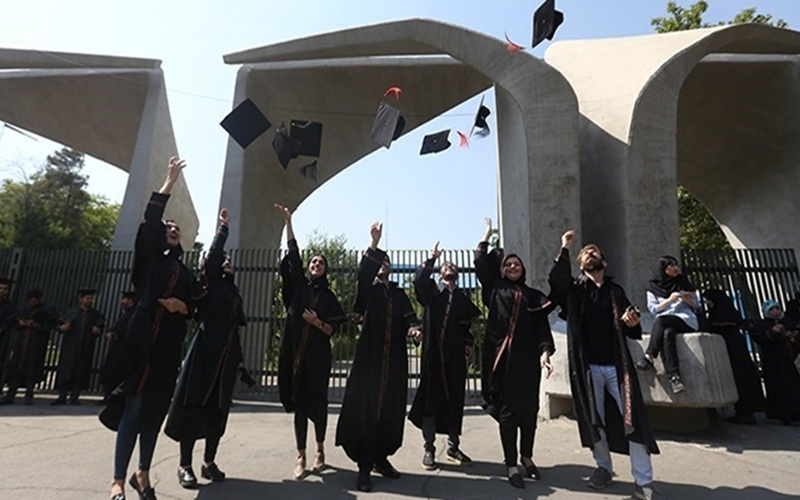

Figures published by the regime’s own Arman-e Melli daily reveal a stark imbalance in access to public universities, raising questions about education, social mobility, and the future of millions of Iranian families.
The Iranian regime’s deepening class-based policies are no longer confined to wages, housing, healthcare, or access to basic necessities. They are increasingly shaping who gets access to higher education—and, consequently, who gets a realistic chance at a better future.
A revealing report published by the regime-affiliated Arman-e Melli daily on August 26, 2026, exposes the extent of this divide. According to figures cited by the newspaper, students from the three lowest income deciles account for only about 5.6 percent of more than 500,000 students enrolled in Iran’s public universities. By contrast, students from the eighth through tenth income deciles account for approximately 62 percent.
The figures offer a stark picture of an education system in which economic status increasingly determines educational opportunity.
When University Stops Being a Ladder of Social Mobility
For decades, university education was regarded by many Iranian families as one of the principal avenues for escaping poverty and improving their children’s social and economic position.
That promise is now increasingly being eroded.
The statistics cited by Arman-e Melli indicate that students from poorer households are dramatically underrepresented in public universities, while students from the wealthiest sections of society occupy a disproportionately large share of available places.
This means that the university system is no longer functioning primarily as a mechanism for upward social mobility. Instead, it is increasingly reflecting and reinforcing inequalities that already exist outside the classroom.
The implications extend beyond admission itself. Access to higher education can determine future employment opportunities, income, professional status, and social networks. Students who are excluded from quality educational opportunities may subsequently find themselves excluded from the professional networks that can help secure employment and improve economic prospects.
In this sense, educational inequality can reproduce itself from one generation to the next.
The Entrance Exam Begins Long Before the Exam
The university entrance examination, or konkur, is formally presented as a competition based on academic ability.
But the figures highlighted by the regime’s own newspaper suggest that the competition is far from equal.
As Arman-e Melli acknowledges, the entrance examination increasingly reflects the educational resources and disadvantages that students have accumulated throughout their school years.
Students from affluent families can often benefit from better schools, private tutoring, preparatory courses, educational materials, technology, and more favorable living conditions.
Poorer families face the opposite reality.
When household income is consumed by food, housing, transportation, healthcare, and other basic necessities, spending thousands of dollars—or its equivalent in Iran—on private education and specialized preparation becomes impossible for many families.
Consequently, what appears to be a competition taking place on the day of the entrance examination may actually have been shaped years earlier.
The Middle Class Becomes the Hidden Loser
The widening educational divide is also putting pressure on Iran’s middle class.
The Arman-e Melli report describes this group as the “hidden loser” of the educational competition, as rising costs of education, housing, and everyday life push a growing portion of the middle class away from access to quality education.
This is particularly damaging because the middle class has traditionally played an important role in expanding educational attainment and professional expertise.
When families can no longer afford quality education, education itself changes from an investment in the future into an expense that must be reduced or abandoned.
The consequences are not limited to the individual student. They affect the country’s future human capital.
A society that systematically restricts educational opportunities according to income risks wasting the abilities of large sections of its younger generation.
Public Universities Lose Their Value
The class-based transformation of education also creates a second problem.
As poorer and middle-income families find it increasingly difficult to secure access to high-quality public education, those who can afford it are pushed toward private schools, private tutoring, and other paid educational services.
This creates a lucrative market around an increasingly unequal education system.
Families are effectively compelled to spend more simply to give their children a chance to compete.
Meanwhile, the deterioration of public education undermines confidence in the very institutions that are supposed to provide equal opportunity.
The result is a vicious cycle: inequality produces unequal educational opportunities; unequal education reproduces inequality; and the resulting loss of confidence pushes families with sufficient resources toward private alternatives.
Destroying Faith in the Future
Perhaps the most damaging consequence is psychological and social.
When young people come to believe that academic effort does not necessarily translate into social mobility, professional opportunity, or a better life, confidence in the future begins to erode.
The problem is therefore larger than university admissions.
It concerns the social contract between education and opportunity.
If a student studies for years but discovers that economic circumstances largely determined the outcome before the entrance examination even began, the message is clear: merit alone may not be enough.
The consequences can include frustration, declining trust in institutions, and growing perceptions of injustice among younger generations.
An Education System That Reproduces Inequality
The figures cited by Arman-e Melli expose a contradiction at the heart of the Iranian regime’s education system.
Education is ostensibly supposed to reduce inequality by giving people the opportunity to develop their abilities regardless of their family background.
Yet the current structure is increasingly doing the opposite.
Instead of serving as a bridge out of poverty, higher education is becoming another mechanism through which existing class boundaries are maintained.
The consequences reach far beyond universities. When access to education becomes increasingly dependent on household income, the class structure of today becomes the professional and economic structure of tomorrow.
Iran’s young people are consequently inheriting not only their families’ economic circumstances but also an increasingly unequal distribution of educational opportunity.
The figures published by the regime’s own media should therefore be read as more than statistics. They reveal a society in which economic inequality is penetrating one of the most important foundations of social mobility.
Under such conditions, the university ceases to be a ladder for those seeking to escape poverty and instead becomes another wall separating the privileged from the rest of society.
And when a government’s economic and educational policies leave millions of families with diminishing faith that their children can build a better future through education, the damage is not merely financial.
It strikes at the country’s social fabric, human capital, and confidence in the future itself.