


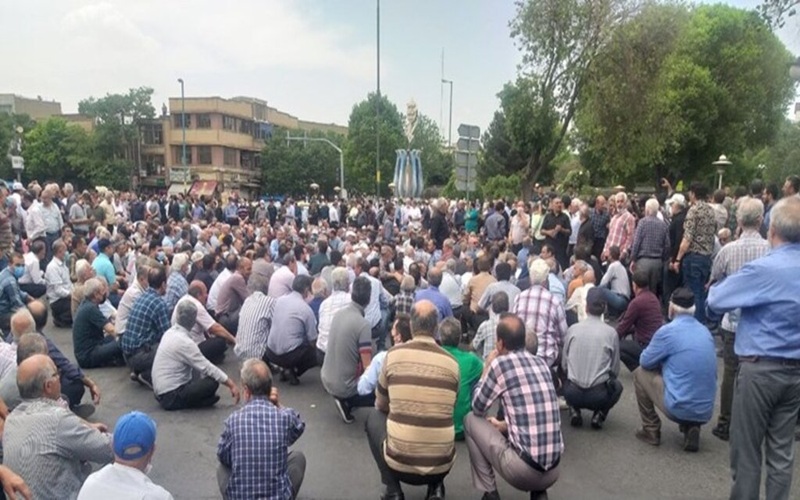

As inflation erodes retirement incomes and medical costs soar, Iran’s retirees face shrinking insurance coverage and mounting out-of-pocket expenses.
For millions of Iranian retirees, retirement has brought neither security nor dignity. After decades of work, many now face inadequate pensions, relentless inflation, and medical expenses they can no longer afford. As the cost of basic necessities rises, healthcare has become one of the most painful dimensions of the crisis.
The problem is not limited to the amount retirees receive each month. The healthcare system itself is increasingly failing to provide the protection that elderly people need most.
Retirees protesting across Iran have repeatedly raised concerns about supplementary health insurance, arguing that coverage is becoming more expensive while the services provided are increasingly limited.
Supplementary Insurance: More Payments, Less Protection
Supplementary insurance is supposed to fill the gaps left by basic health coverage. But for many Iranian retirees, it has become another financial burden.
Retirees are required to pay additional premiums, often deducted directly from already inadequate pensions, while many important medical services remain outside effective coverage. Patients can consequently find themselves paying substantial amounts for medicines, examinations, treatments, and other healthcare needs.
The contradiction is stark: those who are most vulnerable to illness are being asked to spend an increasing share of their limited income simply to obtain access to healthcare.
For an elderly population facing chronic illnesses and greater medical needs, inadequate insurance can quickly turn illness into financial catastrophe.
A Sharp Contrast With European Healthcare Systems
The scale of the problem becomes clearer when Iran is compared with countries where healthcare is treated as a social protection rather than a commodity.
In Italy, for example, healthcare is provided through the country’s national health service, and the distinction between working-age people and retirees does not determine whether someone is entitled to essential medical treatment. Major surgeries, emergency treatment, chronic disease care, and other essential services are largely covered through the public system.
Patients may be required to make limited payments for certain specialist consultations or procedures, commonly known as ticket payments. However, these are generally limited compared with household incomes, and exemptions are available for various categories, including people with particular medical or economic circumstances.
The comparison highlights the fundamental problem confronting Iranian retirees. Healthcare is not merely becoming expensive; access to adequate treatment is increasingly determined by a person’s ability to pay.
When Patients Cannot Afford Their Medicines
The consequences extend beyond retirees.
Iran’s healthcare crisis is increasingly visible in heartbreaking accounts of families unable to pay for medicines, doctors confronting patients who cannot afford prescribed treatment, and households forced to choose between healthcare and food.
When a physician hesitates to prescribe a medicine because the patient cannot afford it, the healthcare crisis has moved beyond questions of insurance administration. It has become a broader crisis of poverty.
For elderly people living on fixed incomes, inflation makes the situation particularly severe. Pension payments do not automatically increase in line with the price of medicines, medical services, food, rent, and other necessities. Every surge in prices therefore reduces their ability to maintain both their standard of living and their health.
Retirees Are Taking Their Grievances to the Streets
These pressures have contributed to recurring demonstrations by retirees in cities across Iran.
Their demands often include higher pensions, protection against inflation, and meaningful healthcare coverage. But their protests increasingly reflect a broader rejection of the conditions imposed upon them.
The elderly workers who spent decades contributing to the country’s economy now find themselves protesting simply to secure basic rights in old age.
Their situation also exposes a wider contradiction in the Iranian economy: while enormous resources are controlled and spent by state institutions and powerful networks, ordinary citizens are increasingly forced to finance basic necessities out of shrinking household incomes.
A Crisis That Goes Beyond Healthcare
The deterioration of healthcare cannot be separated from Iran’s wider economic crisis.
Inflation, declining purchasing power, inadequate pensions, unemployment, corruption, and the erosion of public services reinforce one another. A retiree who cannot afford food will struggle to afford medicine. A family that cannot afford medicine may postpone treatment until a manageable illness becomes an emergency.
This creates a vicious cycle in which poverty produces illness, illness produces additional expenses, and those expenses deepen poverty.
For many Iranians, the problem therefore goes beyond reforming an insurance policy. The growing protests reflect a much deeper demand for a system in which basic social rights are not sacrificed to economic mismanagement and institutional interests.
Iran’s retirees are asking a fundamental question: after decades of work and contributions to society, why should they have to choose between food and medical treatment?
Their protests demonstrate that the healthcare crisis is not an isolated problem. It is one of the clearest expressions of a broader social and economic breakdown—one that cannot be permanently contained by reducing benefits, increasing costs, or asking impoverished citizens to pay more for less.