

Mojtaba Khamenei’s calls for “unity” have failed to silence open disputes among regime factions, revealing a leadership increasingly consumed by fears of renewed popular unrest.
The Iranian regime’s repeated calls for “unity and cohesion” are increasingly revealing the opposite: deepening divisions at the highest levels of power. Recent statements by regime officials show that Mojtaba Khamenei’s attempts to impose discipline on rival factions have failed to silence disputes that are increasingly spilling into the open.
The central issue behind these divisions is not merely a struggle over political influence or economic interests. Increasingly, the dispute is over how the regime can survive mounting economic and social pressures—and the threat of another nationwide uprising.
On August 30, Mojtaba Khamenei called on the regime’s competing factions to preserve unity and warned against actions or statements that could undermine cohesion. Yet events immediately demonstrated the limits of his authority.
Pezeshkian Challenges the Call for Silence
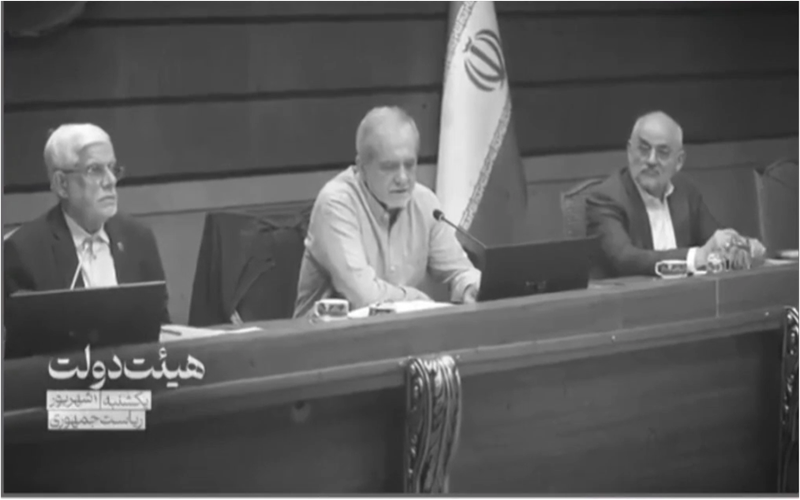
President Masoud Pezeshkian had already publicly expressed his frustration with the regime’s state broadcaster, IRIB, criticizing its coverage and saying that even he, as someone committed to the regime, no longer wanted to watch it.
He warned that the regime needed “unity and cohesion” more than ever. But his remarks came amid increasingly open disputes over the government’s policies, negotiations with the United States, the economic crisis and the regime’s handling of mounting social pressure.
More significantly, on the same day that Mojtaba Khamenei issued his call for unity, Pezeshkian made remarks that directly contradicted the message coming from the new supreme leader.
Rather than concealing the regime’s weaknesses, he acknowledged the gravity of the situation, warning that the country was “on the edge of the precipice.” He also called for attention to the deteriorating social situation and warned against placing additional pressure on the population.
The contradiction did not go unnoticed inside the regime. Saberin News, a channel affiliated with the Islamic Revolutionary Guard Corps (IRGC), publicly rebuked Pezeshkian, effectively telling him that the supreme leader’s message had apparently not reached him.
The exchange illustrates a fundamental problem for Mojtaba Khamenei: his directives are increasingly failing to function as the unquestioned command from above that they are intended to be.
A Struggle Over How to Save the Regime
The disagreements are becoming particularly sharp over how the regime should respond to its mounting crises.
One faction presents confrontation and war as a means of preserving the system and strengthening its ability to suppress domestic opposition. Others argue that negotiations and de-escalation are necessary to prevent further deterioration.
Similar divisions have emerged over negotiations with Washington. While one faction describes an understanding with the United States as humiliating, Pezeshkian has presented it as an achievement.
Even economic policies have become a source of open disagreement. As the population faces worsening inflation and declining purchasing power, the government has discussed measures such as raising gasoline prices, further threatening an already volatile social environment.
These disputes are occurring against a backdrop of severe economic pressure. Economic analyst Hossein Raghfar has acknowledged that public dissatisfaction is at its highest level in five years. Meanwhile, the dollar has climbed beyond 209,000 tomans, adding further pressure to households already struggling with inflation.
The Pressure From Below Is Producing Fractures Above
The relationship between social pressure and elite fragmentation is increasingly visible.
As economic hardship, poverty and political repression intensify, public dissatisfaction grows. That pressure does not remain confined to society. It penetrates the ruling structure itself, turning disagreements over policy into increasingly fundamental disputes over survival.
This explains the extraordinary emphasis on “unity” in recent statements from Mojtaba Khamenei and other senior officials.
Mojtaba’s message effectively warned regime officials not to publicly expose disagreements and to avoid statements that could undermine cohesion. But such an instruction raises an obvious question: Why is the leadership so concerned about the public visibility of its internal disputes?
The answer lies in its fear of society.
A divided ruling structure facing an increasingly dissatisfied population is far more vulnerable to a new uprising. The regime therefore needs to project unity precisely because it fears that visible fractures could encourage people to challenge it.
The Security Apparatus Is Preparing for Unrest
The regime’s security institutions have made the same fear increasingly explicit.
In a recent statement, the IRGC intelligence apparatus warned about the possibility of increased social dissatisfaction and street protests, referring to efforts to undermine the regime’s “national resilience” and disrupt its internal alignments.
The regime’s continued deployment of security forces in the streets likewise reflects its concern that unrest could erupt again.
These preparations reveal an important contradiction. The regime claims that its society is secure and its leadership unified, while simultaneously deploying extensive security resources and repeatedly warning officials about the possibility of street protests.
The more frequently the regime invokes unity, the more clearly its divisions become visible. And the more urgently it warns against unrest, the more evident its fear of another uprising becomes.
The struggle at the top has therefore moved beyond ordinary factional rivalry. With the regime confronting profound economic and social pressure, the central question increasingly confronting its rival factions is not simply who controls the system, but whether the system itself can survive.
That is why Mojtaba Khamenei’s calls for unity have so far failed to resolve the crisis. The pressure driving the divisions comes from below—and no decree from above can permanently suppress it.