
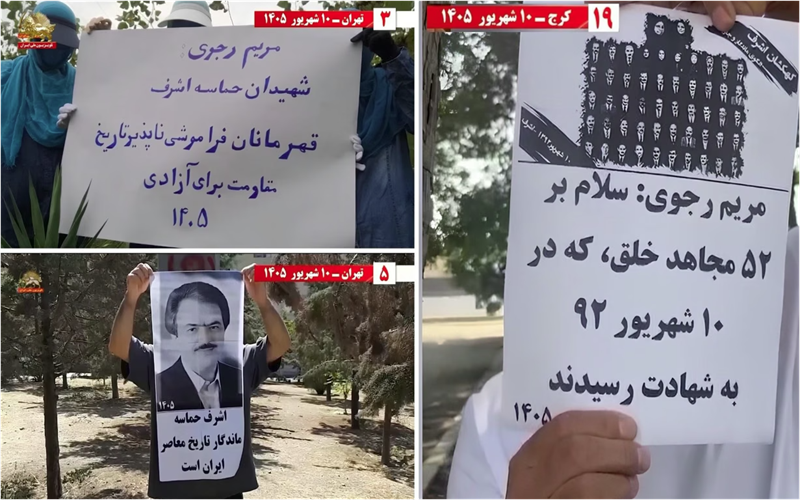

Resistance Units in Tehran, Karaj, Shiraz, Mashhad, Kermanshah, Kerman, and other cities marked the anniversary of the September 1, 2013 massacre at Camp Ashraf, honoring the victims and reaffirming their commitment to freedom.
On September 1, Resistance Units in cities across Iran carried out a series of commemorative actions marking the anniversary of the 2013 Camp Ashraf massacre, honoring the 52 members of the People’s Mojahedin Organization of Iran (PMOI/MEK) who were killed at Camp Ashraf.
Camp Ashraf, located in Iraq, had served for decades as the principal home of thousands of PMOI members. On September 1, 2013, an armed assault on the camp killed 52 residents and left seven others missing. U.S. officials subsequently said that Iranian regime-linked forces had helped plan and direct the attack, while armed groups affiliated with Tehran carried it out. The massacre became one of the most prominent attacks against the PMOI following the organization’s relocation to Iraq.
The victims are commemorated by supporters of the Iranian Resistance as symbols of steadfastness and sacrifice in the struggle against the regime. The anniversary has consequently become an occasion for remembering those killed while reaffirming opposition to repression and the demand for a free and democratic Iran.
This year, young Resistance Units in Tehran, Karaj, Shiraz, Mashhad, Kermanshah, Kerman, Kazerun, Kamyaran, Masal, and Bojnurd marked the anniversary through posters, photographs, memorial displays, candles, and public tributes.
In Tehran, activists organized a memorial table with flowers, candles, and photographs of the Ashraf victims. A recorded message accompanying the display described the 52 victims as an enduring symbol of resistance, sacrifice, and perseverance, and pledged that the Resistance Units would continue their struggle until freedom and the overthrow of the regime. Posters carried messages including: “Ashraf is an enduring epic in contemporary Iranian history” and “The martyrs of the Ashraf epic are unforgettable heroes in the history of resistance for freedom.” Another poster stated: “Ashraf was drenched in blood, but it did not fall silent; from its blood, a thousand Ashrafs arose.”
In Karaj, activists arranged printed leaflets in a large display commemorating the September 1 victims. Messages honored the “heroes of the Ashraf galaxy,” recalled the 52 people killed in 2013, and pledged renewed commitment to their ideals. Similar commemorative posters were displayed in Shiraz, emphasizing Ashraf as a symbol of freedom and equality.
In Mashhad, activists held photographs of the victims accompanied by messages honoring those killed and declaring that their memory would be kept alive. In Kermanshah, colorful posters displayed photographs of the victims alongside messages describing the Ashraf martyrs as an unforgettable part of Iran’s history of resistance.
In Kerman, activists displayed a poster honoring the 52 PMOI members killed on September 1, 2013. In Kazerun, a leaflet marked the anniversary of the “glorious September 1 epic” and honored those who died.
In Kamyaran, activists conducted a photo action featuring the Ashraf victims and messages calling them unforgettable heroes in the struggle for freedom. In Masal, photographs and posters carried messages honoring the victims and declaring that Ashraf, through its martyrs, had become a symbol of resistance. Activists also pledged to renew their commitment to the path of those killed.
In Bojnurd, a commemorative leaflet was displayed with the message: “Long live the memory of the heroes of the Ashraf galaxy on September 1.”
Across these actions, the same central theme was repeated: remembrance is inseparable from resistance. By bringing the memory of Camp Ashraf’s victims into public spaces, the Resistance Units sought to preserve their legacy and connect the anniversary with the continuing struggle against repression.
The nationwide commemorations also underscored the enduring significance of September 1, 2013, for supporters of the Iranian Resistance. More than a decade after the massacre, the names and images of the victims continue to be invoked as symbols of perseverance, sacrifice, and the aspiration for a future Iran free from dictatorship.