


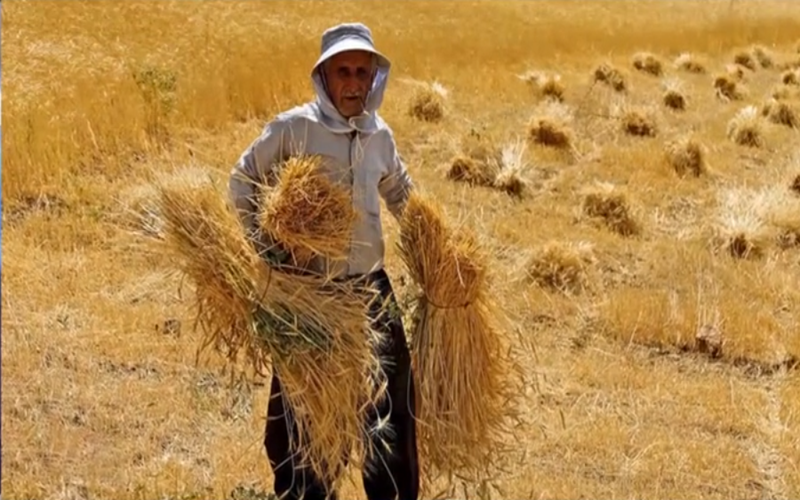

Despite legal guarantees requiring timely payment and compensation for delays, the regime kept a substantial share of wheat farmers’ earnings for months, disrupting their livelihoods and the next planting season. Discrepancies in official production and procurement figures also raise serious questions about the regime’s claims of wheat self-sufficiency.
Iran’s wheat farmers have once again been left struggling with delayed payments, rising production costs, and uncertainty over the next planting season. Although the regime takes delivery of their harvest and stores the wheat for distribution, many farmers have had to wait months to receive the money they are owed.
The problem goes beyond the delayed payment of agricultural earnings. Farmers must purchase seeds, fertilizers, pesticides, and fuel, pay workers, settle debts, and prepare their land for the next planting season. When the government withholds payment for months, it deprives them of the working capital needed to keep their farms operating.
The regime’s own laws provide for guaranteed purchases, timely financing, and compensation for payment delays. Yet official reports and statements by regime institutions reveal a persistent gap between these legal obligations and actual practice.
Guaranteed wheat purchases: Legal promises, practical obstacles
Iran’s Guaranteed Purchase of Agricultural Products Law, adopted in 1989, obliges the government to purchase essential agricultural products, including wheat, at guaranteed prices. The system was intended to give farmers a reliable market for their produce and encourage domestic production.
An amendment adopted in 2020 further stipulated that guaranteed prices must reflect actual production costs, including the prices of seeds, fertilizers, pesticides, machinery, labor, inflation, and a reasonable profit for farmers.
The government is also required to announce the guaranteed purchase price by the end of July, before farmers enter the next agricultural cycle. This allows them to calculate their expected income and decide whether cultivation will be economically viable.
However, the regime has repeatedly failed to provide farmers with the certainty these provisions are supposed to guarantee.
On November 4, 2026, the regime’s agriculture minister said he hoped the final guaranteed purchase price for the 2026–2027 agricultural year would be determined the following week.
By then, the new planting season was already underway. Farmers were expected to buy seeds and fertilizers and commit to substantial expenses without knowing the guaranteed price at which the government would purchase their next harvest.
The uncertainty over prices compounds the financial pressure created by delayed payments for the previous year’s crop.
Unpaid wheat dues: Official figures expose the scale of the delays
The payment delays have been particularly damaging because wheat farmers depend on the proceeds from their harvest to finance the next agricultural cycle.
The regime’s own Court of Audit reported on July 11, 2026, that less than 31 percent of wheat farmers’ outstanding payments had been settled by that date. In other words, more than 69 percent of their dues remained unpaid.
The situation was also acknowledged by members of the regime’s parliament. On September 14, 2026, a member of its Agriculture Commission stated that, despite more than six months having passed since the harvest, approximately 40 percent of wheat farmers’ payments in Khuzestan Province remained outstanding.
Subsequent official announcements presented a picture of gradual settlement:
- October 9, 2026: The head of the regime’s Targeted Subsidies Organization announced that, out of approximately 410 trillion tomans owed to wheat farmers, 392 trillion tomans had been paid.
- November 4, 2026: Authorities announced another payment of 16.9 trillion tomans, bringing total payments to approximately 404.7 trillion tomans. They declared that the dues of farmers who had delivered their wheat by November 1 had been settled.
However, the announcement of eventual payment does not erase the financial damage caused by months of delay.
Farmers who delivered their harvest in April or May and received their money only in October or November had already spent months without the income needed to maintain their operations. During that period, they faced difficulties purchasing agricultural inputs, repaying debts, and preparing their land for the next planting season.
Moreover, farmers continued to report outstanding amounts, including five percent of payments that they said should have been received by June 5.
The regime’s own laws provide for compensation, but farmers receive nothing
The legal framework governing guaranteed purchases also recognizes that delayed payments impose financial losses on farmers.
An amendment to the Guaranteed Purchase Law adopted in 2004 provides for additional payments when the government delays settling its obligations by more than one month. The compensation is calculated on a daily basis, using the interest rate for medium-term bank deposits announced by the regime’s Central Bank.
A further amendment in 2020 required the Planning and Budget Organization to allocate 100 percent of the necessary funding for guaranteed purchases simultaneously with the purchases themselves.
In other words, the law explicitly requires the government to make the necessary funds available when it takes delivery of agricultural products. It also recognizes the need to compensate farmers when payments are delayed.
The regime has disregarded these provisions.
The financial consequences can be illustrated using the outstanding payments reported in Khuzestan. Based on the announced total wheat procurement payments of 404.7 trillion tomans, the approximately 40 percent that remained unpaid in September represented 161.88 trillion tomans.
Using a 20.5 percent annual interest rate for one-year bank deposits in 2026, the compensation calculated for a period of approximately six months would amount to roughly 16.6 trillion tomans. A calculation extending the delay to the full period through November would produce an even higher figure.
This is compensation in addition to the principal amount owed to farmers. Yet the regime’s announcements focused on the eventual settlement of the original payments, without addressing the losses farmers suffered while waiting.
The government effectively used money belonging to farmers for months, while leaving them to bear the consequences of inflation, lost purchasing power, and mounting production costs.
The missing 5.5 million tons: Questions over the regime’s wheat self-sufficiency claims
The financial crisis facing wheat farmers is accompanied by another problem: serious discrepancies in the regime’s official figures on wheat production, guaranteed purchases, and imports.
According to figures attributed to the Ministry of Agriculture, Iran produced approximately 14 million tons of wheat during the 2025–2026 agricultural year. However, the reported volume of wheat purchased under the guaranteed procurement program was only 8.5 million tons.
The difference amounts to 5.5 million tons.
Where did this wheat go?
Regime officials have suggested that a substantial portion remained in farmers’ possession. However, this explanation raises further questions about how such a large volume could remain outside the official procurement system while the country faces concerns over domestic supply.
There are also questions about the country’s actual wheat requirements. If approximately 10 million tons are needed for bread production alone, how could guaranteed purchases of just 8.5 million tons meet domestic demand?
Other unanswered questions concern the quantity of wheat allocated to industrial consumption and the discrepancy between reported domestic production and import requirements.
Despite claims of 14 million tons of domestic production, reports have pointed to the import of approximately one million tons of wheat, while discussions have also emerged about importing another three million tons.
Such imports would impose an additional burden on the country’s already strained foreign currency resources.
These discrepancies were also raised in a November 2026 report by the regime-affiliated Kayhan newspaper, which questioned the official production and procurement figures.
The Ministry of Agriculture, the Planning and Budget Organization, and the Ministry of Industry, Mine and Trade must explain where the missing 5.5 million tons went, why imports are being considered despite claims of self-sufficiency, and how the country’s actual wheat balance is being calculated.
Farmers bear the cost of a system that breaks its own promises
The wheat crisis exposes a broader pattern in the regime’s treatment of Iran’s agricultural sector. Farmers are expected to sustain domestic production, absorb rising costs, and contribute to food security, while the government fails to honor even the basic financial obligations established by its own laws.
The problem is not limited to the price paid for wheat. It extends from the difficulties farmers face when delivering their harvest to the months they must wait for payment, the failure to compensate them for delays, and the uncertainty surrounding the next agricultural season.
By withholding payments, the regime transfers the financial burden of its failures directly onto farmers. Even when the principal is eventually paid, the lost time, diminished purchasing power, accumulated debts, and disruption of the next production cycle cannot simply be reversed.
The unanswered questions surrounding wheat production, procurement, and imports further undermine the regime’s claims of agricultural self-sufficiency.
For Iran’s farmers, the consequences are immediate: a year of labor and investment ends not with financial security, but with unpaid earnings, mounting liabilities, and uncertainty over whether they can afford to plant again.