
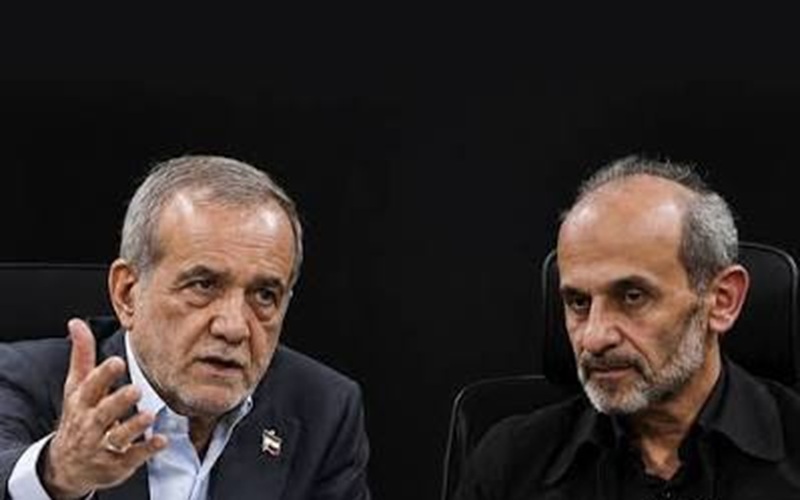

A public dispute between Masoud Pezeshkian and the state broadcaster’s chief reveals growing tensions inside the regime, coming despite renewed calls from Mojtaba Khamenei for unity.
A public exchange between regime President Masoud Pezeshkian and Peyman Jebelli, head of Iran’s state broadcaster, has exposed another layer of growing factional tensions at the top of the regime. The dispute is particularly revealing because it erupted almost immediately after Mojtaba Khamenei called for unity and warned against political “dualities” within the ruling establishment.
A new public dispute between Masoud Pezeshkian and Peyman Jebelli, head of the Islamic Republic of Iran Broadcasting (IRIB), has brought internal tensions within the Iranian regime into the open.
What began as criticism of state television’s coverage has developed into an unusually direct exchange between the regime’s president and the head of its main propaganda apparatus. More importantly, the confrontation comes at a time when the regime’s leadership is publicly demanding greater unity amid mounting political, economic, and military pressures.
Pezeshkian Criticizes State Television
Pezeshkian recently criticized state television, questioning its coverage and suggesting that its reporting does not accurately reflect his positions or those of his administration.
He complained that he himself had become reluctant to watch state television, despite his stated commitment to the regime and its institutions.
The criticism reportedly focused in part on the broadcaster’s treatment of his positions concerning negotiations. According to the remarks attributed to Pezeshkian, statements that he had made in defense of negotiations were either not broadcast or were subjected to censorship.
The complaint was significant because it was directed at an institution under the direct control of the regime’s establishment rather than at an opposition media outlet.
Jebelli Responds Directly on Air
The response from Jebelli elevated the dispute to another level.
Rather than allowing the criticism to pass or addressing it through private channels, the head of state television responded publicly on air, reportedly accusing the president of presenting a weak or incorrect narrative.
The timing was particularly striking. Pezeshkian’s original remarks dated back to September 1, but they were broadcast roughly a week later. The delayed airing, followed by Jebelli’s public response, gave the confrontation an additional political dimension.
A direct public clash between the regime’s president and the head of its state broadcaster is unusual precisely because both occupy positions within the same ruling structure. Their exchange therefore provides a visible indication of tensions that extend beyond an ordinary disagreement over media coverage.
Clash Despite Calls for “Unity”
The dispute becomes even more significant when placed alongside a recent message from Mojtaba Khamenei, who had called for unity and social cohesion within the regime’s ranks.
Khamenei specifically warned against what he described as artificial political dualities, including divisions framed around war versus negotiations, moderation versus extremism, or compromise versus warmongering.
He argued that such divisions had already caused damage and could cause further losses.
Yet almost immediately after this appeal, the public confrontation between Pezeshkian and state television emerged.
The timing underscores the difficulty facing the regime’s leadership: calls for unity from above do not necessarily translate into political cohesion below.
Pressure Is Exposing the “War of the Wolves”
The dispute is unfolding against a backdrop of multiple and overlapping crises confronting the regime.
The leadership is dealing with the consequences of war and military losses while simultaneously facing economic deterioration, social discontent, international pressure, and growing political uncertainty.
Under such circumstances, disagreements that might previously have remained behind closed doors increasingly spill into public view.
The confrontation over state television therefore appears to be more than a dispute about broadcasting policy. It reflects a deeper struggle over who controls the political narrative, how the regime presents its failures and decisions to the public, and which faction will bear responsibility for increasingly difficult conditions.
As pressure intensifies, competing factions have greater incentives to distance themselves from unpopular decisions and shift responsibility onto their rivals.
This dynamic helps explain why the regime’s internal “war of the wolves” becomes increasingly visible during periods of crisis. Calls for unity may temporarily suppress open confrontation, but they cannot eliminate the underlying contradictions between factions competing for influence and attempting to protect themselves from the consequences of the regime’s failures.
The Pezeshkian–Jebelli confrontation is therefore another indication that the regime’s internal cohesion remains fragile. The fact that such a dispute surfaced so publicly—and so soon after an explicit appeal for unity—suggests that mounting external and internal pressures are making it increasingly difficult for the ruling establishment to conceal its divisions.