


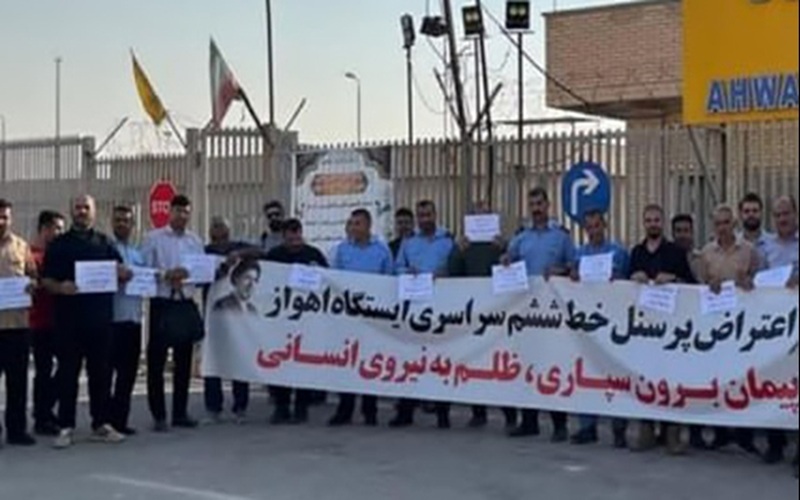

As the rial plunges and living costs soar, workers, pensioners, teachers, and unemployed youth are taking to the streets across Iran over wages, jobs, and basic survival.
Iran’s economic crisis is generating a widening wave of protests across the country as the collapse of the rial pushes the cost of food, housing, and essential services beyond the reach of millions of households.
The dollar reached 233,000 tomans in Tehran on September 10, adding to fears of another wave of price increases. At the same time, workers, pensioners, teachers, and unemployed young people have staged demonstrations in Tehran, Isfahan, Sari, Ahvaz, Shush, Rasht, Kermanshah, Ilam, and Sirjan.
The protests remain dispersed and are largely centered on wages, pensions, employment, and working conditions. But their simultaneous emergence across different sectors and regions highlights the depth of the economic pressures facing Iranian society.
Pensioners and teachers struggle to survive
Pensioners from Iran’s Social Security Organization gathered in Rasht, Shush, and Ahvaz, protesting that their monthly pensions no longer cover even half of their basic expenses.
Telecommunications retirees also demonstrated in Isfahan and Kermanshah, demanding implementation of legally mandated benefits, wage adjustments, and improved healthcare services. In Shush, Karkheh, and Haft-Tappeh, retirees said that repeated letters and negotiations had produced no meaningful result, leaving street protests as their “last resort.”
Teachers are facing similar pressures. In Tehran, serving and retired teachers demonstrated outside the Planning and Budget Organization, demanding wages aligned with inflation and the poverty line, full implementation of the teacher-ranking system, and payment of overdue claims.
Retired educators separately protested the incomplete payment of ranking-related claims after five years. They argue that even when these payments were finally made, the sharp depreciation of the rial had already destroyed much of their purchasing power.
The issue is therefore not simply whether the regime pays overdue salaries or benefits. It is whether those payments retain enough value to cover the rapidly rising cost of living.
Job insecurity adds another layer of anger
The economic pressure extends well beyond public-sector employees and pensioners.
In Sirjan, 115 workers at Mohvar Gostar Nasr gathered outside the governor’s office and labor department, protesting what they described as forced relocation. After years of employment, they say they are being forced to choose between transferring to projects in Mehran and Jask or losing their jobs.
In Ilam, around 180 workers at Pouya Nakh, who have reportedly been unemployed for more than a year, protested outside the provincial governor’s office. They demanded clarity over the factory’s future and their employment.
Unemployed young people from the villages of Moran and Amishieh near Ahvaz have also demonstrated for several consecutive days outside the Daabel Khazai Sugarcane Complex, demanding employment for local residents. They argue that their communities’ land has been placed at the disposal of the complex while educated young people from the same area remain without jobs or income.
Other workers are protesting unpaid wages, excessive working hours, discrimination, and the erosion of labor protections.
Municipal service workers in Neyshabur reported being forced to work three additional hours on asphalt projects without compensation. Employees of the Petrochemical Research and Technology Company in Mahshahr protested delayed benefits, welfare services, and overtime payments. Natural-resources protection personnel in Sistan and Baluchestan reportedly have gone four months without wages, while day laborers at the Iran Shahr steam power plant protested three months of unpaid salaries and a lack of job security.
Contract workers in Iran’s electricity-distribution sector have also issued a nationwide statement against the contracting system, declining purchasing power, and violations of insurance rights, summing up their situation with a stark statement: “We worked and fell behind in life.”
The cost of survival is overtaking wages
The growing protests are taking place against a widening gap between income and living expenses.
Labor activists put the basic monthly wage at around 16 million tomans, while some estimates place the minimum monthly cost of living for a family of four at roughly 90 million tomans. For millions of workers and pensioners living on fixed incomes, the gap makes even essential consumption increasingly difficult.
Reports of low-income families eliminating meat, chicken, and dairy products from their diets coincide with steep increases in rents, including in poorer neighborhoods.
The rial’s continued decline threatens to deepen the problem. With the prices of many goods and raw materials directly or indirectly tied to foreign-exchange rates, a dollar at 233,000 tomans can translate into another round of increases across the economy. For people whose incomes do not rise at the same pace, every new price increase represents another reduction in real purchasing power.
The consequences can be extreme. In Ahvaz, a veteran security guard working on a metro project reportedly went without wages for five months before losing his job. He subsequently attempted self-immolation outside the municipal building and was saved only after people intervened.
Meanwhile, around 1,500 employees of Saman Air Services who were laid off in May say they have yet to receive unemployment benefits despite being approved for them. Some have turned to ride-hailing and temporary work simply to meet daily expenses.
From scattered grievances to a broader challenge
The political significance of the current protests lies not in any single demonstration, but in their breadth and simultaneous appearance.
Pensioners, teachers, industrial workers, contract employees, unemployed youth, and other groups are confronting different immediate problems. Yet beneath those demands lies a common reality: millions of Iranians are finding it increasingly difficult to maintain even a basic standard of living on their current incomes.
For Iran’s regime, this creates a potentially dangerous combination. Inflation, currency depreciation, unemployment, unpaid wages, and declining purchasing power are generating grievances across social and geographic boundaries.
These protests should not automatically be portrayed as a nationwide uprising. For now, they remain largely separate and focused on specific economic and labor demands. But Iran’s experience in recent years has demonstrated that economic grievances can acquire a broader political character when they remain unresolved and accumulate across society.
As the rial continues to lose value and the cost of basic necessities rises, the regime faces a growing challenge: containing thousands of separate economic grievances while lacking an effective response to the underlying crisis.
The protests may be scattered today. But the economic pressure driving them is increasingly shared across Iranian society.