


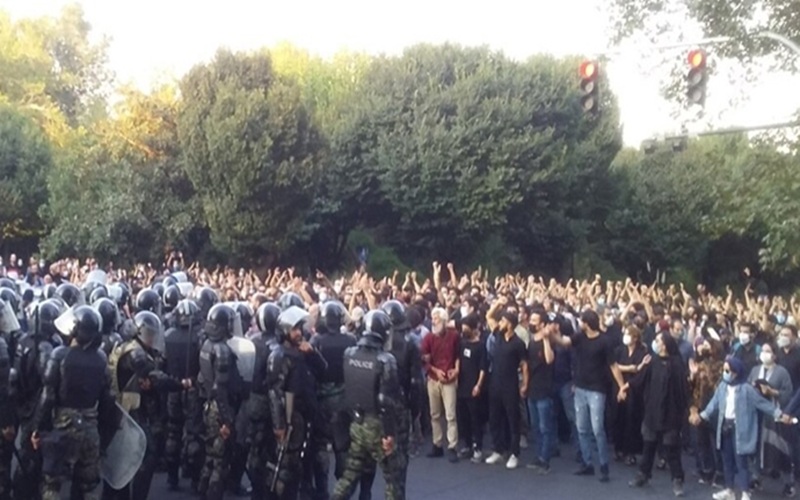

As the anniversary of Iran’s 2022 nationwide uprising approaches, the regime’s threats, security mobilization, and increasingly alarmed rhetoric expose its fears of another eruption of public anger.
As Iran approaches the fourth anniversary of the nationwide uprising that began in September 2022, the regime is confronting a familiar problem: widespread social grievances that cannot be resolved through repression alone.
The authorities are responding with threats, warnings, security deployments, and highly publicized military and paramilitary exercises. But beneath the language of “security” and “readiness” lies a recurring concern expressed by regime officials themselves: the fear that another spark could ignite broader protests.
This fear is particularly evident in the statements of the regime’s security commanders.
On September 13, Iran’s police chief, Brigadier General Ahmad-Reza Radan, declared that the country was in a “war-like situation.” He warned that anyone seeking to create insecurity at the invitation of an enemy would be treated as an enemy. Radan also referred to recent operations against alleged members of the PMOI, claiming that three had been arrested following an attack on one of the regime’s units in a province and that others were being pursued.
The significance of such statements extends beyond the regime’s usual security rhetoric. They reveal that the authorities continue to view organized resistance and the activities of Resistance Units as a serious internal challenge.
Radan also claimed that more than 350 members of the security forces had been killed during the first six months of the year while, according to his formulation, providing security for the Iranian people. The statement was apparently intended to demonstrate the sacrifices made by the security apparatus. Yet it simultaneously underscores the extent to which the regime relies on its coercive institutions to maintain control.
The regime’s concern about a new uprising is not limited to security officials. Cleric Rafi’i previously issued an unusually direct warning about the possibility of a new eruption. He said that the “enemy” was looking for a spark inside the country and warned that even an ill-advised increase in prices could create such a spark.
That warning is particularly significant in the context of Iran’s economic crisis.
For millions of Iranians, declining purchasing power, inflation, high housing costs, unemployment, and the erosion of household incomes have become persistent sources of pressure. Workers, retirees, teachers, students, medical workers, farmers, and other groups have repeatedly taken to the streets over unpaid wages, pensions, living costs, and deteriorating economic conditions.
These protests are often initially centered on specific economic demands. But the repeated appearance of different social groups in demonstrations also reflects a much broader accumulation of grievances. When economic pressure combines with political repression and a lack of confidence in the authorities’ ability to address basic problems, individual disputes can develop into wider expressions of opposition.
This is precisely the kind of dynamic the regime appears determined to prevent.
The authorities have therefore turned increasingly to displays of force. The commander of the Islamic Revolutionary Guard Corps in Tehran Province announced a 110,000-person exercise involving the Basij and other affiliated groups. According to the official explanation, the exercise was intended to demonstrate the “power” and readiness of the Basij and various social groups across the province.
A regime media outlet also reported preparations for a September 18 gathering and exercise in Tehran under the name “Jan-Fada-ye Iran,” claiming that the number of registered participants had exceeded 400,000.
Such announcements are intended to communicate an image of overwhelming organization and state control. But their timing is revealing. The regime is preparing for the anniversary of an uprising that exposed the limits of its ability to prevent nationwide mobilization.
The events of 2022 remain a powerful reference point for both society and the authorities. The uprising spread across numerous cities and brought together people from different generations and social backgrounds. The regime responded with mass arrests, lethal force, executions, and other forms of repression. Yet repression did not erase the grievances that had brought people into the streets.
Four years later, the authorities are again attempting to establish deterrence before protests can gather momentum.
The language used by officials is also significant. Demonstrators and political opponents are repeatedly described through the vocabulary of war and national security. Economic grievances can be portrayed as attempts to create insecurity, while organized opposition is presented as an extension of an external enemy.
This framing serves an obvious political purpose: it shifts attention away from the causes of public anger and toward the threat of repression.
But a security response cannot solve an economic crisis. A military exercise cannot restore purchasing power. Threats against protesters cannot resolve unemployment, poverty, or the collapse of household incomes. And portraying every expression of dissent as an enemy operation does not eliminate the underlying grievances.
Indeed, the regime’s repeated warnings about a potential “spark” acknowledge the opposite. They indicate that officials understand how quickly accumulated social tensions can turn a local grievance into a broader protest movement.
The anniversary of the 2022 uprising therefore arrives at a sensitive moment for Iran’s rulers. Their public message is one of strength and preparedness. Their actions, however, show how much effort is being devoted to preventing another nationwide eruption.
The contrast is difficult to overlook. A government confident in its social legitimacy would not need to rely so heavily on threats, mass security exercises, and warnings about a single spark. The scale of the preparations suggests that the authorities remain deeply conscious of the potential for renewed unrest.
Ultimately, the central issue is not whether the regime can stage another large military or paramilitary exercise. It is whether displays of force can suppress the accumulated grievances of a population facing economic hardship and political repression.
The experience of 2022 demonstrated that fear of repression does not necessarily eliminate public anger. As the anniversary approaches, the regime is once again trying to project control before the streets become the center of political expression.
Its threats may be loud, and its exercises may be enormous. But the regime’s own warnings reveal what it fears most: not an external battlefield, but the possibility that another domestic spark could connect the country’s unresolved grievances with a new wave of popular protest.