


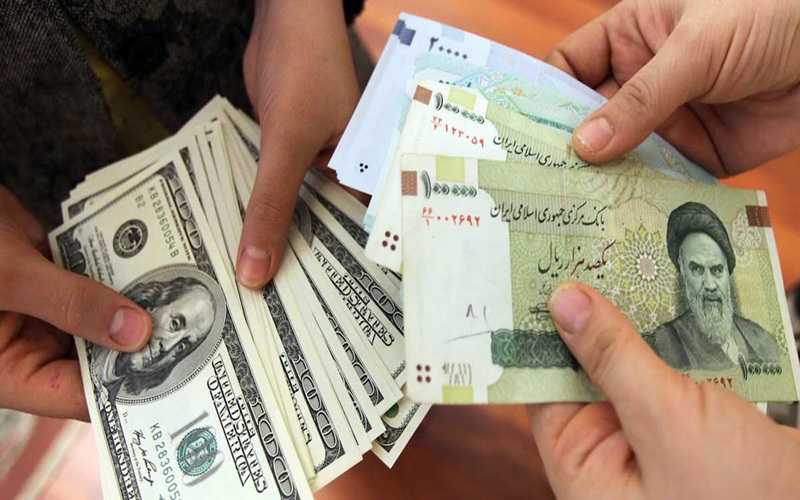

A sharp collapse in the rial is exposing the combined impact of shrinking oil revenues, financial restrictions, structural corruption, and mounting production costs across Iran’s economy.
The Iranian rial is undergoing another sharp and destabilizing decline, with the U.S. dollar surging from around 198,000 tomans to nearly 240,000 tomans within two days. The speed of the increase has intensified concerns among households, businesses, and economic actors already struggling with inflation and declining purchasing power.
The latest plunge is not simply a short-term fluctuation in the foreign-exchange market. It reflects deeper weaknesses in Iran’s economy, including the deterioration of its principal source of foreign-currency income, restrictions on international financial transactions, and structural corruption and mismanagement.
Shrinking Oil Revenues Put the Rial Under Pressure
Iran’s economy remains heavily dependent on oil and petroleum-product exports for its foreign-currency earnings. Any major disruption to this flow immediately affects the regime’s ability to supply the foreign-exchange market.
Recent reports indicate that the average volume of Iranian crude being loaded onto tankers has fallen dramatically. Between January and April, the figure was reportedly around 1.8 million barrels per day. More recent estimates put the volume at only 200,000 to 250,000 barrels per day—an estimated decline of roughly 85 percent.
The problem extends beyond current production and exports. Restrictions on selling and transporting Iranian oil have also made it more difficult to convert available crude into usable foreign currency. At the same time, oil stored on tankers offshore has reportedly been declining, raising concerns that these reserves could reach minimal levels in the coming months.
A sustained reduction in oil revenues therefore creates a direct foreign-exchange shortage. With fewer dollars entering the economy, pressure on the rial increases and the exchange rate becomes increasingly difficult to stabilize.
Banking Restrictions Further Limit Access to Foreign Currency
A second factor is Iran’s restricted access to the international financial system.
Sanctions and banking restrictions have complicated the transfer of money, access to foreign assets, and repatriation of export revenues. Some Iranian banks have also faced restrictions affecting their access to assets held abroad.
Even when foreign currency is technically available, the inability to move and use it efficiently creates additional pressure on the domestic market. Businesses face greater difficulty obtaining currency for imports, while the regime has fewer effective mechanisms for managing foreign-exchange demand.
This creates a vicious cycle: restricted access to international finance reduces the supply of usable foreign currency, while rising demand pushes the dollar higher and further erodes the value of the rial.
Why Currency Intervention Has Failed to Stabilize the Market
The regime has also attempted to intervene directly in the foreign-exchange market.
At the beginning of the latest surge, reports indicated that roughly $2 billion had been injected into the market. Under normal circumstances, such an intervention could temporarily increase dollar supply and slow the pace of depreciation.
Yet the effect proved short-lived. The market stabilized only briefly before the dollar resumed its upward movement.
This points to a deeper problem than a temporary shortage of liquidity. When foreign-exchange interventions fail to produce lasting results, the underlying causes are likely operating beyond the reach of short-term market injections.
The allocation and distribution of foreign currency, along with entrenched corruption and ineffective economic management, have become central concerns. Resources injected into the market cannot resolve a structural imbalance between dwindling foreign-currency revenues and persistent demand.
The Rial’s Collapse Is Feeding Unemployment and Production Cuts
The consequences extend far beyond the exchange-rate market.
Iranian industries are already facing rising production costs and difficulties obtaining imported raw materials, machinery, and intermediate goods. As the rial loses value, the cost of these inputs rises sharply.
Industries including petrochemicals, steel, and oil-related sectors have faced mounting difficulties, while other manufacturing businesses have struggled to maintain production.
Some factories have reportedly reduced or halted production. Others have been forced to cut their workforce or delay wage payments.
The impact of job losses also extends beyond individual workers. When a factory reduces production, suppliers, transport companies, distributors, retailers, and other businesses connected to the production chain are affected as well.
The result is a broader contraction in economic activity.
Households Bear the Cost of the Currency Crisis
For ordinary Iranians, the most immediate consequence of the rial’s collapse is the loss of purchasing power.
A weaker rial makes imported goods and imported production inputs more expensive. Those higher costs are eventually passed through to consumers, adding to inflation and increasing the cost of food, housing, transportation, medicine, and other essential goods and services.
At the same time, wages generally do not rise at the same speed as prices. This widens the gap between household income and the cost of maintaining even a basic standard of living.
The combination of inflation, unemployment, declining purchasing power, and economic stagnation creates a particularly damaging cycle. Businesses reduce production because costs are rising and consumers have less money to spend. Lower demand then further weakens businesses and employment.
No Quick Fix for a Structural Crisis
The latest surge in the dollar therefore cannot be understood as an isolated currency-market event. It is a symptom of a broader economic crisis.
Shrinking oil revenues reduce the supply of foreign currency. International financial restrictions make available resources harder to access. Structural corruption and mismanagement undermine the effectiveness of market interventions. Rising production costs then weaken businesses, while inflation and unemployment place increasing pressure on households.
As long as these underlying conditions persist, temporary injections of foreign currency are unlikely to provide a durable solution.
The continuing decline of the rial is consequently not merely a problem for currency traders or importers. It is increasingly translating into lost jobs, shrinking household incomes, declining purchasing power, and a deeper economic burden for millions of Iranians.
The question facing Iran’s economy is therefore not simply how high the dollar will rise, but how long an economy already under severe pressure can absorb the consequences of the rial’s accelerating collapse.