


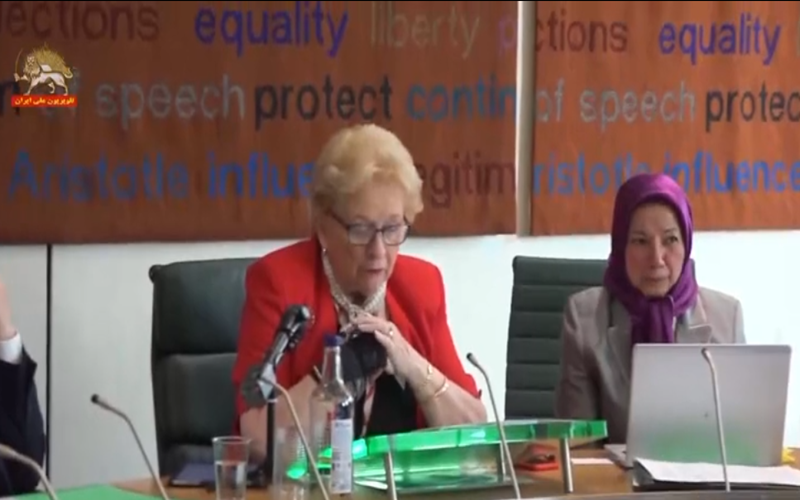

Speaking at a conference in the UK Parliament, Baroness O’Loan called for stronger international action over Iran’s human rights crisis and emphasized the need to support the Iranian people’s pursuit of democratic change.
A parliamentary conference in the United Kingdom brought together lawmakers, legal experts, members of the Anglo-Iranian community, and representatives of the Iranian Resistance to discuss the continuing human rights crisis in Iran, accountability for the regime’s crimes, and prospects for democratic change.
Baroness O’Loan, a crossbench member of the House of Lords specializing in police accountability, human rights, and security, chaired part of the meeting. She described the discussion as particularly timely amid rapidly developing events in Iran and highlighted the need to examine their implications for British policy.
The conference also marked the 61st anniversary of the founding of the People’s Mojahedin Organization of Iran (PMOI/MEK). Baroness O’Loan congratulated Mahnaz Mohammadi on her election as the organization’s new secretary-general, presenting the development as evidence of the movement’s continuity and organizational renewal. She also highlighted the participation of women in leadership positions within the Iranian Resistance.
UK Proscription of the IRGC
A central point in Baroness O’Loan’s remarks was the British government’s decision to proscribe the Islamic Revolutionary Guard Corps (IRGC) under new legislation.
She described the measure as an important step for British national security and for the Iranian people, arguing that the IRGC represents a common threat. In her assessment, outlawing the organization and criminalizing support for its activities would further restrict its ability to operate and isolate an institution she characterized as central to the regime’s repression.
Baroness O’Loan also credited Maryam Rajavi and supporters of the National Council of Resistance of Iran (NCRI) with campaigning for the proscription of the IRGC. She pointed to the work of cross-party members of the British Committee for Iran Freedom, as well as the NCRI and Anglo-Iranian community, in raising awareness and engaging policymakers on the issue.
Neither War Nor Appeasement
The speech placed the question of Iran’s future within a broader rejection of both military confrontation and accommodation with the regime.
Baroness O’Loan argued that the Iranian crisis cannot be resolved through war or appeasement, but through the Iranian people’s pursuit of democratic change. She referred to what Maryam Rajavi and the NCRI describe as a “third option,” based on two principles: that the Iranian people must determine their own future and that an organized democratic alternative exists to facilitate a peaceful and orderly transition of power.
This framework, she argued, derives its legitimacy from the Iranian people themselves and places the question of political change in the hands of Iran’s population rather than foreign governments.
Executions and Repression
Baroness O’Loan warned that the regime’s response to growing resistance has included intensified executions, politically motivated arrests, and increased repression, particularly against supporters of the PMOI.
She linked these measures to an effort to suppress organized opposition and prevent the emergence of sustained national resistance. At the same time, she noted that Tehran continues to reject efforts aimed at reaching a negotiated settlement.
The human rights situation therefore remains central to the question of Iran’s political future. For the parliamentary speakers and participants described in the conference, accountability for abuses is not separate from democratic change but an essential component of it.
A Call for Concrete British Action
Baroness O’Loan called on the United Kingdom to stand with the Iranian people and support their right to democratic change. She noted that the British government and its European allies had already urged Iran’s regime to respond to demands for change and halt the escalating executions.
She nevertheless argued that statements of principle should be followed by concrete measures. Among the actions she called for were advancing accountability through the United Nations and international legal mechanisms, closing the Iranian regime’s embassy in London, and conditioning future relations with Tehran on a verifiable end to executions and torture and the release of political prisoners.
The speech thus connected three issues—human rights, accountability, and democratic transition—as parts of a single policy challenge. Rather than treating repression inside Iran as an isolated domestic matter, Baroness O’Loan presented it as an issue requiring sustained international attention and legal accountability.
Her remarks concluded with the introduction of a video message from NCRI President-elect Maryam Rajavi, bringing the parliamentary discussion back to the question at the heart of the conference: how international policy can support the Iranian people’s stated aspirations for a free and democratic Iran.