


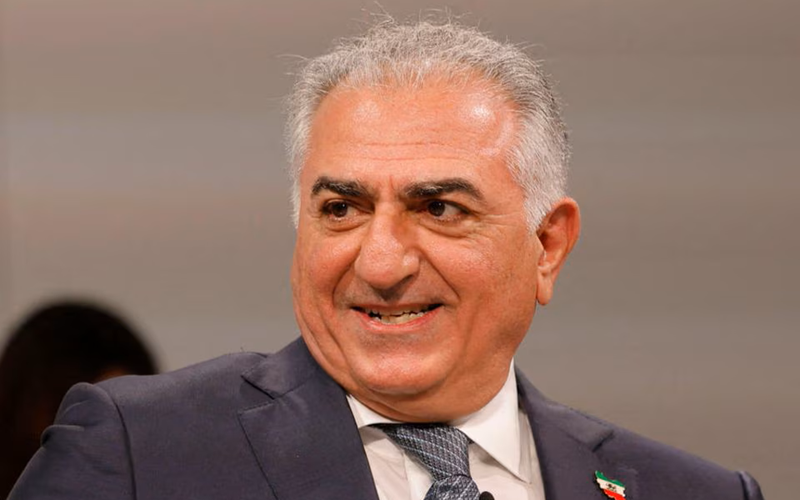

His June 2025 description of military strikes as a historic opportunity, subsequent appeals to “finish the job,” and November 2026 account of his anti-war position leave important questions about his consistency and political mandate.
Reza Pahlavi’s November 7, 2026, speech in Frankfurt presented a carefully framed account of his position on military intervention in Iran. Accepting the Friedrich Naumann Foundation’s Freedom Prize, he said he had long opposed both appeasement and war, advocating instead a “third path” of maximum pressure on Iran’s regime and maximum support for the Iranian people. He added that only after the January 2026 killings did he and his associates reluctantly conclude that military pressure on the regime’s repressive apparatus might be necessary.
But Pahlavi’s earlier public statements tell a different story. His remarks during and after the June 2025 conflict, followed by his statements in March and May 2026, raise a straightforward question: how does his claim to have opposed war until January 2026 fit with his earlier description of military action as an opportunity for regime change and his subsequent appeals to continue the campaign?
The issue is not whether Iran’s regime should be held accountable for its repression, or whether the Iranian people have the right to determine their future. The debate is over whether political change in Iran should be brought about by Iranians themselves or through a war waged by foreign powers. Where does Reza Pahlavi stand on that question? Does his approach uphold the principle of national self-determination, or does it depend on such a war to bring about change?
June 2025: Pahlavi described the military campaign as an opportunity for regime change
On June 15, 2025, Pahlavi appeared on the BBC’s Sunday with Laura Kuenssberg. Discussing the conflict then unfolding, he described regime change as the ultimate solution and the situation as an opportunity, arguing that the regime was at its weakest point.
Eight days later, in an interview with Iran International, published on June 22 and updated on June 23, Pahlavi again described the situation as a historic opportunity. He said the regime was “collapsing” and “the weakest it has ever been since coming to power.” He argued that the international community should support the prospect of regime change.
At the same time, Pahlavi explicitly rejected foreign troops and financial assistance as the means of determining Iran’s future. “We don’t want your boots or your money,” he said. “What we need is recognition that the solution is the Iranian people—not negotiations with the regime.”
He also stated: “This war is not the people’s war. It’s Khamenei’s war. And the price is being paid by the Iranian people.”
In June 2025, well before the January 2026 crackdown he later identified as the turning point in his position, Pahlavi was already presenting a military confrontation as a historic opening for regime change and urging the international community to support that outcome.
His position was also reflected in a June 23, 2025, press conference in Paris, where he described the regime as “collapsing” and announced a communications channel for members of the military, police, and security forces who wished to break with it.
March and May 2026: The call to “finish the job”
Pahlavi’s subsequent statements made the question of his position even more pertinent.
On March 28, 2026, addressing the Conservative Political Action Conference (CPAC) in Dallas, Texas, he called for the removal of the regime in its entirety. “We must finish the job,” he told the audience. He warned against leaving a remnant of the existing system in place and urged the United States to “stay the course,” adding: “Do not throw this crumbling regime a lifeline. Pave the way for the Iranian people to finish the job.” These remarks were reported by Iran International on March 28.
On May 12, Iran International reported on Pahlavi’s remarks at Politico’s Security Summit, where he described the Iranian regime as a “wounded beast” and said the opportunity should not be missed. “It’s an opportunity to finish the job and get it over with,” he said. (Iran International, May 12, 2026)
These were not merely general appeals for international attention to human rights abuses or support for democratic change. They were public calls to maintain pressure during an ongoing military confrontation, framed around the opportunity to bring down the regime.
Pahlavi’s shifting stance on war points to a single conclusion. The position he takes in public depends on whether his audience favours or opposes a war against Iran. His own role in urging foreign powers to bomb Iran is hardly a secret. Yet in Frankfurt, aware of how little support such a war commands in Europe, he presented himself as someone who had opposed it all along.
Frankfurt: A retrospective account that leaves questions unanswered
In his November 7 speech, Pahlavi said that for years he had argued against both appeasement and war. He described the January 8–9, 2026, killings as the moment that changed his assessment, saying that military pressure on the regime’s repressive apparatus had become perhaps the only remaining way to weaken it and give the Iranian people a fair chance.
He summarized the shift by saying: “While our tactics were forced to change, our principles did not.”
Yet the public record raises questions that this explanation does not resolve. His June 2025 remarks had already welcomed the military confrontation as a historic opportunity for regime change. His March and May 2026 statements went further, urging that the opportunity be pursued to its conclusion.
Pahlavi offers two excuses for his shifting stance on war. He claims to distinguish between a war against the Iranian people and military pressure on the regime’s security apparatus. He also invokes the January killings to explain why his view of what was necessary changed. Whether his position was as consistent as he claimed in Frankfurt must be judged by his own words, including what he said before the killings and what he said afterwards.
There is another issue in his speech. Pahlavi said that every innocent Iranian killed in the war was a grief he carried, while assigning responsibility for those deaths to the regime. His position on the regime’s responsibility for creating the crisis is clear. But a political figure advocating a course of action that involves military pressure should also be prepared to address the consequences and limitations of that course, rather than treating the question of responsibility as settled by assigning blame to one party.
A political title is not a democratic mandate
In Frankfurt, Pahlavi accepted the prize “on behalf of” the Iranian people and described himself as a temporary trustee of their aspirations. He also presented himself as a bridge to democracy and said that the future form of government must be decided by Iranians at the ballot box.
His standing to make that claim rests entirely on the name he inherited. No Iranian electorate chose him as its representative. He told his audience that Iranians would decide their political future at the ballot box, yet he had already presumed to speak for them without putting that choice to a vote.
For many Iranians, the Pahlavi name recalls the one-man rule of the last Shah. Under his father, SAVAK, the Shah’s secret police, tortured political prisoners, and the state executed political opponents. Iranians who organised for political freedom risked imprisonment for exercising the very freedoms his son invoked in Frankfurt.
The organisers were free to honour Reza Pahlavi. Their decision gave him no authority to accept the award in anyone else’s name. By claiming to speak for the Iranian people as a whole, he presumed to speak even for those tortured by SAVAK and for the families of those executed under his father’s rule. To invoke their name, too, on the strength of his own is an affront to the Iranian people and to those who paid with their freedom or their lives for the right to choose who governs them.
Iran’s future belongs to its people—not to a self-appointed representative
The Iranian people have struggled against dictatorship under both the monarchy and the clerical regime. Their demand for freedom cannot be reduced to a choice between two forms of authoritarian rule, nor can the opposition’s future be determined by the international visibility of one political figure.
Pahlavi’s public record deserves scrutiny on its own terms. His June 2025 interviews, his March and May 2026 appeals, and his November Frankfurt speech provide a clear chronology against which his explanations can be assessed. The central question is not whether he now describes himself as a reluctant advocate of military pressure. It is whether that description fully accounts for what he said before, and whether he has addressed the political implications of those statements.
Iran needs neither hereditary entitlement nor clerical absolutism. Its future must be decided through free elections, political pluralism, equality before the law, and the right of all citizens to choose their system of government. No individual can claim that mandate in advance.