


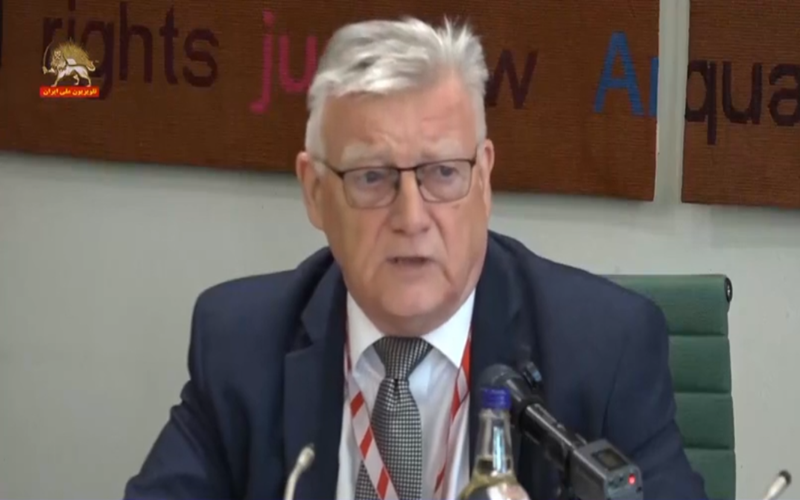

Speaking at a conference in the UK Parliament, Stephen McCabe called for action against executions and repression in Iran, accountability for the IRGC, and recognition of organized democratic opposition.
The escalating use of executions and repression in Iran requires a clear moral and political response from the international community, British MP Stephen McCabe said at a conference in the UK Parliament focused on human rights, accountability, and democratic change in Iran.
McCabe highlighted the large number of people executed in Iran since the beginning of the year, including opposition activists, protesters, young people, and people who, according to his remarks, had not yet reached the age of 18. He argued that the scale of the executions and the erosion of human rights create a moral obligation for governments to act.
Executions as an Instrument of Repression
McCabe characterized the death penalty in Iran as a tool used by the state to create fear and suppress dissent. He argued that international attention should focus not only on individual cases but also on the broader use of executions as an instrument of political repression.
For McCabe, opposing such practices is fundamentally a human-rights responsibility. He called for action to protect those facing repression and to challenge those responsible for abuses.
His remarks came as part of a wider parliamentary discussion about the human rights situation in Iran and the international community’s responsibilities toward the Iranian people.
The IRGC Ban Must Be Enforced
McCabe also welcomed the British government’s decision to ban the Islamic Revolutionary Guard Corps (IRGC), noting that he had campaigned for such action.
However, he stressed that legislation alone was insufficient. In his view, the decision must be followed by practical measures to prevent individuals connected to the IRGC from continuing to benefit from its activities in Britain.
He specifically questioned the continued presence in London of people he described as benefiting from the activities of those responsible for killings and repression. He also raised questions about the Iranian embassy in London, asking what role it plays in facilitating or providing cover for IRGC operations.
The comments therefore placed implementation and enforcement at the center of the discussion over Britain’s IRGC policy.
Neither Military Intervention Nor Appeasement
McCabe argued that neither external military action nor appeasement offers a solution for the Iranian people. He rejected approaches involving military force, prolonged negotiations, or financial concessions that could provide resources for further operations by the regime.
Instead, he emphasized the principle that Iran’s future should be determined by the Iranian people themselves.
He argued that Iranians do not need foreign military intervention and that Western governments should not attempt to determine Iran’s political future or select its leaders. He also criticized diplomatic approaches that, in his characterization, favor one side while excluding another.
Opposition Voices Must Be Heard
A further part of McCabe’s remarks concerned the need to ensure that organized opposition forces inside and outside Iran receive a meaningful voice in international discussions about the country’s future.
He argued that the opposition confronting repression and defending human rights in Iran is entitled to participate in discussions about the country’s political future. In his view, Britain should make its position clear by refusing further concessions to Iran’s ruling establishment and placing the human rights of Iranians at the center of its policy.
McCabe also called for accountability for those responsible for human rights abuses and urged the British government to take steps to ensure that the “real voice” of the Iranian people is heard.
Free Elections and Democratic Opposition
The British MP concluded by calling for international support for free and fair elections in Iran and recognition of organized democratic opposition.
He specifically called for support for Maryam Rajavi and her Ten-Point Plan, presenting these as part of what he described as a democratic alternative for Iran.
His remarks placed the question of Iran’s future within a framework centered on human rights, accountability, and the right of Iranians to determine their own political system. Rather than advocating foreign intervention, McCabe called for Britain to use its political influence to oppose repression, hold perpetrators accountable, and ensure that organized democratic opposition has a place in international discussions about Iran’s future.