


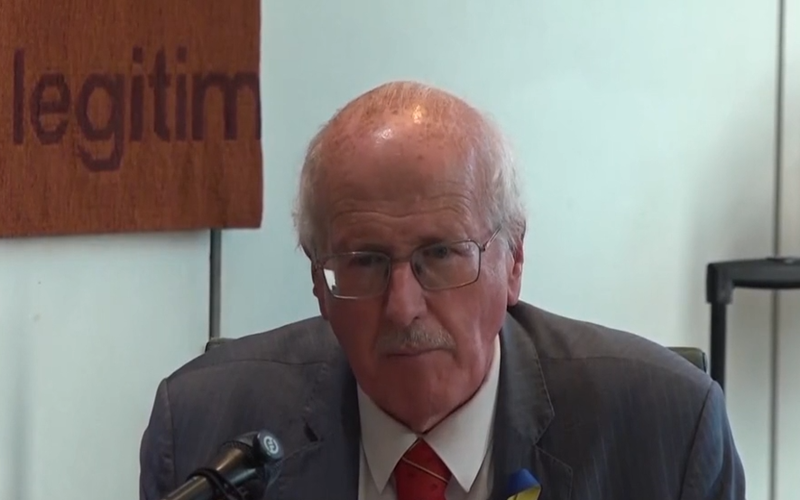

Speaking at a UK Parliament conference, MP Jim Shannon called for British support for the Iranian people’s struggle for freedom, recognition of an organized democratic alternative, and accountability for the regime’s crimes.
British Member of Parliament Jim Shannon has called on the United Kingdom to stand with the Iranian people in their pursuit of freedom and democracy, arguing that the responsibility for political change ultimately belongs to Iranians themselves and that Britain should support their right to determine their future.
Speaking at the parliamentary conference “The Road to a Free Iran: Human Rights, Accountability and Democratic Change,” Shannon reaffirmed his support for human rights, accountability, and democratic change in Iran, as well as for what he described as the organized resistance seeking that change.
He emphasized that international support should not replace the Iranian people’s own role in determining the country’s future. In his remarks, he said the objective should be to ensure that Iranians have the right to bring about political change themselves.
An Organized Democratic Alternative
Shannon rejected the Iranian regime’s portrayal of the struggle for democratic change as a foreign project. He argued that the demand for freedom is rooted in the aspirations of the Iranian people rather than being imposed from outside.
He pointed to the National Council of Resistance of Iran (NCRI), led by Maryam Rajavi, as an organized democratic alternative. Shannon also noted that he and other cross-party colleagues in Britain and Europe have supported Rajavi’s Ten-Point Plan for Iran’s future.
In his view, the persistence of the resistance and the sacrifices made by Iranians challenging repression demonstrate that the movement for political change is not simply an external campaign but an effort rooted in Iran.
Resistance and Repression
Shannon highlighted the growth of Resistance Units inside Iran alongside what he described as escalating executions of PMOI members, political prisoners, and detained protesters.
He presented these developments as evidence of both the persistence of resistance and the regime’s determination to suppress it. In particular, he argued that the regime’s repression reflects its concern over organized opposition and international attention to Iran’s human rights situation.
Shannon further argued that peace, stability, and democratic progress are incompatible with what he described as the nature and conduct of the current regime. He accused Tehran of repeatedly choosing repression, terrorism, conflict, and violence rather than reform and cooperation.
He also referred to the regime’s refusal, in his characterization, to honor a memorandum of understanding with the United States, despite the economic benefits he said the agreement offered.
What Role Should Britain Play?
A central question in Shannon’s speech was the role Britain should play in relation to Iran’s democratic movement.
He argued that British parliamentarians should actively pursue the goal of freedom and democracy for Iran and asked whether the United Kingdom would stand alongside the Iranian people in their pursuit of those objectives.
Shannon invoked Britain’s historical support for the French Resistance during the Second World War and its contemporary support for Ukraine as examples in raising the question of whether Britain should similarly support Iran’s organized resistance.
For Shannon, the issue is therefore not simply whether Britain condemns repression, but what practical political role it chooses to play in relation to those seeking democratic change.
Calls for Recognition and Accountability
Shannon concluded his policy recommendations with a direct appeal to the British government.
He called for Britain to stand with the Iranian people and what he described as their popular resistance, reject the ruling regime, and recognize the NCRI’s provisional government as a democratic alternative.
He also called for cooperation with Maryam Rajavi at the international level to hold the Iranian regime accountable for its crimes.
Shannon characterized these measures as both a moral and strategic course for British policy toward Iran.
Women in the Iranian Resistance
The MP also addressed the 61st anniversary of the founding of the People’s Mojahedin Organization of Iran (PMOI), extending his congratulations to Maryam Rajavi on her election as the organization’s new secretary-general.
He described her election as an important moment for a movement that, in his assessment, has demonstrated resilience and a continuing commitment to freedom, democracy, and human rights in Iran.
Shannon particularly emphasized the prominent role of women in the leadership of the Iranian Resistance. He said this role sends a message of equality, courage, and hope to women and young people in Iran and beyond.
He concluded by wishing Rajavi success in her new responsibilities and expressing his support for the Iranian Resistance’s stated objective of achieving a free, democratic, and prosperous Iran.