


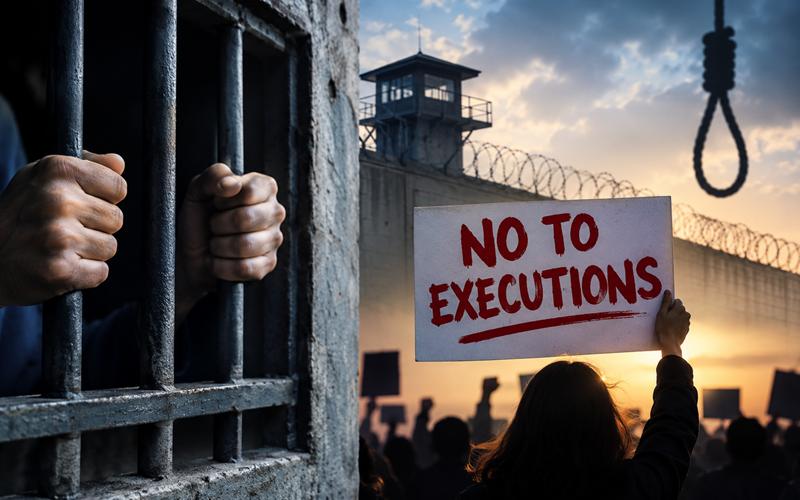

As Iran’s regime intensifies executions, threats, and intimidation, prisoners are turning the country’s prisons into platforms for defiance and political protest.
Iran’s regime is escalating its language of threats and intimidation as it seeks to deter renewed unrest. Judiciary Chief Gholam-Hossein Mohseni Ejei has repeatedly defended executions and demanded that those accused of opposing the regime be rapidly identified, prosecuted, and punished. Police chief Ahmad-Reza Radan has likewise warned that security forces are “finger on the trigger” and will not hesitate to arrest opponents.
Yet inside Iran’s prisons, where repression is at its most concentrated, another message is emerging: fear has not produced submission.
The continuing expansion of the “No to Execution Tuesdays” campaign offers one of the clearest examples. What began as a prison-based protest has developed into a sustained campaign involving prisoners in dozens of facilities across Iran. In its 138th week, the campaign was being maintained in 62 prisons.
The contrast is striking. While officials publicly threaten harsher punishment to deter dissent, prisoners repeatedly use the limited space available to them to challenge executions and express solidarity with political resistance.
When Threats Become a Sign of Fear
The regime presents executions and threats as instruments of deterrence. Its officials repeatedly argue that severe punishment is necessary to prevent opposition and create an example for others.
But the persistence of resistance inside prisons raises a different question: if executions are intended to extinguish dissent, why does opposition continue to find new forms of expression even among prisoners facing the greatest pressure?
The answer offered by resistance activists is that the increasingly aggressive rhetoric itself reflects the authorities’ fear of renewed protest.
For prisoners, the issue is not simply their own fate. Their statements and collective actions increasingly connect prison conditions to the wider political situation in Iranian society.
Every week that prisoners refuse food, protest executions, issue statements, or send messages beyond prison walls, they demonstrate that repression has not completely isolated them from the society outside.
62 Prisons and a Growing Campaign
The No to Execution Tuesdays campaign has become a recurring expression of this resistance.
Its significance lies partly in its continuity. Rather than a one-time protest, prisoners have maintained collective action week after week despite the risks of retaliation, transfer, solitary confinement, and further prosecution.
The campaign’s expansion from a smaller number of participating prisons to 62 facilities also illustrates how opposition to executions has spread across the prison system.
Political prisoners have used their statements not only to oppose the death penalty but also to commemorate previous generations of prisoners who were executed, express solidarity with current resistance activities, and appeal to international institutions to intervene against executions in Iran.
Their messages have also increasingly connected prison resistance with developments outside prison walls.
This transforms the prison from a closed institution of punishment into a political arena.
A Letter Can Break Through the Prison Walls
Under extreme restrictions, even a written message can acquire political significance.
A letter from a political prisoner may appear insignificant compared with the coercive machinery of a state. Yet its importance lies precisely in the fact that it emerges from an environment designed to silence its author.
Prisoners who publicly reject executions are therefore challenging more than an individual sentence. Their statements confront the logic of intimidation on which the regime relies.
The continued circulation of these messages also means that prison walls do not completely isolate prisoners from the wider society. Their words reach families, activists, media organizations, and international institutions.
In this sense, every statement becomes an attempt to reverse the direction of intimidation: instead of allowing the prison to silence the prisoner, the prisoner uses the prison to expose the system of repression.
From the Prison Cell to the Street
The resistance described inside prisons is also presented by opposition activists as part of a broader pattern of unrest throughout Iran.
They point to continuing protests, resistance activities, and the activities attributed to Resistance Units as evidence that repression has not eliminated opposition outside prison walls.
The recent activities of Resistance Units in Karaj, for example, were portrayed by opposition sources as a public demonstration of continued organizational activity despite heightened security measures.
The prison campaign and street-level resistance thus reinforce one another politically. Prisoners send messages to society, while developments outside demonstrate that their resistance is not occurring in isolation.
The same dynamic is visible in the campaign’s appeals to the United Nations and international human-rights mechanisms. Prisoners have called for action to halt executions and highlighted concerns about the potential consequences of renewed social activity as schools and universities reopen.
Their messages demonstrate an awareness that the struggle over executions is connected to a wider struggle over political repression.
The Regime Can Raise the Cost—But Has Not Silenced the Opposition
The regime retains extensive coercive power. Arrests, executions, prison transfers, intimidation, and restrictions remain formidable tools.
But the continuing resistance of prisoners presents an important contradiction.
A prison system designed to isolate political opponents has become a place from which political messages repeatedly emerge.
The No to Execution Tuesdays campaign demonstrates the same point through persistence rather than a single dramatic event. Week after week, prisoners continue to reject executions and demand an end to the death penalty.
For a government that relies heavily on deterrence, such persistence creates a political challenge: repression may raise the cost of dissent, but it does not necessarily eliminate the willingness to resist.
That is why Iran’s prisons have become more than places where the regime confines its opponents. They have also become places where prisoners challenge the narrative that fear has defeated resistance.
From the regime’s threats of being “finger on the trigger” to prisoners’ continued call of “No to Executions,” the two messages reveal a profound confrontation over whether repression can ultimately silence a society demanding change.