


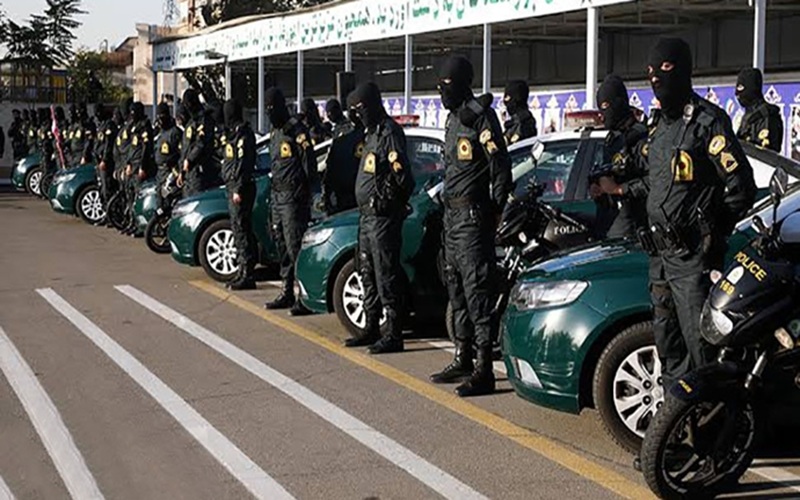

The cancellation of military and security personnel leave, emergency deployments across Tehran, expanded surveillance, new detention sites, and financial incentives for suppressive forces point to heightened regime concern over renewed protests.
Iran’s regime has placed its military and security apparatus on heightened alert and canceled personnel leave through September 27, according to information released by the National Council of Resistance of Iran (NCRI). The measures include the deployment of 51,000 security and suppressive forces in Greater Tehran, expanded patrols and surveillance, new detention facilities, and increased financial incentives for security personnel.
The reported measures offer a detailed picture of the regime’s preparations for possible unrest at a time when economic and social grievances remain widespread across Iran.
According to the NCRI statement, the Army, Islamic Revolutionary Guard Corps (IRGC), Basij, and State Security Force (SSF) have been placed on 100-percent alert. Personnel leave has been canceled until midnight on September 27, with the measure subject to extension depending on “social conditions and political developments.”
51,000 forces deployed across Greater Tehran
The most significant element of the reported security preparations is the deployment of 51,000 forces to control Greater Tehran.
According to the NCRI, the force consists of approximately 21,000 SSF personnel and 30,000 members of the IRGC and Basij.
The forces have reportedly been concentrated not only in major squares but also at secondary locations and intersections across Tehran and other major cities. The arrangement is intended to allow rapid intervention in the event of demonstrations or other emergencies.
Motorized security parades have also been organized in Tehran and other cities under the official pretext of “War Week.” According to the NCRI, these events serve to maintain a high level of visible military and security presence in urban areas.
The scale of the deployment suggests that the regime is preparing for localized incidents as well as larger demonstrations, with security forces positioned to respond rapidly across urban neighborhoods.
Security forces target phones and pedestrians
The reported security measures extend into everyday public spaces.
According to the NCRI, motorized patrols have been conducting body searches of pedestrians on sidewalks and at traffic lights. Security personnel have also reportedly been checking mobile phones in an effort to identify people described by the regime as “those seeking to overthrow the regime.”
The measure reflects the regime’s longstanding concern over the role of mobile phones and digital communications during protests. Smartphones can allow citizens to document security-force actions, distribute information despite state censorship, and maintain communication during periods of unrest.
The reported inspections therefore extend the security apparatus beyond conventional crowd control into routine monitoring of citizens and their communications.
New detention centers prepared for potential arrests
The NCRI also reports that new detention centers have been established in remote and uninhabited areas.
According to the statement, the facilities were prepared based on the regime’s experience during previous uprisings, when large-scale arrests reportedly placed considerable pressure on existing detention capacity.
The establishment of additional detention infrastructure indicates that the regime is preparing logistically for the possibility of a significant increase in arrests.
Financial incentives to reinforce suppressive forces
Alongside the security deployment, the regime is reportedly using higher salaries, bonuses, and increased mission payments to encourage security personnel to remain available for operations.
The NCRI says these measures apply to personnel from the SSF, IRGC, and intelligence forces.
It also reports that Basij chief Hossein Taeb is seeking to expand the organization by recruiting unemployed people, particularly in Tehran, through increased salaries and other benefits. A joint plan involving Taeb and Hassan-Zadeh, the IRGC commander in Greater Tehran, is reportedly aimed at strengthening plainclothes forces.
The reported recruitment drive comes against the backdrop of Iran’s severe unemployment and cost-of-living pressures. Using financial benefits to expand auxiliary security forces would allow the regime to draw on a pool of economically vulnerable people while simultaneously increasing its capacity for domestic repression.
New anti-riot equipment and accelerated training
The NCRI further reports that the IRGC and SSF have introduced new anti-riot equipment to security and law-enforcement units.
Training programs to familiarize personnel with the new equipment reportedly began approximately one month ago.
Combined with the reported deployment of tens of thousands of personnel, the equipment and training program indicates that the regime is preparing its forces for a range of potential protest scenarios rather than relying solely on conventional policing.
A security apparatus preparing for renewed unrest
Taken together, the reported measures include a nationwide military and security alert, canceled leave, a 51,000-member deployment in Greater Tehran, concentrated forces in major and secondary urban locations, expanded pedestrian and phone searches, new detention facilities, recruitment incentives, increased payments, and new anti-riot equipment.
The NCRI presents these measures as evidence of the regime’s fear of renewed popular unrest. While the motivations behind individual measures cannot independently be established from the statement alone, their combined scope demonstrates the extent of resources being devoted to internal security and protest control.
For a regime publicly committed to maintaining political and social stability, the decision to keep its principal military and security forces on full alert and prepare additional detention and crowd-control capacity is itself significant.
The measures also show that Iran’s rulers continue to regard potential unrest as a central security threat—one requiring extensive manpower, surveillance, logistical preparations, specialized equipment, and financial incentives to maintain the forces responsible for suppressing dissent.