


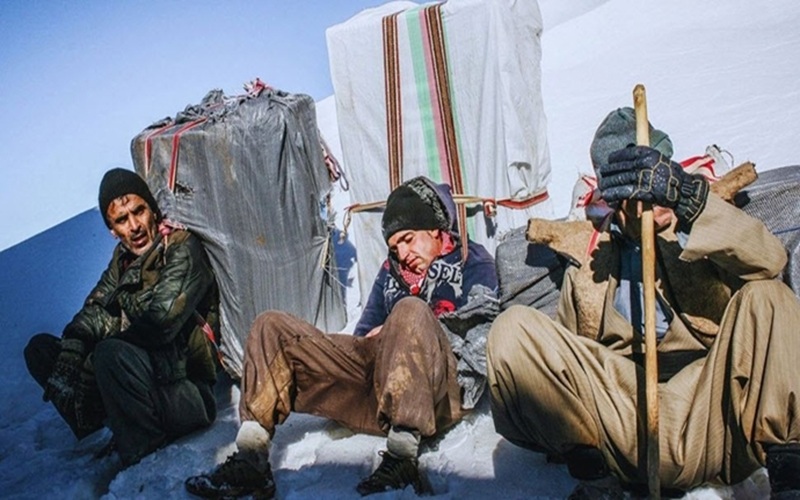

UN experts have called on Iran’s authorities to stop using lethal force against Kurdish border couriers and Baloch fuel carriers, warning that reported killings require prompt, independent, and impartial investigations.
United Nations human rights experts have called on Iran regime’s authorities to end the use of lethal force against Kurdish kolbars and Baloch sukhtbars, describing the reported killings as unlawful and demanding independent investigations into every death caused by security forces.
Kolbars, mostly Kurdish border couriers, and sukhtbars, Baloch fuel carriers, operate in some of Iran’s most economically deprived and heavily militarized border regions. The UN experts noted that many depend on carrying goods or fuel across difficult border areas because they have few other means of supporting their families.
“They must not pay for that poverty with their lives,” the experts said in a statement issued on September 23.
At Least 12 Kolbars Reportedly Killed Since January
According to information received by the UN experts, at least 12 kolbars have been shot dead by Iranian border forces or the Islamic Revolutionary Guard Corps since the beginning of 2026.
The experts said they had received reports of seven kolbars killed by direct gunfire from Iranian border guards during the previous two months alone. Several were reportedly shot at close range and without warning, including cases in which the victims were allegedly carrying no goods.
One case cited by the UN experts concerns 44-year-old Madeh Kermani, who left his home in Marivan on July 28 and never returned. Reports indicated that Kermani was carrying nothing when he was shot. His body was subsequently removed from the area.
Authorities reportedly told his family that he had died after falling from the border heights. However, forensic records cited by the experts reportedly showed that he had sustained a gunshot wound to the head.
Another case involved 28-year-old Milad Tabad, who died on August 18 after months in intensive care. According to the UN experts, border guards had reportedly shot him in the head almost a year earlier. Unable to afford his continued medical treatment, his family eventually took him home and cared for him there until his death.
The UN experts stressed that even when people are suspected of transporting goods in violation of customs regulations, such conduct does not constitute a threat to life that could justify the use of firearms.
Baloch Sukhtbars Also Face Lethal Force
The UN experts said Baloch fuel carriers have faced a similar pattern of deadly actions by Iranian military and security forces.
At least 13 sukhtbars were reportedly killed between January and August 2026 in incidents involving shootings, pursuits, and other actions by military and security personnel.
The deaths occur in a region where poverty and economic marginalization have left many Baloch families dependent on informal cross-border trade and fuel transportation. The UN experts emphasized that economic deprivation cannot justify placing people’s lives at risk through unlawful use of force.
The scale of the killings remains difficult to establish because Iranian authorities do not publish official statistics on deaths among kolbars and sukhtbars. Families and civil society organizations have therefore been left to document and count the victims.
Border Killings Part of Broader Pattern
The UN experts placed the reported killings at Iran’s borders within a wider pattern of alleged unlawful killings by Iranian security forces.
Their statement comes as international attention remains focused on the killings of protesters during the December 2025 and January 2026 protests and on subsequent executions. At the same time, the experts pointed to reported extrajudicial killings in heavily militarized provinces and deaths in custody.
The lack of official transparency over deaths at the borders, they noted, means that many victims receive far less public attention than those killed during major protest movements.
The experts stressed that every death resulting from the actions of Iranian security forces carries legal obligations for the authorities.
“Each of these deaths engages Iran’s obligation to conduct a prompt, independent and impartial investigation,” they said, adding that families are entitled to truth, accountability, and reparation.
They also emphasized that communities living in Iran’s marginalized border regions are entitled to livelihoods that do not require people to place themselves “in the line of fire.”
The statement was issued by Mai Sato, UN Special Rapporteur on the situation of human rights in Iran; Morris Tidball-Binz, Special Rapporteur on extrajudicial, summary or arbitrary executions; Elena Carolina Díaz Galán, Special Rapporteur on extreme poverty and human rights; and Nicolas Levrat, Special Rapporteur on minority issues.